In this article
The thread is forty messages long and nobody can find the one that matters.
Somewhere in it is the pickup time. Somewhere else is the thing about the field trip money, and a photo of a permission slip, and a question you meant to answer four days ago that is now sitting there looking like an opinion about you. You scroll up. You scroll past it. You scroll up again. The kid needs to be somewhere in an hour and the only durable record of where is buried in a conversation that also contains a disagreement from March.
So you send a new message asking the thing that was already answered. And you know exactly how that lands, because you’d know how it landed if someone did it to you.
I want to name what took me a long time to see, because I spent years treating this as a character problem: almost none of that was about caring less. It was about running a two-household operation on a channel that cannot hold a record.
A text thread is a conversation, not a system
Here’s the structural thing. A text thread has three jobs stacked on top of each other, and it is genuinely good at exactly one of them.
It’s a conversation — fine, that’s what it’s for. It’s also being used as the schedule, which it is bad at, because a schedule needs to be somewhere you can look without reading anything. And it’s being used as the record — who said the dentist was Thursday, what the agreement about the birthday party actually was — which it is worst at, because a record needs to be findable by a person who is not currently upset.
When those three collapse into one channel, every logistics question arrives wearing the emotional weather of whatever else is in the thread. You cannot ask about a pickup time without also re-entering a conversation. For an ADHD brain that already treats a full inbox as a threat, that’s the whole failure right there: the channel itself becomes something to avoid, and avoiding it looks — from the outside, and honestly from the inside too — like not caring.
Why this hits an ADHD brain harder
Not to excuse it. To aim the fix at the right thing.
Retrieval is the problem, not memory. You did know the pickup time. It was in there. But recalling a specific fact on demand, under time pressure, out of an unstructured stream of two hundred messages, is precisely the operation an ADHD brain does not perform reliably — and it degrades further at 5 PM when the tank is empty. This is the same mechanic as time blindness: the information exists, and the retrieval path to it doesn’t.
Then there’s the second layer, which is the one nobody writes down. Every unanswered message in a co-parenting thread carries a little charge of are they annoyed at me, and if you’ve got rejection sensitivity in the mix, opening the thread costs actual energy before you’ve read a word. So you open it later. Later becomes tomorrow. Tomorrow becomes an apology, and the apology is now the fourth apology this month, which makes the next message even more expensive to open.
That loop is not fixed by trying harder to check your phone. It’s fixed by moving the logistics somewhere with no emotional charge on it at all.
The shared doc: five fields, decided once
One shared document — Google Doc, shared note, whatever both households will actually open. Not an app anyone has to be sold on. The rule that makes it work is the only rule: if it’s logistics, it goes in the doc. If it’s in the doc, it doesn’t need a text.
1. The standing schedule. The regular week, written out plainly, including the handoff times and places. Not “the usual” — the actual times. This is the field that ends the most arguments, because most of them were never disagreements. They were two people confidently remembering a verbal arrangement differently.
2. This week’s exceptions. One short list: the early pickup Wednesday, the away game Friday. Exceptions are where the whole thing breaks, so they get their own space instead of being mentioned in passing inside a paragraph about something else.
3. The kid-facing facts. Sizes, the current medication or allergy notes the school has on file, teacher names, who the current best friend is, what they’re afraid of this month. Boring, and enormously useful, and the single field most likely to prevent a “you didn’t tell me” that neither person deserves.
4. Open items. Two columns: the thing, and whose it is. Soccer registration — me. Dentist reschedule — you. Not a to-do list for the other household. A shared surface so an open loop is visible instead of being carried in someone’s head, resented, and then mentioned at the worst possible moment.
5. Decided. A running log of things you’ve already settled, with the date. Holidays, the phone rule, whether the birthday party happens at one house or both. This is the field people skip and then wish they had. Nine months later, “we decided this in March” is a sentence with something behind it, and neither of you has to relitigate it from memory.
Write it once on a calm afternoon. Update it in under two minutes on a fixed day — Sunday works, since the week is already getting reset then. The doc is not extra work. It’s the same work, done once, in a place where it stays found.
The three scripts
Some messages are hard enough that the improvising is the failure point. Have the words ready.
When you dropped something. “I missed the form deadline — that one’s on me. I’ve submitted it now, and I put the next one in the doc so it doesn’t happen twice.” Own it, state the repair, name the system change. Stop there. The long apology reads as asking to be reassured, which quietly makes it the other person’s job to manage your feeling about the thing you did.
When you need to change the plan. “Can I swap Thursday for Friday this week? Same pickup time, I’ll cover the drive both ways. I’ve put it under exceptions.” Ask, offer the compensating thing, log it. Never open with the reason — the reason invites a negotiation about whether the reason was good enough, and you did not need permission for your reason.
When something is genuinely wrong. Not in the doc, not in the thread, not typed at 11 PM. “There’s something about school I want to talk through — can we do ten minutes on the phone Wednesday?” The one rule that will save you the most grief: logistics go in writing, feelings go on a call. Reversing those two is how a scheduling question becomes a three-day thread.
What good looks like
Not a friendly relationship — that may or may not be available, and the system doesn’t require it. Good looks like a Tuesday where the pickup happened at the right time because it was written down, nobody had to ask, and no message got sent that needed managing.
Start with field one alone. The standing schedule, plainly written, shared, this week. If you want the physical half of it — the wall the week lives on so the kid can see it too, in whichever house they’re in — the free parent starter set has the routine cards and the command-wall layout, and the ADHD family calendar template is the printable version of field one.
The other thing worth saying: two households running the same shape is worth more than either household running a perfect one. If the mornings are the part that keeps breaking, running the same morning sequence in both places does more for the kid than any amount of coordinating over text.
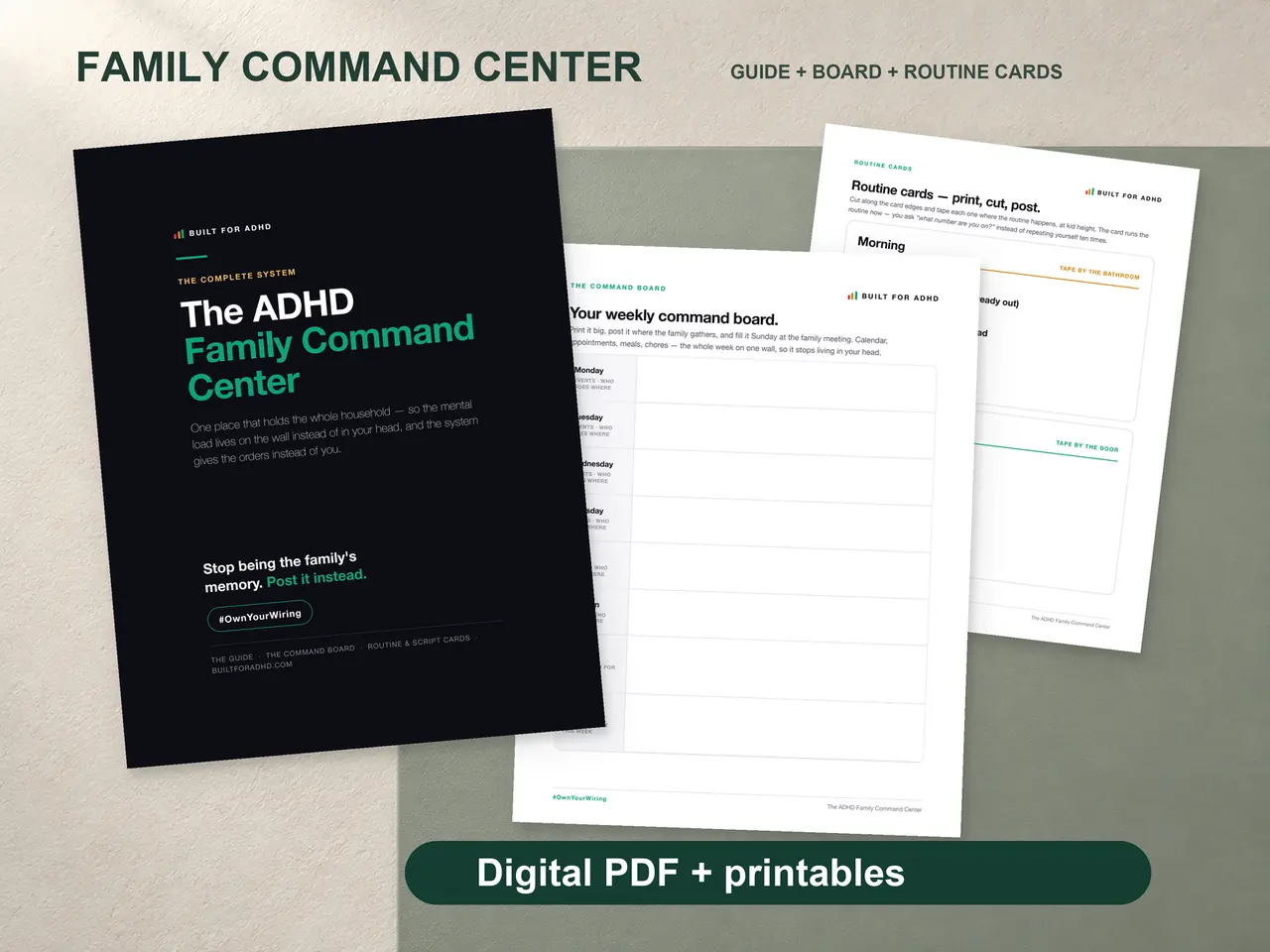
If you’d rather post it than build it — the command board, the weekly layout, the routine cards at kid height, and the family meeting agenda that gives the standing schedule a place to get revised out loud — that’s the ADHD Family Command Center, $19. It’s the wall half of this; the doc half is free and you should build it either way.
Related tools
- The free parent starter set — routine cards and the command-wall layout
- The ADHD family calendar template — the printable version of the standing schedule
- Setting up an ADHD command center — the wall the week lives on
- Sibling fights over screens — the same decide-once move, applied to screens
- ADHD parent burnout — why the 5 PM handoff is the hardest hour
- ADHD mornings and packing lunches — the sequence worth running in both houses