In this article
There’s a specific flavor of tired that parenting books don’t have a name for. It’s not sleep-deprived tired, though you’re probably that too. It’s the tired of being the household’s only working memory: the one who knows the permission slip is due Thursday, that you’re out of the good granola bars, that soccer moved to 5:15, that the library books were due yesterday — while also managing a brain that loses its own keys.
That’s ADHD parent burnout, and calling it a patience problem is like calling an empty gas tank an attitude problem. Being the household’s only working memory is a structural problem with a structural fix — the ADHD command center guide covers getting that running list out of your head and onto a wall where the rest of the household can see it.
The double spend
Every parent runs their household’s logistics. An ADHD parent runs them on hardware that’s already paying full price for its own logistics. Executive function — planning, sequencing, remembering, transitioning, regulating — is exactly the resource ADHD taxes, and parenting is executive function all the way down.
So you’re spending it twice. Once to keep yourself upright: your work, your deadlines, your own morning. And once more to be the external brain for people who are — reasonably, because they’re children — outsourcing their executive function to you. When both of those draws hit the same battery, the battery empties by 4 PM. The yelling-then-guilt loop that follows isn’t a character flaw. It’s what any system does when it browns out.
And here’s the multiplier most articles skip: ADHD is heritable. There’s a decent chance at least one of your kids runs on similar wiring — which means the transitions, the mornings, and the bedtimes that are hard for you are also hard for them, at the same moment, in the same kitchen.
Why “self-care” advice bounces off
The standard burnout prescription — take time for yourself, lower your standards, ask for help — isn’t wrong. It’s just aimed at the wrong layer. A bubble bath doesn’t refill executive function while the household’s entire operating system still lives in your head. You come back from the “break” to the same 47 open tabs, plus guilt about the break.
The fix isn’t to try harder or care less. It’s to get the load out of your head and onto systems — so that remembering, sequencing, and deciding stop being things only you can do.
Move the load onto the wall
The principle behind everything that follows: anything the household needs to know should live somewhere the household can see. Every piece of logistics that exists only in your memory is a tax only you pay.
1. One command wall. A physical spot — kitchen, hallway, wherever the traffic is — that holds the week: who’s where, what’s due, what’s for dinner. Not an app; apps are where information goes to be forgotten by everyone but you. When the answer to “Mom, when is—” is “check the wall,” you’ve stopped being the family search engine.
2. Give routines to paper, not to your voice. The morning list, the after-school list, the bedtime order — printed, posted at kid height, owned by the chart. “What does your list say?” is a fundamentally different sentence than the fourth “put your shoes on.” The chart doesn’t have a tone. The chart can’t be argued with. The chart never runs out of patience, because it doesn’t need any.
3. Decide once, in writing. Most household friction is the same ten decisions made fresh every day. Default them: same five weekday breakfasts, a two-week dinner rotation, screen-time rules written down where everyone can point at them. Every decision you make once on paper is one you stop making three hundred times a year at 5 PM.
4. A launch pad by the door. Backpacks, shoes, your keys, the library books — one landing zone, loaded the night before. Mornings fail at the door; move the door’s demands to the night before, when everyone’s regulation is better.
5. A reset rule, pre-written. Some days the wheels come off anyway — that’s not the system failing, that’s Tuesday. Write the recovery in advance: blown morning = drive them in, no autopsy; blown evening = bedtime moves 30 minutes, chart resumes tomorrow. A pre-written reset is what stops one bad transition from becoming a bad day, and a bad day from becoming evidence in the case against yourself.
The part that’s actually about you
Notice what all five systems have in common: they don’t ask you to become someone else. No patience transplant, no 5 AM club, no laminated perfection. They shrink the number of things that need your brain in real time — which is the only intervention that actually touches ADHD parent burnout, because the burnout was never about your attitude. It was about unpaid cognitive labor running on taxed hardware.
Start with one wall and one routine chart this week. Not the whole system — that’s an all-or-nothing setup, and you know how those end. One wall, one chart, one pre-written reset rule. The rest can join when those hold.
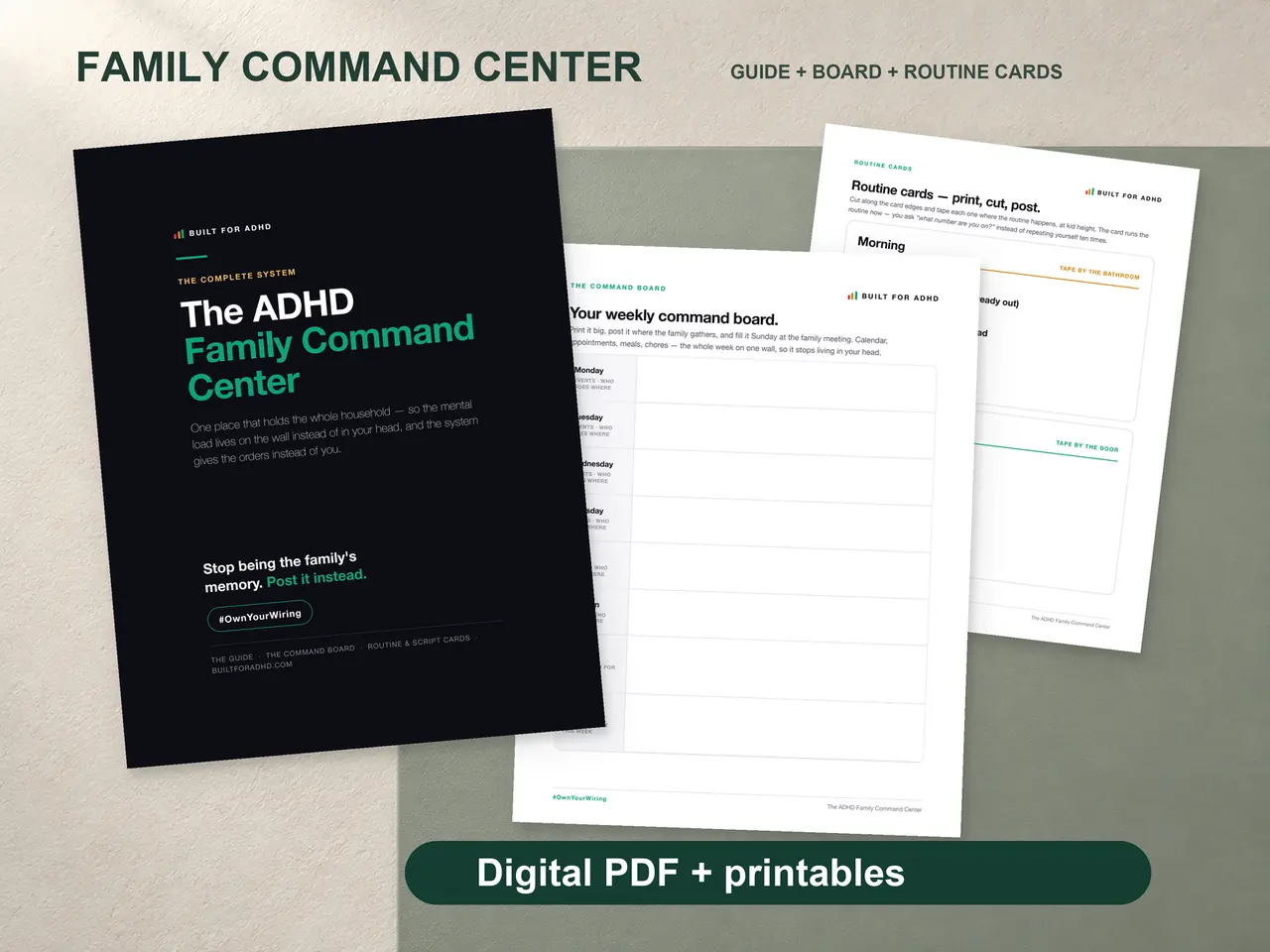
The done-for-you version — command board, routine cards at kid height, launch-pad checklist, and the reset scripts — is the Family Command Center. Print it, post it, stop being the only calendar your family has.