In this article
Bedtime in an ADHD household is not a routine. It’s a negotiation held at the worst possible hour — a kid whose brain is still going ninety, managed by a parent whose executive function ran out around 4 PM, both of you improvising a sequence that was supposed to be automatic by now.
You’ve tried routines. They worked for four days. Then Thursday got weird, the chart fell behind the dresser, and by week two you were back to calling out “did you brush your teeth?” for the tenth time — the question that is somehow both nagging and not working.
Here’s the reframe that changes the design: the routine didn’t fail because your kid won’t follow routines. It failed because it was stored in people. Your memory, their memory, your voice as the delivery system — the three least reliable places an ADHD family can keep anything. Routines that stick get stored on the wall. That’s the whole idea behind an ADHD command center: one visible place the family runs from, so nobody has to be the memory.
Why bedtime is the boss level
Bedtime is a chain of five or six transitions — stop the fun thing, start a boring thing, repeat — and transitions are exactly what ADHD brains, small and large, do worst. Every link is a chance for the chain to break, and it’s scheduled at the hour when everyone’s stopping-power is at its daily minimum. (Yours too. If your own evenings dissolve into revenge bedtime scrolling, you already know the feeling from the inside.)
Add the classic pattern-killers:
- Verbal instructions evaporate. “Pajamas, then teeth, then pick a book” is three items in working memory. One goldfish thought later, it’s zero.
- Novelty wears off. The sticker chart worked because it was new. Week three, it’s furniture.
- Same-time thinking breaks on real life. “Bedtime is 8:00” dies the first evening practice runs late. A clock-based routine has a single point of failure; a sequence doesn’t care when it starts.
- The end of the routine is a wall. Lights out is the kid’s whole fun day ending with nothing on the other side — of course they stall. (It’s the same wall adults hit; kids just stall out loud.)
The posted-sequence system
1. Put the routine on the wall, in order, at kid height. Five steps, numbered, with pictures for pre-readers: pajamas → teeth → tomorrow’s clothes out → screens in the basket → book and lights low. The wall now holds the routine, which changes your job completely — instead of being the routine’s engine (“brush your teeth!”), you’re just its referee: “what number are you on?” That one question replaces the nagging, and better: the kid checks the wall, not your face. The fight was never about teeth. It was about the delivery system.
2. Same order, not same time. The sequence is sacred; the start time flexes. A late night runs the same five steps, faster. This is the difference between a routine your family runs and a schedule your family fails — and it’s the same order-over-clock principle that makes energy-based planning work for adult ADHD brains.
3. Front-load tomorrow into tonight. Step three — clothes out for tomorrow — is doing secret double duty: it’s tonight’s routine and it defuses tomorrow’s 7 AM meltdown. One step, two fires. (Pair it with a launch pad by the door — bag, shoes, the permission slip — and school mornings stop being a scavenger hunt.)
4. End with a landing, not a wall. The last step must be something the kid walks toward — the book, five minutes of couch snuggle, tomorrow’s one fun thing said out loud. Screens can’t be it (they rev the engine you’re trying to idle), but “lights out, goodnight, door closes” can’t be it either. A routine that ends in a small good thing gets pulled forward. A routine that ends in a wall gets stalled against, every single night.
5. When it breaks — and it will — restart at the wall. A chaotic Thursday doesn’t ruin anything, because the routine isn’t a streak, it’s a place. Friday, you point at the wall: “what number are you on?” No relitigating, no starting over from scratch. The chart never fell behind the dresser, because it’s taped to the wall the routine lives on.
Put it where the whole family runs
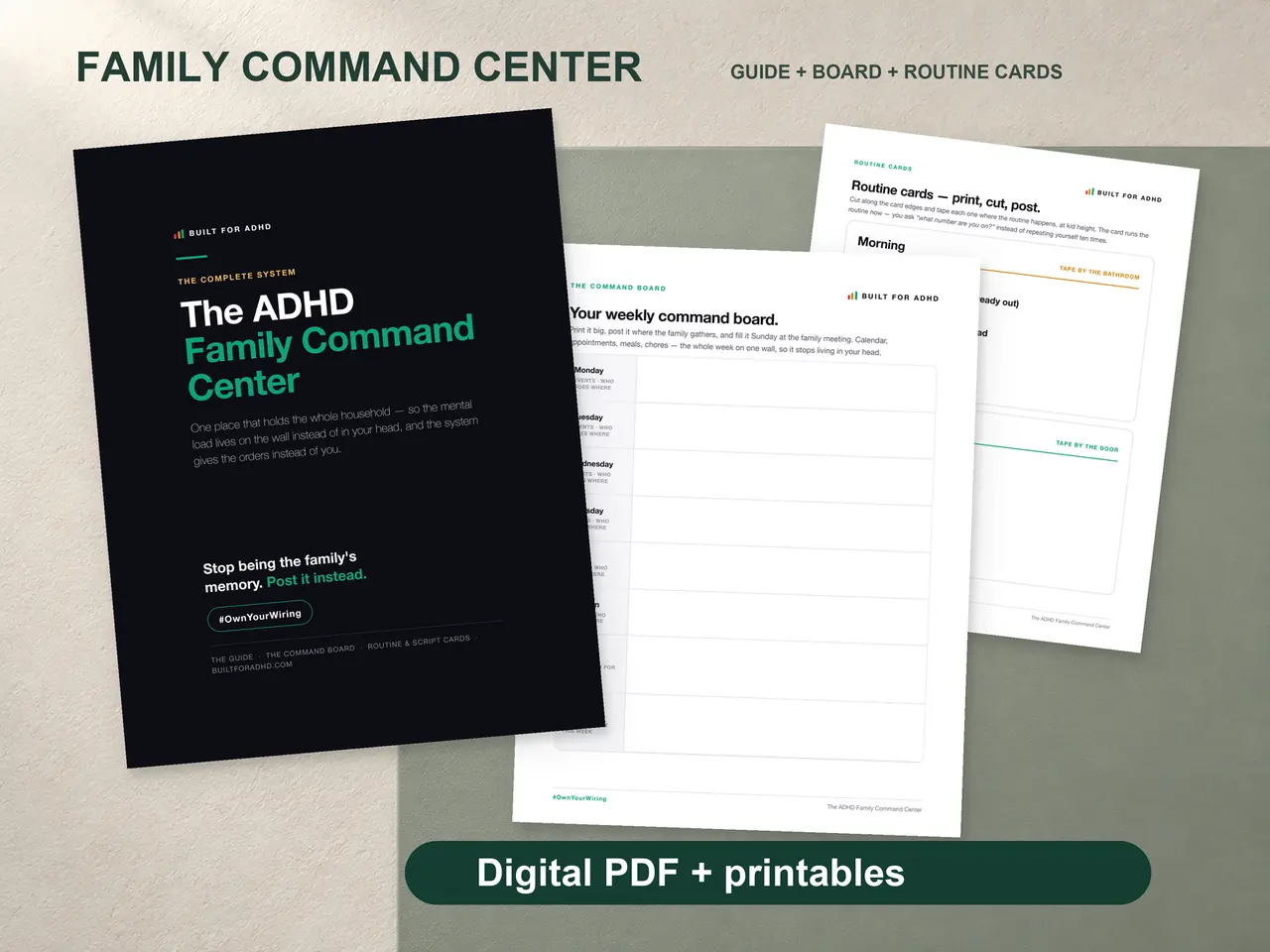
The bedtime card is one card in a bigger fix: the same posted-sequence trick works for mornings, after school, and chores — and the parent version is a command board where the family calendar, the launch pad, and the routine cards live in one visible place, instead of in your head. That’s the ADHD Family Command Center: the board, the printable routine cards (bedtime included), and the nag-free scripts, $19 once. Your memory retires; the wall takes the shift.
Not sure yet? The free parents’ starter kit has the first pieces printable tonight — and the full command center walkthrough shows how families set the whole thing up.
Related tools
- Free ADHD parents’ starter kit — the first routine pieces, printable tonight
- ADHD Family Command Center — $19: the board, the routine cards, the scripts
- Setting up an ADHD command center — the wall system, step by step
- Revenge bedtime procrastination — the parent’s version of the same fight