In this article
It’s 12:40 AM. You’re not having fun, exactly — you’re scrolling, or twelve episodes deep, or reorganizing something that did not need reorganizing. You’re exhausted. You have to be up at seven. You know all of this.
And you stay up anyway. Not because you can’t sleep — because you won’t. Going to bed feels, weirdly, like losing. (The evening routine that makes bed feel less like losing is in the ADHD wind-down routine guide — but first, why this happens.)
There’s a name for this: revenge bedtime procrastination — reclaiming, at midnight, the free time the day never gave you. The “revenge” is against the day itself. And if you have ADHD, you’re running the deluxe version of it, for reasons that matter — because the standard advice (“just value your sleep!”) completely misses what the late hour is actually for. (This is a different beast from lying down and having your brain refuse to shut off — that’s the brain racing against your will; this is you, on purpose, not lying down. Plenty of us run both, back to back. Either way, the underlying move is the one running through every ADHD tool we make: stop asking the brain to hold what a page can hold.)
Why the ADHD version hits harder
The day genuinely wasn’t yours. An ADHD day is spent compensating — masking at work, white-knuckling focus, managing the forty tiny decisions everyone else automates, apologizing for the dropped things. A neurotypical person’s Tuesday has pockets of autonomy scattered through it. Yours got consumed by the overhead of running your brain in a world tuned for other brains. So the hunger for one unclaimed hour isn’t a vice. It’s arithmetic. Midnight is simply the first hour with nobody in it.
Nighttime dopamine is the best dopamine. No demands, no interruptions, no judgment — the late hours are when an understimulated brain finally gets clean stimulation. That’s a real reward, delivered immediately, versus “feeling rested,” an abstract reward delivered tomorrow. You already know which one wins in a brain wired for now versus not now: tomorrow-you is, neurologically speaking, a stranger.
And stopping is a transition. Ending the scroll and starting the bed routine is a task switch, and task initiation is the thing ADHD does worst — especially at 1 AM with zero executive function left in the tank. Half of “staying up” is just the switch not firing.
So: a real deficit (no autonomy all day), a real reward (the only good dopamine hour), and a broken off-switch. Calling that “poor sleep hygiene” is like calling the ADHD tax “bad budgeting.”
The fix is in the day, not at midnight
Here’s the part that changes things: you cannot win this fight at 12:40 AM. At 12:40 the deficit is real, the reward is real, and the willpower is gone — three against zero. The interventions that work all happen earlier:
1. Put a “yours” hour in the actual day. The revenge exists because the day contained nothing to defend. So schedule the unclaimed time before exhaustion: thirty real minutes — after dinner, before the evening collapses into obligations — that are yours with the same seriousness as a meeting. Not productive. Not restorative-on-purpose. Just yours. This shrinks the midnight debt at its source, which no bedtime rule can do.
2. Give the night a landing, not a wall. “Go to bed” is a wall — it ends the only good part with nothing on the other side except tomorrow’s demands. What works is an off-ramp: a short, fixed sequence that steps down (screens dim → tomorrow’s three things written down → the small physical routine → bed) so stopping is a slide, not a cliff. The written-down part matters most — racing tomorrow-thoughts are half of why bed feels bad, and giving them a page tonight instead of a ceiling to spiral at is the cheapest sleep aid that exists.
3. Make the switch not depend on you. The transition that won’t self-initiate at 1 AM can be triggered from outside: lights on a timer that dim at 11, the phone charging outside arm’s reach so continuing requires getting up (friction flips sides — now staying up is the effortful choice), an alarm labeled with the first off-ramp action, not the word “bedtime.”
4. Keep the score honest. The night you run the off-ramp at 11 instead of 12:40 is a win even though it isn’t 10 PM. The perfectionist version of sleep advice — in bed by ten, every night, forever — is a streak, and you know what your brain does to streaks. Better-than-last-night is the only sustainable metric.
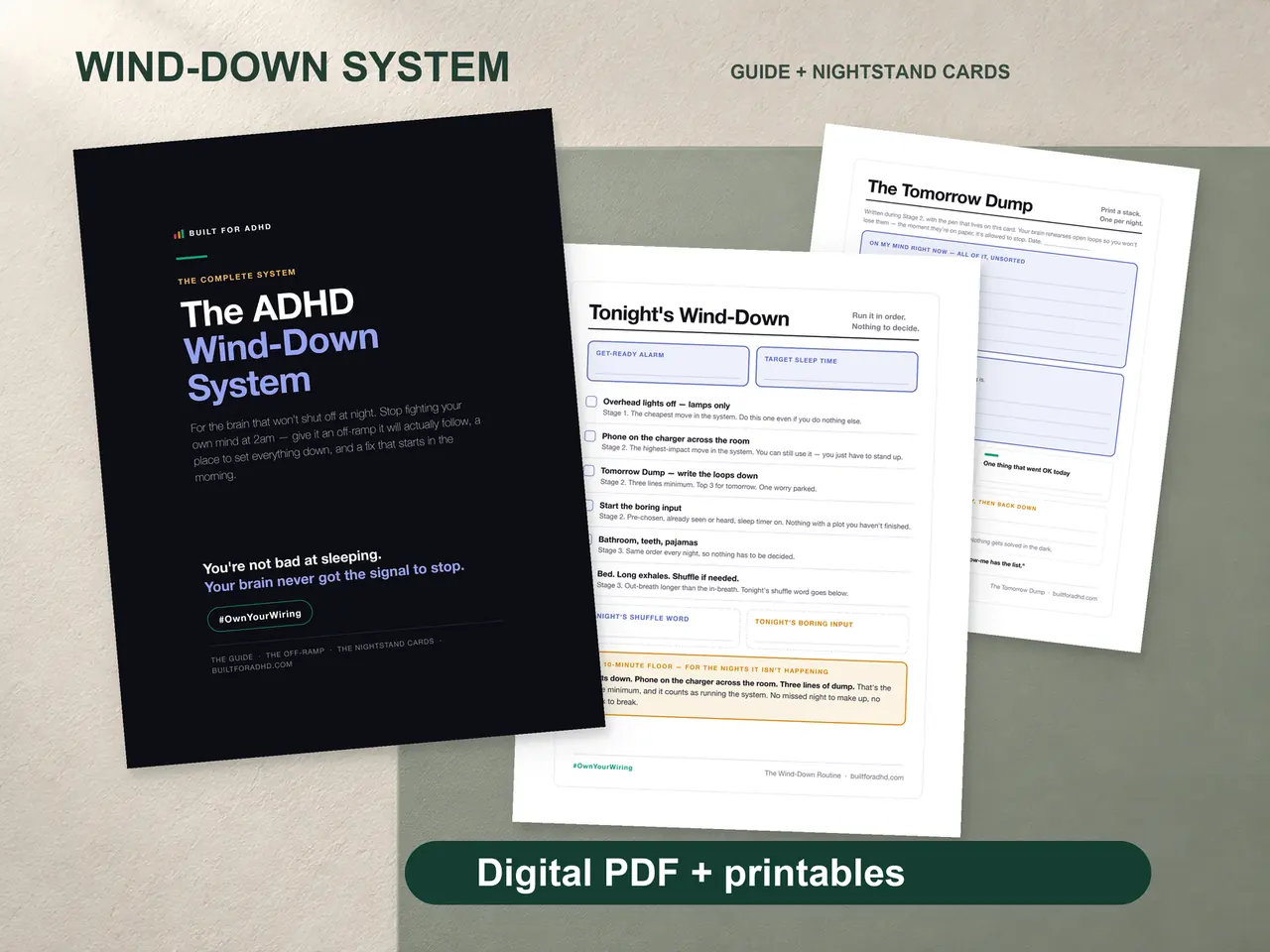
That four-part structure — the deficit fix, the off-ramp, the Tomorrow Dump, the external triggers, plus a protocol for the 3 AM wake-up — is the ADHD Wind-Down System: $12, printable, with the nightstand cards so the routine exists where you’ll actually see it, not in an app you’d have to remember to open at the exact moment you’re avoiding your phone’s clock. The free sleep starter is the no-cost first step.
The line worth keeping
You were never bad at sleep. You were starving for an hour of your own, and midnight was the only place it was sold. Put that hour back in the daylight, give the night an off-ramp, and the revenge has nothing left to avenge.
Related tools
- ADHD Wind-Down System — $12: the off-ramp, the Tomorrow Dump, the 3 AM protocol
- Free sleep starter kit — the checklist version, free
- When your brain won’t shut off — the involuntary sibling of this problem
- ADHD decision fatigue — why the day drains you into midnight mode