It’s 2am. You’re exhausted, and your brain is running a full staff meeting about something that happened three years ago. Your body has been asking for sleep since 10pm. Your brain didn’t get the memo. An ADHD wind-down routine doesn’t fix that by trying harder to fall asleep — it works by finally telling your brain the day is over, then giving it somewhere to put everything it’s still holding.
Why Time-Based Bedtimes Fail an ADHD Brain
Most sleep advice is a clock: lights out at 10, screens off at 9, same time every night. That advice assumes your brain slows down when the clock says it’s supposed to. ADHD brains don’t run on a clock — they run on stimulation and unfinished loops, and at 10pm you often have more of both than you did at 6.
The clock also assumes the day actually ended. For a lot of ADHD adults it didn’t — the inbox is still open in your head, the thing you forgot to say back to someone is still replaying, and the day’s dopamine-starved feeling is finally getting its first real hit from the phone in your hand. A time-based bedtime tells you to stop. It doesn’t tell your brain how. Why your brain won’t shut off at night is the fuller version of this — the real reasons the lights-out time keeps sliding later, revenge bedtime procrastination chief among them.
The 20-Minute Off-Ramp
You can’t slam an ADHD brain from full speed to asleep. You need an off-ramp — a short, repeatable sequence that steps stimulation down in stages instead of demanding an instant stop.
Twenty minutes is the shape that survives contact with an actual night: something to lower the noise (dim the lights, put the phone somewhere that isn’t your hand), something to close the day’s loose ends, and something small and boring enough that your brain stops looking for the next hit of stimulation. What actually works with screens before bed is worth reading here, because the phone is usually the loudest part of the routine to get right, not the easiest one to just remove.
On a bad night, the off-ramp has a 10-minute floor: skip everything except the one piece that matters most, which is next.
The Tomorrow Dump
This is the part that actually does the work. Most nights, what keeps you awake isn’t one big worry — it’s a stack of small open loops: the email you didn’t send, the thing you need to remember for tomorrow, the argument you’re still narrating in your head. Your brain keeps replaying them because it doesn’t trust you to remember them without its help.
The Tomorrow Dump is a page you empty all of that onto before you lie down — every loose end, no sorting, no prioritizing, just out of your head and onto paper. Once it’s written down somewhere your brain trusts, it stops needing to guard it. If you want the same idea as a standalone page, the brain dump before bed template runs exactly this pattern on one printable sheet.
The 3am Protocol
Waking up at 3am and finding your brain already mid-thought, right where it left off, is its own problem — and lying there trying to force sleep back just hands it more time to run.
The move is the same one that works before bed: get it out of your head. Keep a small pad by the bed for exactly this, write down whatever woke you up thinking about, and put the pad back down. You’re not solving it at 3am — you’re proving to your brain that it’s been captured, so it can stop holding it. If the wider pattern is that your sleep is scattered across the whole week and not just the middle of one night, weekend sleep schedule chaos covers the version of this that shows up as Sunday-night dread and a Monday you never fully recover from, and the afternoon crash covers the daytime half of the same irregular-energy pattern.
The No-Shame Restart
Some nights the routine doesn’t happen. You fall asleep on the couch, or the day runs too late, or you just don’t do it. That’s not a broken streak — a wind-down routine with a streak to break is a routine an ADHD brain will eventually abandon rather than face the guilt of restarting.
The rule is simple: whatever happened last night has no bearing on tonight. You don’t owe the routine a make-up session, and skipping it once doesn’t disqualify you from running it tonight. The only version of this that survives a real ADHD life is one you can pick back up from wherever you are, with nothing to apologize for.
What This Looks Like on Paper
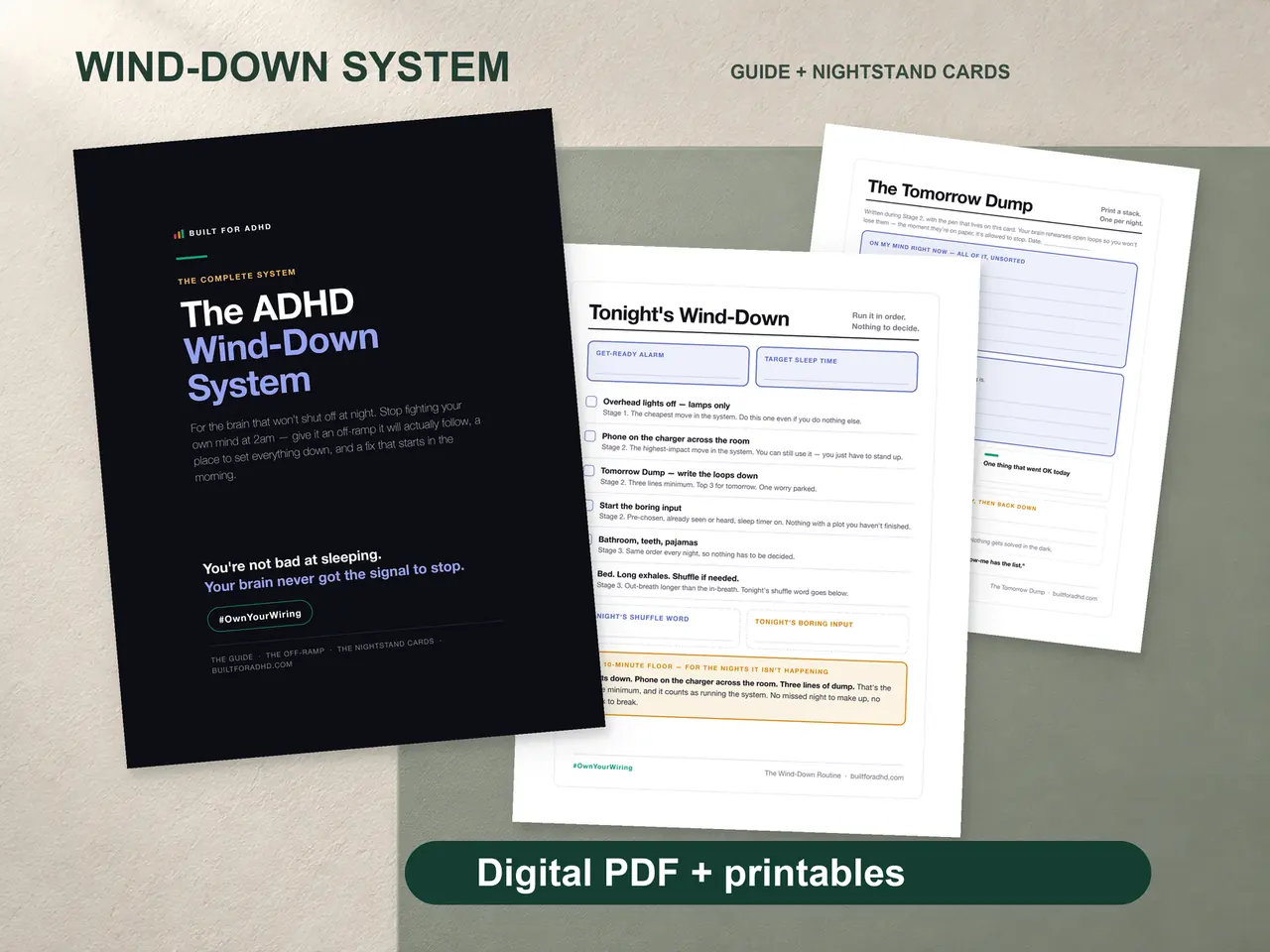
None of this needs to live in an app you’ll stop opening in a week. The ADHD Wind-Down System puts the whole routine on paper: the evening off-ramp stage by stage, the Tomorrow Dump sheet, and a card for the 3am protocol, all built to print and keep by the bed. No login, no notifications, nothing to remember to open at exactly the moment your brain is least equipped to remember anything.
If you want to try the core piece before anything else, the free wind-down guide is the fastest way to feel the difference tonight — get the loop out of your head, in writing, before you lie down.
A wind-down routine isn’t about proving you can be disciplined enough to fall asleep on command. It’s about giving a brain that never got the “day’s over” signal somewhere to put everything it’s still carrying — so it can finally stop.