In this article
Every piece of sleep advice I’ve ever read says no screens an hour before bed, and I have never once managed it. Not for a week. Not for a night, honestly, unless the phone was dead.
So let me start by conceding the argument nobody wants to concede: I am not going to put the phone down an hour before bed, and neither are you, and building a plan on the assumption that we will is how the last nine plans died.
What did work was smaller and slightly embarrassing. I stopped trying to remove the screen and started giving it an ending.
The problem isn’t the light. It’s that nothing ends.
I’ll skip the blue-light debate entirely, because it isn’t the part that gets me. Whatever the light is or isn’t doing, the thing keeping me upright at 12:40am is that I opened one app that has no bottom.
That’s the actual design. A feed doesn’t finish. A next episode starts on its own. A rabbit hole branches. Every one of these things is built to never hand you a moment where the obvious next move is stop — and an ADHD brain running on the last dopamine of the day is not going to manufacture that moment out of willpower. Transitions are the expensive part (the deciding, not the doing), and stopping something enjoyable with no natural edge is the most expensive transition there is.
Which reframes the whole thing. You’re not fighting a screen. You’re fighting a thing with no ending, at the hour you have the least ability to invent one. Ban the screen and you’ve removed the only thing holding your attention while your brain is still going — which is why the ban lasts two nights and why the evening rule never holds in the first place.
So don’t ban it. Swap it for a screen that ends.
The swap, not the ban
Here’s the whole move: whatever you were going to scroll, replace it with something on the same device that has a last page.
An episode you chose, with autoplay off. A downloaded chapter. One saved video you picked earlier, not one the feed picked for you. A game with levels rather than an infinite one. It’s still a screen, still glowing, still in bed with you — but it runs out. When it runs out, you’re a person holding a finished thing at 11:40 instead of a person forty minutes into something that will not finish.
Two rules make it work, and they’re both about deciding early:
Pick it before you’re in bed. Choosing at 11pm from inside the algorithm means the algorithm chooses. Pick at 9, or pick this morning. The decision is trivial when you’re not tired and impossible when you are.
Turn off autoplay and next-episode. Once, in settings, tonight. This is the single highest-leverage thirty seconds in the whole post, because autoplay is the feature that specifically deletes the ending you’re trying to create.
That’s the fix. Everything below is scaffolding to hold it.
The five-line handoff card
Same shape as any card I actually keep — short enough to read at 1am when patience is gone. Write it once. Don’t re-decide it nightly.
1. Last screen tonight: ______ — the thing with an ending. Named, not a category.
2. Where the phone sleeps: ______ — across the room, in a drawer, in the kitchen. Not “on the nightstand, face down.” Face down is still arm’s length, and arm’s length is the whole game. This is the same lever as the notification purge, pointed at one ten-minute window instead of your whole day.
3. What I do with the loops: the tomorrow dump. Every open thing your brain is guarding goes on one page before the light goes off. Not organized, listed. Your brain rehearses open items specifically because it doesn’t trust they’re written anywhere — the loops are what’s actually keeping you up, and the phone is just what you reach for while they run. If a paper page is more structure than you’ll manage, the brain dump before bed template is the version with prompts on it.
4. The one exception I’m allowed: ______ — the group chat, the one game, the show you’re mid-season on. Name it. A plan with zero exceptions is a plan you break on night three and then abandon entirely, because breaking it feels like proof you can’t do this.
5. What happens when it’s midnight anyway: put it down mid-thing. No finishing the episode, no reaching a stopping point. Mid-sentence is a legitimate ending.
Line five is the one people skip, and it’s the one that matters most. The instinct to find a clean stopping point is exactly what turns twenty minutes into ninety. There is no clean stopping point. That’s the entire problem.
Why “just move the phone” fails on its own
Because on a bad night you will get up and get it. I have. Twice in one night, which is a fact about me and not a moral failing.
Moving the phone works when there’s something else in the bed to hold. The distance buys you about forty seconds of friction, and forty seconds is enough only if the alternative is already in your hand. Book, kindle, the ending-having screen — something. Distance plus nothing is a test of willpower at the hour willpower is lowest, and you already know how that test goes.
The pairing is the point: friction on the endless thing, zero friction on the ending thing. Charge the phone in the kitchen. Leave the finite thing on the pillow.
What to expect, honestly
The first few nights you’ll land at roughly the same time you always do. The swap doesn’t make you sleepy — it just stops actively preventing the sleepy from arriving. Give it a week and you’re going to bed maybe twenty, thirty minutes earlier, from a lower level of stimulation, which is a smaller win than “fixed my sleep” and a much bigger one than every screen ban I’ve ever attempted.
Judge it on how the mornings feel, not on the clock. And take partial credit seriously: autoplay off and the phone across the room, with nothing else from this post, is most of the result.
If your bedtime is also sliding four hours every weekend, this card won’t hold on its own — the weekend anchor comes first, because a card can’t compete with a schedule that moved. And if you genuinely cannot tell where the last ninety minutes went, that’s closer to time blindness than to screens, and it wants a different tool.
The honest caveat
None of this is treatment, and none of it is a claim about what screens do to a brain. It’s a workaround for one specific failure — the thing with no ending, at the hour you can’t invent one. If you’re exhausted across all seven days regardless of when you get to bed, that’s worth raising with someone qualified rather than solving with an index card.
Do this tonight
Open settings and turn off autoplay. Then name the one thing you’ll watch or read, and put the charger somewhere that isn’t your nightstand.
Three minutes, all of it done while you’re still awake enough to do it. The card can wait until tomorrow.
I still take my phone to bed most nights. The difference is that now it’s holding something that ends, and I’m the one who picked it.
If you want the rest of the shutdown — the off-ramp and the tomorrow dump the third line is built out of — the free wind-down guide is where to start.
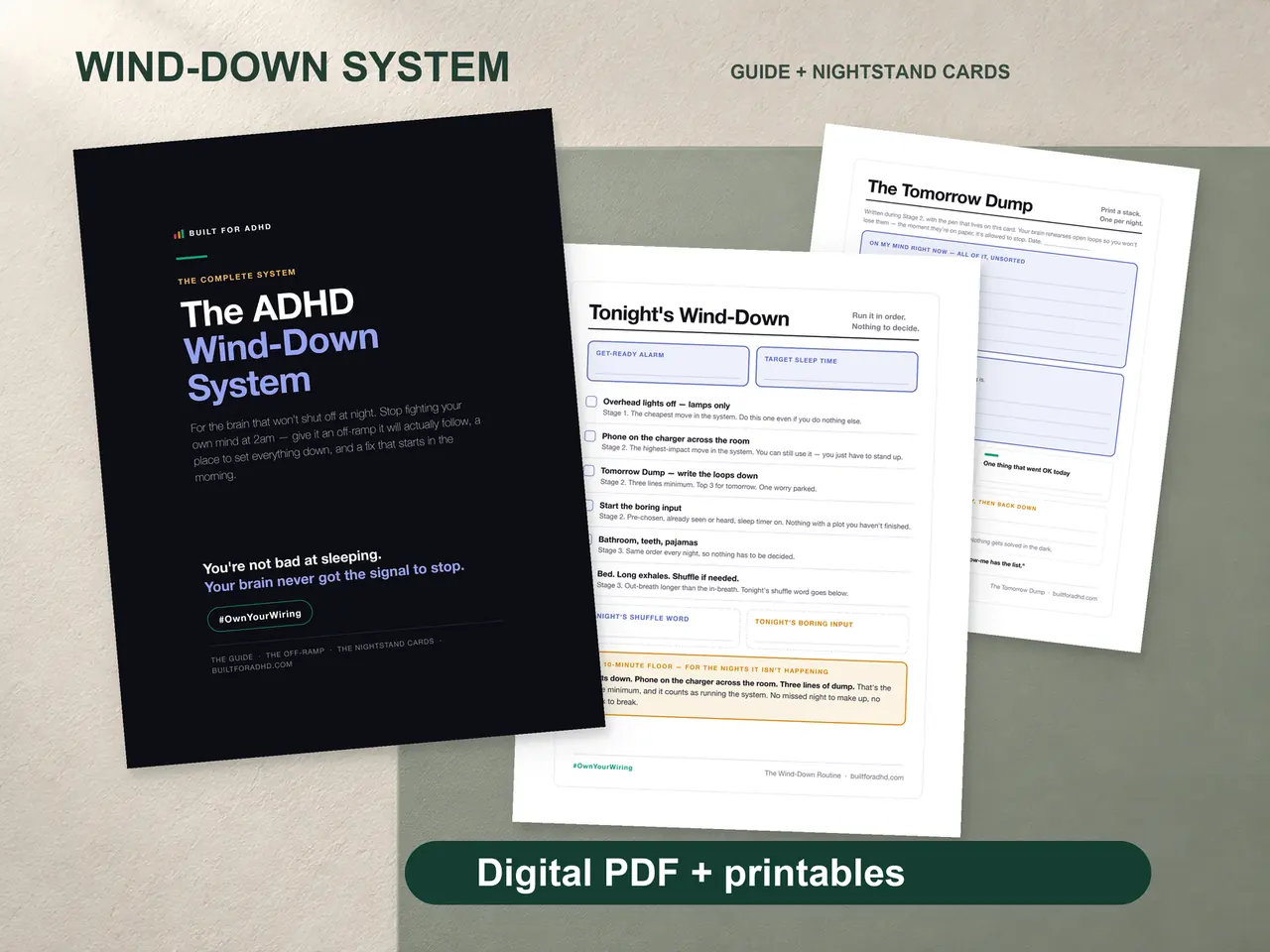
If the loop-emptying turns out to be the part that helps, the ADHD Wind-Down System is the full nightly version — the off-ramp, the Tomorrow Dump, the 3am protocol, and two printable nightstand cards. $12. Honest caveat: it isn’t a screen system, and there’s no section in it about autoplay. What it gives you is the thing to do instead, which is the half of this that’s hardest to invent yourself.
Related tools
- The free wind-down guide — the off-ramp and the tomorrow dump
- Revenge bedtime procrastination — why the evening rule never holds
- When your brain won’t shut off at night — the loops running underneath the scrolling
- ADHD notification overload — the daytime half of the phone problem
- ADHD weekend sleep chaos — the anchor that comes before the card
- How to fix ADHD time blindness — if the missing ninety minutes is the real issue
- Brain dump before bed template — the prompted version of line three