In this article
The week I finally admitted I was cooked, I had been doing a very convincing impression of a functioning person for about four months.
The work was still going out. Nothing was on fire. But I had stopped being able to start anything without a deadline shoving me, I was reading the same three sentences of an email eleven times, and by 6 PM I had precisely enough left to sit on the floor and look at my phone. Not scroll it. Look at it. I’d go to bed at one in the morning anyway, because the evening was the only part of the day that had felt like mine, and then do the whole thing again.
The advice I got was take some time off. So I did — five days, a real break, no laptop. I came back on a Monday and was flattened again by Wednesday afternoon. (The one-in-the-morning half of that loop is its own problem; the ADHD wind-down routine guide covers it.)
That’s the thing nobody says plainly. Rest doesn’t fix burnout if the load that caused it is still sitting there waiting for you. Five days off is a pause in the input, not a change in it. You return to the same number of open loops, the same meeting density, the same three channels asking you things, and with ADHD you return with less slack than a neurotypical colleague would, because you were already paying a surcharge to run a normal day.
Why work burnout lands harder on an ADHD brain
Three costs stack, and none of them show up on a calendar.
You’re paying twice for the same hours. Executive function — planning, sequencing, switching, remembering, regulating — is exactly what ADHD taxes, and it’s also what an office day consumes from open to close. Everyone spends it. You spend it, plus a surcharge just to keep yourself pointed in one direction. Same output, more fuel burned, and the gauge isn’t visible until it’s at zero.
Masking is work, and it’s unpaid. Holding your face still in a meeting you lost the thread of twenty minutes ago. Re-reading a Slack message four times so the reply sounds normal. Hiding the fact that you have no idea what was decided. None of that lands on a timesheet, all of it draws from the same battery, and it runs hardest on the days you’re already low — which is exactly when the room is loudest and the sensory load is at its worst.
Hyperfocus borrows against next week. The nine-hour stretch where it finally clicked and you did a week of work in a day felt like proof you were fine. It wasn’t free. It was an advance, and the bill arrives as three flat days you then read as laziness. Over months, that cycle looks like a motivation problem and is actually a debt schedule.
Which is why the fix is not more discipline, and not a better morning routine. The fix is to take weight off before you try to carry anything new. Subtraction first.
Week one: stop the bleed
Move 1 — write the stop-doing list
Not a to-do list. One page, and the only question is: what comes off this week?
Mine had seven things on it the first time. Two recurring meetings I attended out of habit and contributed nothing to. A weekly summary nobody had referenced in a year. A side project I’d quietly stopped believing in. Three “quick favors” that had become standing obligations by repetition.
You will not get all of it off. Four of my seven came off within a week, and that was enough to feel the difference. Write the page anyway, because the load you can’t see is the load you can’t argue with — and most of us have never once looked at the list as an object.
Move 2 — give the day an actual end
Burnout recovery runs on the hours after work, and for me those hours were not recovery. They were a second shift of low-grade input: half-working, half-scrolling, nothing finished, no off switch. Then a 1 AM bedtime, which is revenge bedtime procrastination and not a character flaw — it’s what happens when the day never gave you anything that was yours.
One rule for week one: pick a time, and at that time the open loops go onto a page instead of staying in your head. That’s it. The racing brain that won’t shut off at night is usually guarding unfinished things, and it will keep guarding them until it watches you write them down somewhere it trusts.
Move 3 — stop scheduling work into the dip
You already know roughly when your floor falls out. For me it’s 1:45 to 3. Recovery weeks are not the time to be heroic inside that window — put the admin, the filing, the dumb mechanical stuff there, and protect the two good hours you still have for the work that actually needs you. The full version of that mapping is the afternoon crash fix, and it matters more during recovery than at any other time, because right now the good hours are the only hours.
Week two: rebuild one anchor
Here’s where most recovery attempts die. You feel 30% better, you get a surge of optimism, and you try to install a whole new system on Monday — the gym, the meal prep, the 6 AM start, the new app. By Thursday it’s all gone and now you have evidence against yourself.
One anchor. That’s the whole of week two. One repeatable thing, attached to something you already do without deciding. Mine was the ten minutes after I shut the laptop: tomorrow’s three things on paper, laptop closed, done. Ten minutes, same trigger every day.
One anchor holds because it doesn’t need willpower to remember, and because when it slips on Thursday you’ve only lost one thing instead of six. Pick the one that buys back the most — usually it’s the end-of-day page or sorting tomorrow by energy instead of by clock time, because both of them take weight off the brain rather than asking it for more.
Then change one structural thing
Two weeks of subtraction and one anchor will get you upright. It will not keep you there if the week you walk back into is identical to the one that flattened you.
So pick exactly one structural change and make it a request, not a resolution. A protected focus block. One fewer recurring meeting. Written instructions instead of hallway hand-offs. Headphones with nobody raising an eyebrow. It doesn’t have to be framed as a diagnosis conversation at all — how to actually ask for it is mostly a matter of writing one specific sentence about what would be different next week.
What recovery actually looks like
Less dramatic than you want. Not a morning where you bound out of bed. More like: the thing you’ve been avoiding takes twenty minutes instead of three days of dread, and you notice afterward that it didn’t cost what it used to.
And it is not linear. I had a great week, then a bad Tuesday, and spent most of that Tuesday deciding the whole thing had failed. It hadn’t. One bad day inside a recovery stretch is weather, not a verdict. The stop-doing list is still shorter. The anchor is still there. You keep the two moves and you don’t relitigate them on the strength of one afternoon.
If the evening half of this is where you’re stuck — the day ends, the brain doesn’t — the free ADHD wind-down starter is the ten-minute version of Move 2.
Related tools
- Free ADHD wind-down starter — the end-of-day page, in its shortest form
- The ADHD afternoon crash — mapping the dip so you stop scheduling into it
- ADHD sensory overload at work — the input cost nobody puts on a timesheet
- How to ask for ADHD workplace accommodations — the one structural change, in writing
- Energy-based task management — the anchor most people should pick first
- ADHD parent burnout — if the second shift starts when you close the laptop
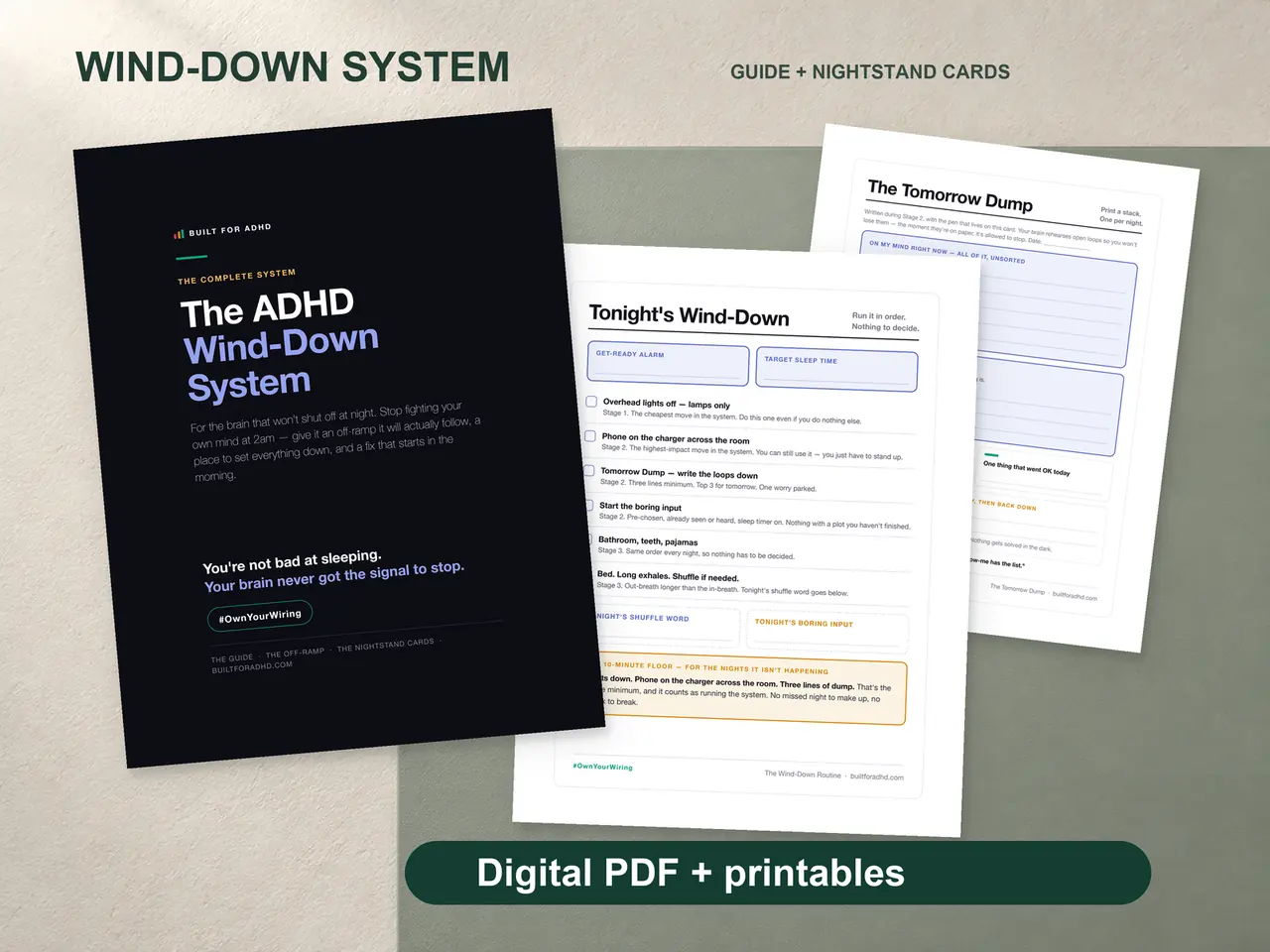
If Move 2 is the one you need and you want it already built — the evening off-ramp, the Tomorrow Dump for the loops your brain is guarding, and two printable nightstand cards — that’s the ADHD Wind-Down System, $12. A blank page and a bedtime work fine; this is just the version that already has the pages. It’s a planning tool, not treatment for anything.