In this article
Somewhere between 1:45 and 2:30, the lights go out.
Not sleepiness exactly. More like the part of my brain that decides things quietly leaves the building. I can still read a sentence. I cannot pick which sentence to read. I sit in front of the same open document I was moving through at eleven, and it has turned into a wall — and then I spend ninety minutes doing the worst possible thing, which is trying to do the eleven o’clock work anyway, badly, while feeling like a fraud about it.
For years I read that stretch as evidence. Everybody else seemed to have a whole afternoon. Mine reliably ended early, so the story wrote itself: I was soft, or lazy, or not trying at the moment trying counted.
Here’s the reframe that finally made it workable. The crash is not the problem. The schedule sitting on top of it is. The window arrives at roughly the same time every day, which makes it the single most predictable thing about my day — and I was treating the most predictable thing about my day as a surprise, every day, forever.
You can’t discipline your way out of a two-hour dip. You can absolutely stop putting your hardest work inside it.
Step 1: find your actual window (three days, one line a day)
Before you plan around it, you need to know when it really is. Mine is not the 3pm that every productivity article assumes — it’s closer to 1:45, and knowing that turned out to matter more than anything else in this post.
For three days, write one line: the time you first noticed the work getting heavy. Not a log, not an app, not a mood score out of ten. One timestamp, on whatever paper is nearest.
Three days is enough to see it. Almost everyone I’ve asked finds a window that’s tighter and earlier than they assumed — usually about ninety minutes to two hours, landing within the same half hour each day. That’s the thing you’re scheduling around. (if your three days come back genuinely scattered, that’s real information too — skip to the caveat at the end)
While you’re at it, note whether you ate. I lose a shocking number of afternoons to having skipped lunch without noticing, and no system survives that. Fixing the eating is cheaper than fixing the schedule, so rule it out first.
Step 2: build the crash list before you’re in the crash
Here’s the trap. During the window, you don’t just have less energy — you have less deciding. Which means “I’ll find something easy to do” fails exactly when you need it, because finding something is itself the expensive part. That’s decision fatigue landing at the worst hour, and the fix is the same: decide once, in advance, so the window doesn’t have to.
So make a standing list. Ten to fifteen items, written when you’re sharp, kept where your eyes already go. The bar for the list is: could I do this while mildly annoyed and not thinking clearly?
Mine, honestly:
- File the week’s receipts
- Empty the downloads folder
- Reply to the three easy emails (the ones with a one-line answer)
- Print and sign whatever’s been sitting there
- Restock the bag for tomorrow
- Clear the desk surface
- Water things, run the dishwasher, take the walk
- Rename and sort the screenshots
- Read the article I’ve had open since Tuesday
None of that is impressive. All of it is real work that has to happen sometime, and it happens far better at 2pm than the strategic work does. The list turns a dead window into the place where the admin backlog goes to die — which is a much better deal than what I was getting, which was ninety minutes of nothing plus guilt.
The list only works if it’s written down. Held in your head, it doesn’t exist at 2pm; that’s the whole reason the window eats you. A system that lives in six apps is a system you won’t reach for, and this one has to be reachable at your least resourced moment. One page. One place.
Step 3: move the hard thing out of the window on purpose
Now the part that actually buys back the day: stop scheduling into the dip.
Whatever your genuinely hard work is — the writing, the thinking, the call you’re dreading, the thing with no obvious first step — it gets placed in the block before the window, or in whatever comes back afterward. This is the same move as sorting tasks by energy instead of by priority, applied to one specific recurring hour instead of the whole day. Priority says do the important thing now. Energy says do the important thing when the machinery for it is on.
Two practical notes from doing this badly for a while:
Protect the morning block harder than feels reasonable. If the good hours are 9 to 1, then meetings, errands, and “quick” calls are expensive in a way the calendar doesn’t show. Scheduling a 10:30 call doesn’t cost thirty minutes. It costs the best block you get.
Expect a partial return. Mine comes back around 4, not to morning levels but well past the floor — that’s a fine home for medium work, the second-pass edit, the email that needs a real answer. Knowing it returns is what stopped me writing off entire afternoons at 2:05.
And a boundary worth naming: the window is not a nap, a scroll, or a bonus break. Twenty minutes of lying down is a legitimate thing to schedule if it helps. Ninety minutes of phone is how the whole day tips over, and it tends to collect a debt you pay back that night as revenge bedtime procrastination. The list exists so the window has a plan that isn’t the phone.
The honest caveat
Some crashes aren’t schedule-shaped. If your energy has dropped across the board — mornings included, weekends included, for weeks — that’s a different thing than a predictable daily dip, and no list is the right response to it. Nothing here is a substitute for talking to someone qualified about it. This post is about the ordinary recurring 2pm wall, and only that.
There’s also a version of this that’s time blindness rather than fatigue — the window feels like a crash but is really the moment you realize how much of the day left without you. The three-day log usually separates them: a real dip shows up at a consistent time, and the other one shows up right after you check the clock. If it’s the second one, the time blindness tools are the better starting point.
Do this today
Write down the time it got heavy. That’s it — that’s today’s whole task.
Do it three days running, then spend ten minutes writing the crash list while you’re sharp. You’ll have the entire system by Thursday, and it costs you about fifteen minutes total.
I still crash at 1:45. Every day, on schedule. The difference is that 1:45 now has a job, and I stopped spending the back half of the day proving something to myself that was never in question.
If you want a starting stack of energy labels and low-energy defaults instead of building yours from scratch, the free ADHD toolkit for adults has the brain dump page this list comes out of.
Related tools
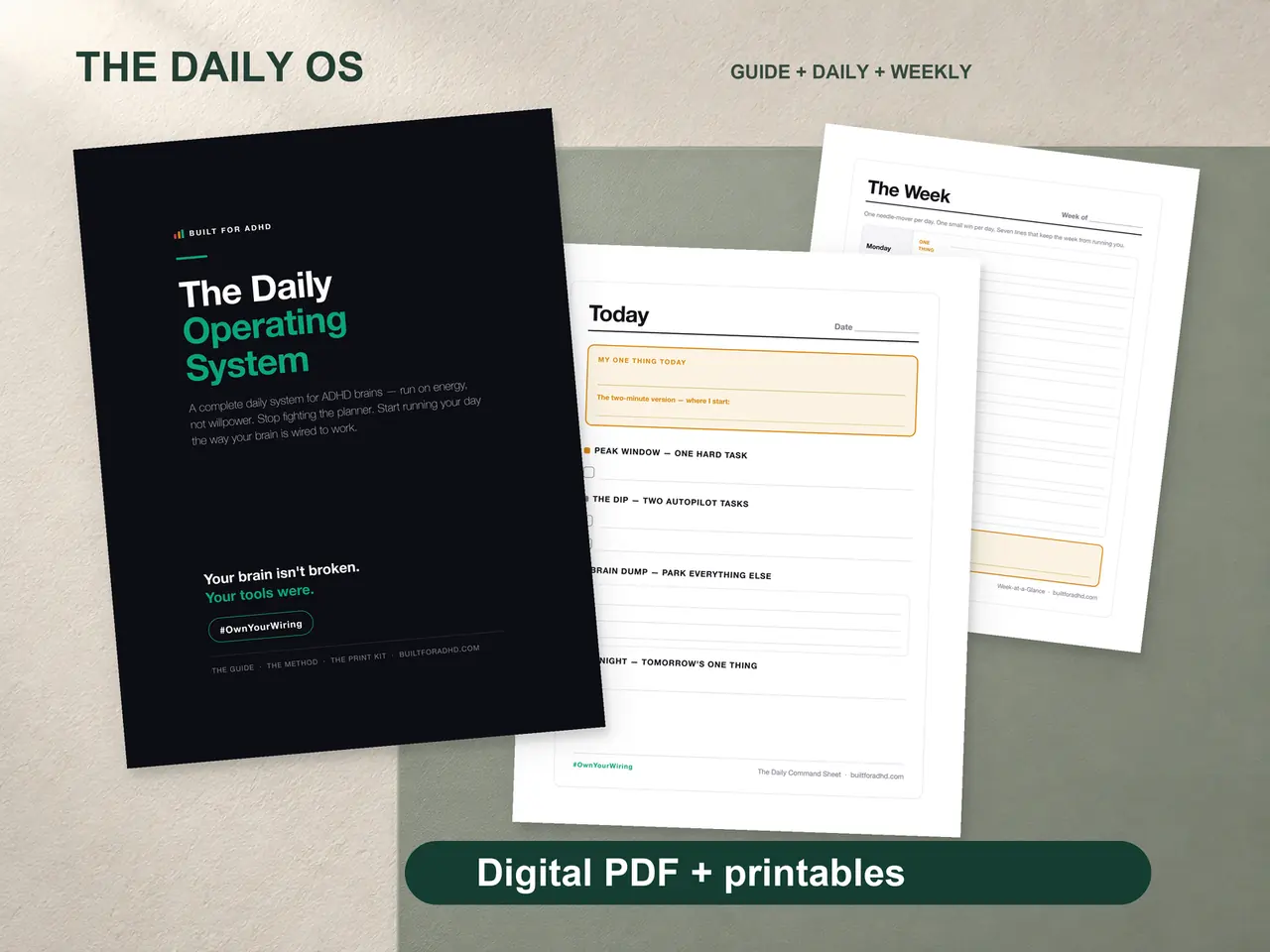
- ADHD Daily Operating System — $17: the energy matrix, the worked example, the morning loop
- Energy-based task management — the principle this applies to one recurring hour
- ADHD decision fatigue — why “find something easy” fails at 2pm
- ADHD forgetting to eat — rule this out before you rebuild the schedule
- Revenge bedtime procrastination — where a lost afternoon gets paid back
- ADHD time blindness tools — if the crash is really a clock problem
If the fix here is the part that helped — sorting work by the energy it takes rather than the day it’s due — the ADHD Daily Operating System is the full version of it. $17. Honest caveat: it’s a daily planning system, not an afternoon-crash product, and there’s no page in it called “the 2pm list.” What it does have is the energy matrix and a worked example of a real day sorted into high, medium, and low — which is where the crash list came from in the first place.