In this article
The week after I got diagnosed I bought four books, three of which I have still not read.
I also made a spreadsheet. I joined two subreddits and read them until two in the morning for about nine days straight. I rewrote my entire task system twice. What I did not do, in that whole first month, was change a single thing about how an actual Tuesday went. The diagnosis handed me an enormous amount of explanation and exactly zero instructions, and I did what this brain does with an open question and no next step: researched it, beautifully, instead of acting on it.
The gap nobody warns you about is not an information gap. There is more good ADHD information available than you could read in a year. The gap is sequencing. You get handed a word that reorganizes your entire personal history, then get sent home to work out unaided which of four hundred available changes to make on Monday. Most people make all of them, which is the same as making none.
So this is the order. Three stages, and the only rule is that you move to the next one when the previous one holds — not when a calendar tells you it’s been a month. (that distinction matters more than it sounds like it does)
Stage one: relabel, don’t rebuild
Your first instinct will be to change your systems. Don’t, not yet. The first job is cheaper, and it is what makes everything after it work.
Go back through your own history once with the new word in hand. The job you left after seven months and could never explain why. The friendships that went quiet because you did not answer a text for five weeks and then felt too ashamed to answer at all. The bank account you stopped opening. Every one of those you have filed, for years, under a story about your character — lazy, flaky, inconsistent, too much, not trying hard enough.
Write them down, and write the mechanism next to each one. Not an excuse: a mechanism. “Left the job” next to “the role was eighty percent low-stakes admin with no deadlines, and nothing in my brain fires without stakes.” “Stopped answering” next to “the reply got expensive, then the shame about the delay cost more than the reply.”
This is unglamorous and it is the highest-leverage twenty minutes of the process, because almost every failed system after diagnosis fails the same way: you are still running it on the belief that the problem is your character. If the problem is character, the solution is effort, and you have already tried all of the effort. There isn’t more.
Two things usually happen on this page. The first is grief — a normal response to realizing how much of your life went to paying a tax nobody told you about, and it does not mean you are doing this wrong. The second is sneakier: a wave of then none of it counted, the sense that every achievement was invalidated by having an explanation. It did count. ADHD imposter syndrome in high achievers is the long version of why that specific thought arrives on this specific page, and what to do with it.
Stage two: protect the two loads that are already costing you most
Before you add anything, subtract. Two things in your week are quietly eating most of your available capacity, and they are invisible because you built them yourself, on purpose, years ago.
The first is masking — the performance of being someone for whom all of this is easy. It runs on the same tank as your actual work and never appears in the day’s accounting, which is why a day with no hard tasks can still leave you sitting in a parked car outside your own house. A one-week masking cost audit prices it in four columns.
The second is whatever your single most expensive recurring obligation is — the standing meeting, the commute, the one inbox, the one person whose approval you are managing in every exchange. You do not have to fix it. You only have to know which one it is, because that tells you how much room you actually have for new systems. Most people coming out of diagnosis install a system that needs capacity they do not have, conclude it doesn’t work for them, and add that to the character file.
Subtract one thing here. One. The cheapest available performance that nobody is grading.
Stage three: change exactly one system
Now you can touch the systems, and the instruction is narrower than you want: change one.
The temptation is a full rebuild — new app, new planner, new everything, starting Monday. It feels like progress and it is reliably the least productive month of the year, because you lose every working scaffold you built while you didn’t know, and the ones you built blind were often good. The keep, kill, rebuild audit is the three-column pass that sorts which of your pre-diagnosis systems deserve to survive, and most of them do.
Pick the one system attached to the loudest consequence — the bills, the mornings, the thing that generates the most apologizing. Rebuild only that, energy-first: sorted by what the task costs you, not by what the clock says. Then leave it alone long enough to find out whether it holds. A new system that survives three bad weeks is worth more than six systems that each survived four good days, which is the whole reason a habit tracker has to be built for the days you miss.
The other people question
Somewhere in here you will decide what, if anything, to say at work. That is a separate decision and it does not belong in stage one.
Keep the two halves apart. Changing your working conditions — notes instead of attendance, a quieter desk, a deadline in writing — is a practical conversation about how you do your job, and how to ask for ADHD workplace accommodations covers what to write and who to send it to. Saying the word itself is a different call with different consequences, and telling your boss you have ADHD walks through when it helps and when it doesn’t. Plenty of people do the first forever and never the second, and that is a legitimate outcome.
Worth saying plainly: everything on this page is about sequencing, energy and systems. It is not treatment, and nothing here is a substitute for working with a clinician on the clinical side of this.
The one page that holds all three
Put it on a single page, because three stages across four hundred possible changes is the kind of thing this brain loses by Thursday.
- Stage one — relabel. The history list, with a mechanism next to each line. Done when the character story stops being the default explanation.
- Stage two — subtract. The two most expensive loads, named. One performance dropped. Done when you know your real capacity number.
- Stage three — rebuild one. The single loudest system, rebuilt energy-first. Done when it has survived a bad week.
Nothing else goes on the page. The books can wait — honestly, mine are still waiting, and the stages worked anyway.
In the next twenty minutes
Don’t start a system. Open a note and write the history list from stage one — six lines is plenty, and you already know what they are, which is why you can do it tonight while the research spiral is still tempting.
Then stop. That is the entire assignment. What makes the next six months different from my first four books is not how much you learn this week; it is that you relabeled before building anything on top of it. The free ADHD starter kit for adults is where to pick up the stage-three templates when you actually get there, and not before.
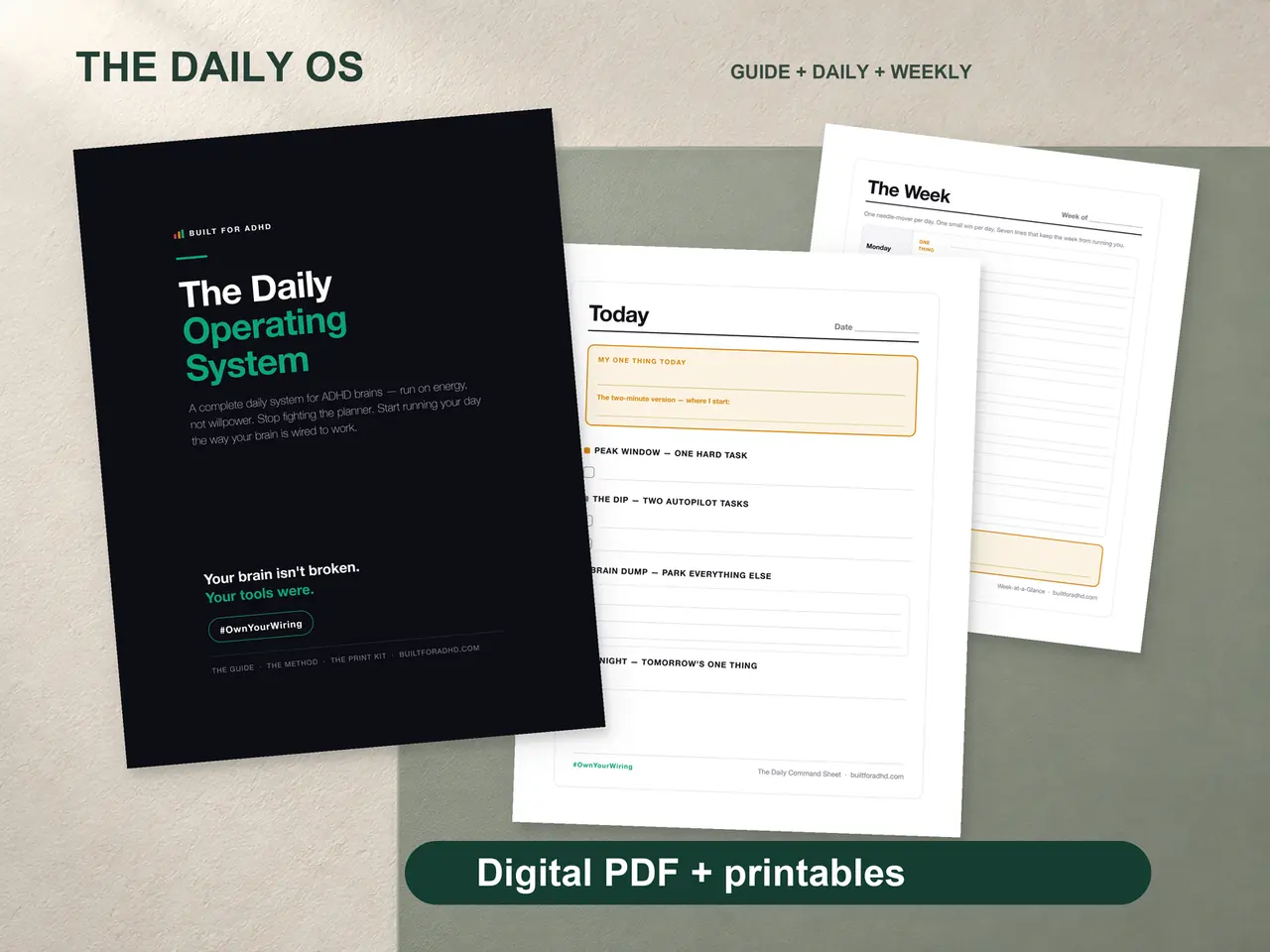
When stage three arrives and you want the energy-first daily system already built rather than designed from scratch, the ADHD Daily Operating System is the $17 version — tasks sorted by what they cost you instead of by the clock. Stages one and two are free and they are the part that has to happen first, so if you are still on the history list, stay there.
Related tools
- Rebuilding your systems after an ADHD diagnosis — the stage-three audit in full
- ADHD masking exhaustion at work — the stage-two cost audit
- ADHD imposter syndrome in high achievers — for the “then none of it counted” wave
- AI for ADHD and late-diagnosed women — the same sequence with the tooling layer added
- ADHD over-apologizing and RSD — the habit that outlives the diagnosis
- The complete guide to ADHD tools for adults — the rest of the working set