In this article
I used to get home from a good day at work and sit in the car in the driveway for twenty minutes.
Not a bad day. A good one — meetings I handled, a room I read correctly, the right amount of eye contact, notes taken in a way that looked like someone who takes notes. Nobody in that building would have described me as struggling. And I would sit in a parked car outside my own house because walking in meant being a person again, and I did not have another person left in me that day.
For years I read that as a stamina problem — other people did the same eight hours and went to the gym afterward, so clearly I needed more discipline. It took an embarrassingly long time to notice the obvious thing: they had done eight hours of work, and I had done eight hours of work plus eight hours of performing someone for whom that work was easy.
Masking is work. It is unpaid, invisible, and nobody put it on your plate — you did, usually years ago, for good reasons. But it runs on the same tank as everything else, and it never shows up in the day’s accounting. So the day looks like it should have cost forty units and it cost ninety, and the missing fifty get charged to your evening.
Why it lands after the day, not during it
During the day you are running on stakes. There is a room, there are consequences, there is the thing that makes an ADHD brain work beautifully — live pressure. That is also the exact condition under which you cannot feel what anything is costing. The interoception bill arrives late. You are fine, you are fine, you are fine, and then the car door closes and you are not fine, and because nothing happened at 5:40pm it feels like it came out of nowhere.
Then the second mechanic. The specific things masking asks of you are the things that are already expensive here: sitting still with a flat face while someone talks for forty minutes, holding a thought you cannot say yet, not interrupting, converting a nonlinear idea into a linear sentence in real time, re-reading an email four times so the tone reads neutral. Each one is small. Each one is executive function spent on presentation rather than on the job. Add forty of them to a Tuesday.
And unlike the actual work, there is no done. A deliverable ends. Being perceived does not — it runs continuously from the first hallway hello to the last Slack message, which is why a day with no hard tasks in it can still empty you out completely.
This is also why the usual advice fails. Time off does not fix it, because you return to the same performance at the same price — the same reason burnout recovery has to start with subtraction rather than with rest. And “just be yourself at work” is not advice, it is a dare with your income attached.
The audit: one week, four columns
You cannot redesign a cost you cannot see, and right now the cost is invisible by design — you hid it, that was the whole point. So the first job is not unmasking. It is pricing.
One week. One page. Four columns, filled in at the end of each day in under two minutes.
What I held together today. Specific, not emotional. “Two-hour planning meeting, stayed still, took legible notes.” “Rewrote three emails to sound calm.” “Lunch with the team.” “Open-plan all day, no headphones because of the new guy.”
Where it happened. The room, the call, the channel. Patterns live in places, and places are something you can sometimes change.
What I had left after. One word is enough. Fine. Flat. Fried. Driveway. You are not scoring yourself, you are leaving a readable mark.
What it cost tonight. The honest column. Dinner was cereal. Did not answer my sister. Scrolled until one. Snapped at someone who did not earn it. Skipped the thing I had been looking forward to.
No app, no tagging, no system. A note on your phone, appended to. Under two minutes or it dies by Wednesday, which is the same rule that makes a habit tracker actually hold.
One instruction that matters more than it looks: write it the day it happens. By the weekend you will have rewritten the week into a story about your character, and the log exists precisely to stop that.
What the week usually shows you
Three patterns come out of most people’s first page, and all three are useful.
One or two line items are most of the bill. It is rarely the whole job. It is the recurring meeting where you perform stillness for ninety minutes, or the one person whose approval you are managing in every exchange, or the open-plan Thursday. Four days are survivable and one is not, which is a much smaller problem than “work is killing me” and a much more fixable one.
The expensive days have no recovery attached. The days that cost the most are reliably followed by the evenings with the least in them — no transition, no food, straight from performing to a screen. That is the gap, not the day.
Some of it is not masking at all. A fair amount of what shows up in column one is tone management: the four rewrites of an email, the pre-apology, the long explanatory preamble. That is RSD doing the typing, and it has its own fix — the over-apologising habit is cheaper to drop than a meeting is to change.
Three moves, in order
Drop one line item. Not all of them, one — the single most expensive thing on the page that you have any control over. Camera off for the standup. Headphones back on. Notes you take your way and tidy after. Leave the lunch at forty minutes. You are not declaring anything to anyone, you are removing one performance nobody was grading.
Build a transition instead of a collapse. Every expensive day needs ten minutes that are neither work nor home — in the car before you go in, a walk around the block, music with the windows up. It sounds like nothing and it is the difference between arriving empty and arriving human, and it is the same move as an afternoon crash plan landed at the end of the day instead of the middle. The evening version is a wind-down routine that starts before you are too far gone to run it.
Convert one cost into a request, if the room is safe. Sometimes the fix is structural: notes from the meeting instead of attendance, a camera-optional norm, a quieter desk. That is a practical conversation about working conditions, not a disclosure — what to write and who to send it to is the whole job of asking for workplace accommodations, and if you are weighing whether to say the word at all, telling your boss is a separate decision with its own script. Plenty of people run this audit and change nothing at work. The log is still worth having, because then the evening is designed around a real number instead of a mystery.
Worth saying plainly: this is about energy accounting and schedules, not treatment. If what the week shows you feels heavier than tired, that is a conversation for a clinician, not a log.
Twenty minutes, starting tonight
Open a note. Title it Cost. Write today’s four columns from memory — you will remember today fine, that is the easy one. Then do it four more nights.
On Friday you will have something you have never had in writing: the actual price of holding it together, in your words, next to what it bought and what it cost. One line item will be obviously worse than the others. Drop that one next week.
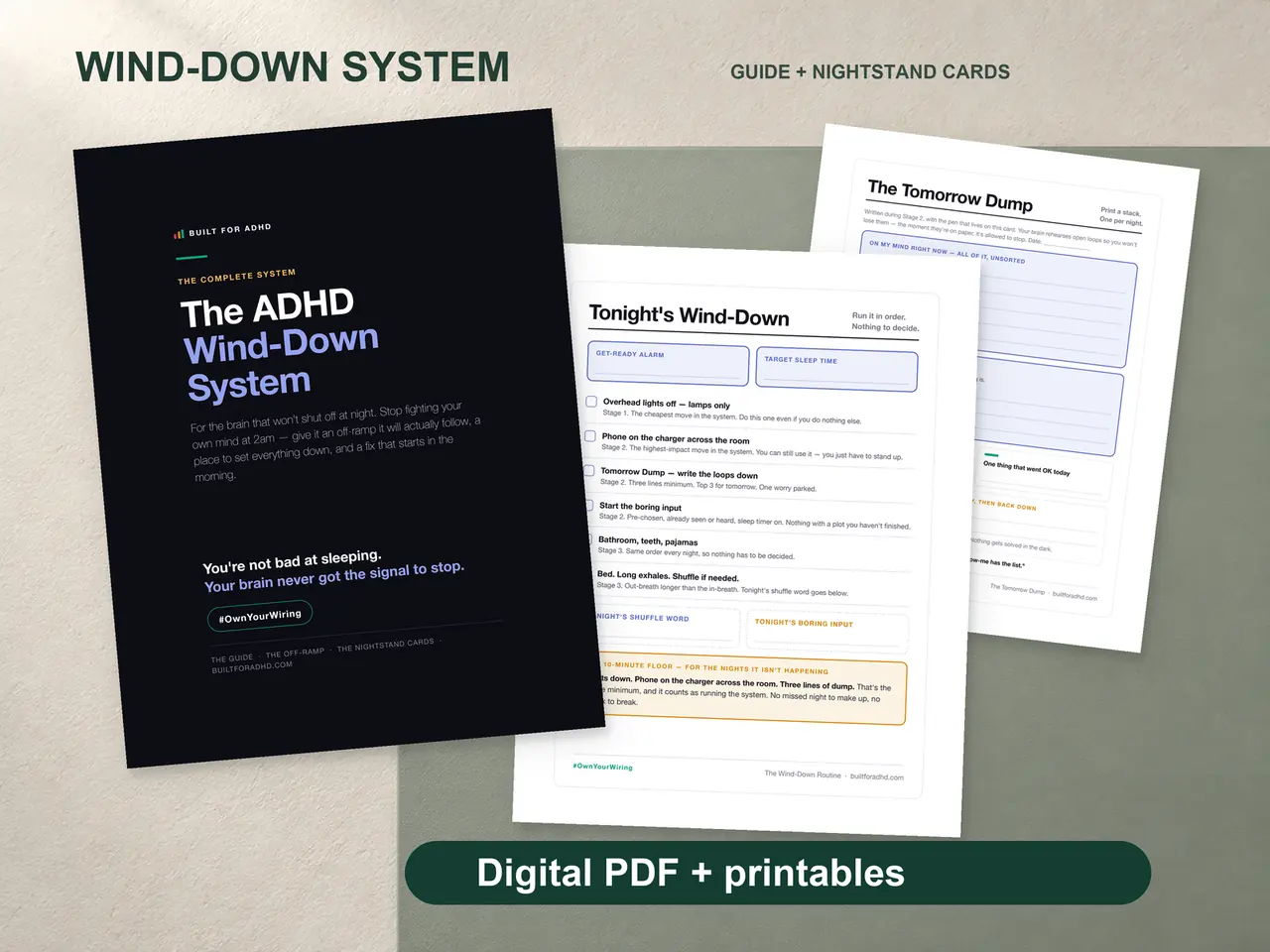
If Friday’s page shows days that end with nothing left in them, the ADHD Wind-Down System is the $12 version of the second move above — the transition and evening routine built for a brain that is running on empty by the time it needs one. The audit itself is free, and it is the part that has to happen first.
Related tools
- ADHD work burnout recovery — where this goes if nothing changes
- ADHD afternoon crash fatigue — the same accounting, earlier in the day
- ADHD over-apologizing and RSD — the tone-management half of the bill
- Asking for ADHD workplace accommodations — turning one line item into a request
- ADHD imposter syndrome in high achievers — the file that goes next to this one
- The complete guide to ADHD tools for adults — the rest of the working set