In this article
You say sorry when someone else bumps into you. Sorry for asking a question in a meeting. Sorry for taking four minutes to reply instead of two. Sorry at the start of an email that contains nothing to be sorry about. Sorry for being tired, sorry for being excited, sorry for the thing you said twenty minutes ago that nobody else remembers.
Somebody has probably told you to “just stop apologizing so much,” which lands about as usefully as being told to just stop having ADHD. The reflex isn’t a manners problem. It’s a pre-emptive one — and once you see what it’s trying to do, you can give it a better job.
The sorry is a flinch, not a sentence
Most ADHD over-apologizing isn’t about the thing you’re apologizing for. It’s insurance.
Somewhere in there is a long history of being a little too much, a little too late, a little too loud, a little too off-script — and the correction arriving after, from someone who’d already decided. So the brain learns a cheap trick: apologize first. Get the flinch in before the criticism does. If you’ve already said sorry, nobody can hand you the disappointment you were bracing for, because you beat them to it.
That’s rejection sensitivity doing logistics. The wave of rejection-pain is disproportionately expensive, so the brain starts paying a small tax constantly to avoid the big bill. Each individual sorry costs almost nothing. Forty a day, for fifteen years, is a different number.
(the relief when you realize it’s a strategy and not a character defect is instant, and I’d like to keep it instant — this is not a post about how you’ve been doing your personality wrong.)
What it actually costs
Three things, and the third one is the one people miss.
It rewrites how people read you. Apologize for your own question and the question sounds optional. Apologize before a good idea and the idea arrives pre-discounted. You’re not being humble; you’re doing the other person’s skepticism for them, unpaid.
It makes the real apology worthless. When you genuinely do the thing — missed the deadline, forgot the favor, snapped at someone who didn’t earn it — the sorry has to carry weight. It can’t, if it’s the same word you used for standing in a doorway.
It burns executive function you need elsewhere. Every pre-emptive sorry is a tiny scan: was that okay, was that too much, should I soften it. That scan runs on the same battery as your actual work, and it runs all day. A lot of what feels like 4 PM brain fog is just the running tally of that scan.
The swap script
Here’s the part that works, and it works because it’s a swap and not a deletion. Deleting a reflex is an impossible instruction for an ADHD brain — there’s nothing to do instead, so you stand there mid-sentence doing nothing and then say sorry about that too. Swapping it gives your mouth something to reach for.
The rule is one line: name the thing, or thank them for it, instead of apologizing for it.
Print these five. They cover most of the day.
| What you say now | Swap to |
|---|---|
| ”Sorry I’m late getting back to you" | "Thanks for your patience — here it is" |
| "Sorry, this is probably a dumb question" | "Quick question —" |
| "Sorry for the long message" | "Here’s the short version, details below" |
| "Sorry, I’m being so scattered today" | "Give me one second, I’m switching tracks" |
| "Sorry, does that make sense?" | "Let me know if you want me to go deeper on any of that” |
Read the right-hand column out loud once. Same information, zero flinch, and the thank-you version is warmer than the apology — which is the thing nobody tells you. Sorry asks the other person to absolve you. Thanks gives them something. People feel the difference even when they can’t name it.
Make it a rule, not a vigilance project
Watching your own mouth all day is just the scan again with extra steps. Pick one narrow lane and only run the swap there for two weeks.
The best lane is written. Email, Slack, texts — anywhere there’s a gap between typing and sending. Before you send, search your own message for “sorry.” One word, one look. If it’s not attached to an actual harm you caused, swap it from the table. Written is the right starting lane because you get a do-over, and because written apologies are the ones that get forwarded and reread.
Then stop. Don’t take it to spoken conversation yet, don’t take it to the group chat, don’t count your sorries. One lane until the swap comes out without being summoned.
If you’re already running a system for late replies, bolt the sorry-check onto that — the apology and the lateness usually arrive in the same message anyway, and fixing both in one pass is cheaper than two habits.
The three sorries you should keep
This isn’t a no-apology rule, and any advice that goes there is bad advice. Keep these:
- You actually caused harm. Short, specific, no explanation tour. “I forgot to send the file and it held you up. Sending now.”
- Sympathy sorry. “I’m sorry that happened to you” isn’t an apology, it’s a condolence, and it’s doing real work.
- You need a repair, not an exit. After a hard conversation, a genuine apology is how two people get back to each other. Don’t swap that one out for a thank-you — it’ll read as deflection, and the person you’re repairing with will feel it.
The test for all three: is there a harm, and did I cause it? Two yeses, apologize properly. Anything else is the flinch.
When you catch one mid-sentence
You will say “sorry” and hear it land and feel the familiar urge to apologize for apologizing. Do not. Say the swap right after it and keep moving: “Sorry — thanks for waiting — anyway, here’s the file.”
Nobody notices the double. Everybody notices a person derailing for ten seconds to narrate their own speech patterns. The second apology is the one that actually costs you something, and letting the first one go uncorrected is the whole skill.
If the catch-and-spiral is happening a lot, the problem usually isn’t the apologizing — it’s that you’re running on empty and every social moment is costing full price. That’s a capacity thing, not a wording thing, and sorting the day by energy does more for it than any script will.
What changes
Not much, at first — which is worth saying, because over-apologizing is tied up with enough history that it’s tempting to expect a transformation.
What you’ll notice around week two: your requests get answered faster, because they stopped sounding optional. Your “no” starts holding, because it isn’t wrapped in three cushions. And the low-grade resentment cycle at home gets quieter, because pre-apologizing for your own needs is one of the things that makes them invisible until they come out sideways.
You stop paying the tax. The money was always small. The relief is in not running the meter.
Start free: the ADHD tools for adults guide covers the rest of the executive-function load this is sitting on top of, and the free brain dump sheet is the first ten minutes of getting the running scan out of your head.
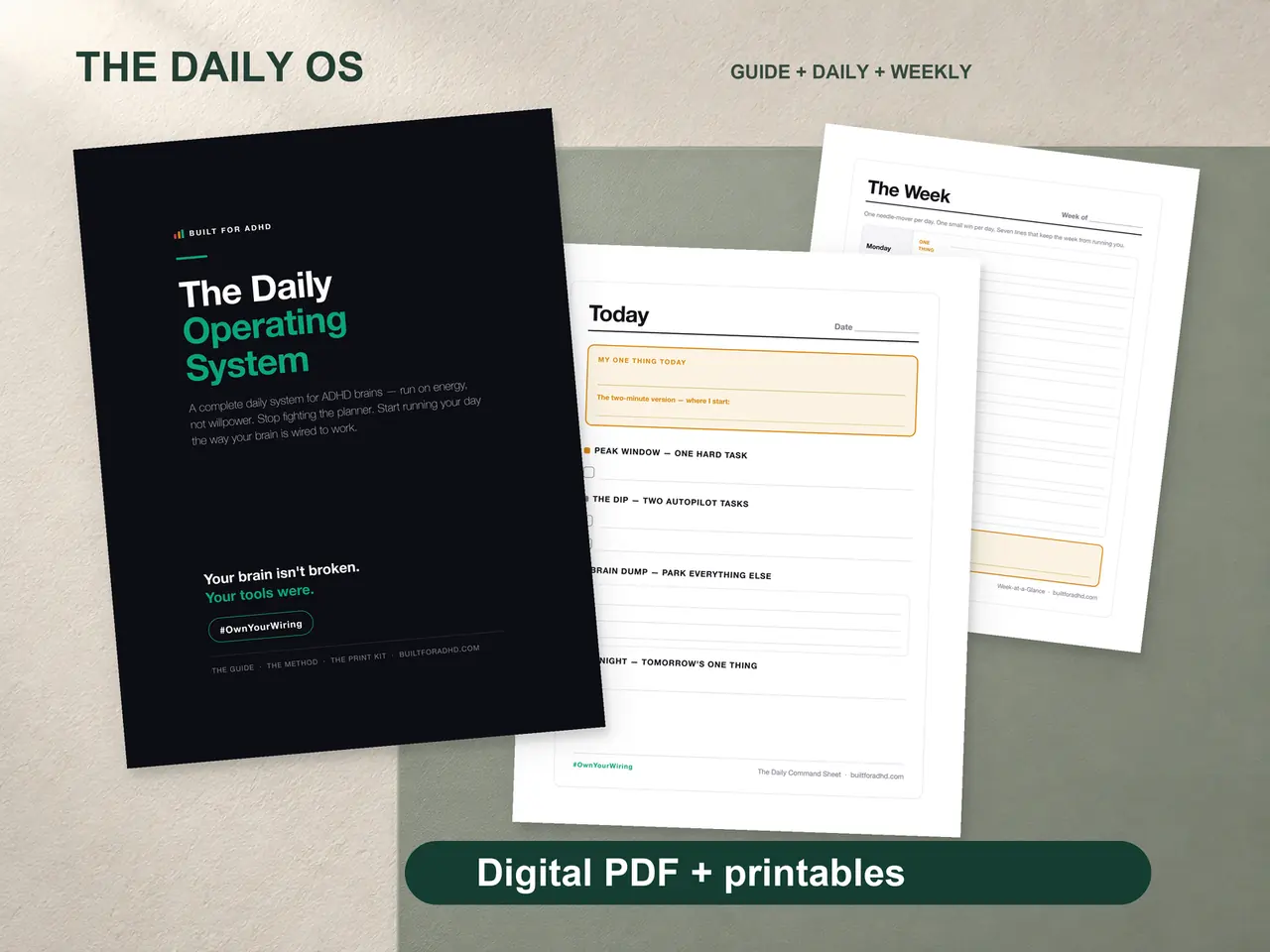
If the sorry reflex is mostly an out-of-capacity problem — and for a lot of us it is — the ADHD Daily OS is the thing underneath it. $17, printable, tasks sorted by energy instead of the clock, so you’re not arriving at every conversation already overdrawn. It won’t fix the reflex. It makes the days where the reflex runs hardest less frequent.
Related tools
- Free ADHD brain dump sheet — get the running scan onto one page
- ADHD Daily OS — $17: energy-based daily system
- ADHD tools for adults — the full toolkit, compared
- What RSD actually feels like — the wave this reflex is bracing for
- The nagging and resentment cycle — what unspoken needs turn into
- ADHD late text replies — the system the sorry-check bolts onto