In this article
The third time she asked about the recycling, the question had changed shape.
By the third it was flatter — pre-loaded, already carrying its own answer. And I heard it the way I heard all of them: not as a logistics query, but as a short review of my character that happened to mention bins.
So I got defensive. About bins. Which were, it should be said, still in the kitchen. (The fix turned out to be a system, not a conversation — more on that in ADHD household systems.)
The loop has four beats and no villain
Here’s the machine. Every beat in it is a reasonable response to the one before.
One. Something needs doing. It doesn’t get done — not refused, not deprioritized, just never converted into a thing that exists anywhere outside my skull.
Two. She notices. Which means she is now holding it, because somebody has to. She mentions it.
Three. I hear criticism, because that’s how a neutral question lands when rejection sensitivity is in the room. So I defend, or I go quiet, or I over-apologize at a volume that makes the whole thing about my feelings instead of the bins. What I do not do, in that specific moment, is take out the recycling.
Four. She learns that mentioning it once doesn’t work. So next time she mentions it earlier, and firmer, and with a little armor on it. Which lands even more like criticism. Which makes beat three worse.
That’s the whole cycle, and it runs on two perceptions that are both accurate: she really is having to remember things for me, and I really am not being lazy.
Two true things, grinding against each other, on a loop, about bins.
The job nobody applied for
The part that took me far too long to see is that there is a job in this house that nobody ever named, and she had been doing it for years.
The job is being the reminder system.
It’s not the recycling — that takes ninety seconds and neither of us cares about it. The job is holding a running list of things that might not happen, checking it against reality, and deciding when to raise each item and how hard. That’s a real load, it never clocks out, and the reward for doing it well is being called a nag.
A nag, structurally, is a human alarm clock with feelings. That is a miserable thing to ask of somebody you love, and an unbuilt household asks it of them by default.
On my side the resentment was just as real and pointed the other way: I felt managed. Supervised in my own kitchen. Both of us were angry at a job neither of us wanted, and because it had no name, we kept aiming at each other instead.
This is not dividing the chores themselves, which is about who owns which domain, and it’s not the one-off ask that evaporates mid-conversation, which needs a capture rule. This one is about the recurring stuff — and about which of you is carrying the remembering of it.
Take the person out of the loop
You cannot fix beat three by having better feelings about being reminded. I tried that for a couple of years. The flare happens faster than the decision to be reasonable does.
What actually works is removing the human from the reminder role entirely. The reminding has to be done by something that cannot sound disappointed in you.
Three parts, and the third is the one that does the work:
One surface, and it’s visible. A whiteboard, a paper page on the fridge, a printed sheet — something in the room where the thing happens. Not an app one of you opens — then checking the app becomes a task that can be forgotten, and you’ve rebuilt the same loop with extra steps. Visible beats organized.
Every recurring thing on it, with its day attached. Bins Tuesday. Sheets Saturday. The specific, boring, repeating items that generate ninety percent of these conversations. This surface has exactly one purpose: to be the thing that remembers, so a person doesn’t have to.
The rule: if it’s on the surface, nobody says it out loud.
That rule is the entire fix, and it’s a gift to the person who has been nagging. It tells them they are allowed to put the list down. Not allowed to trust me — that’s a big ask and it hasn’t been earned yet. Allowed to stop holding it, because the board is holding it now. The board can be checked, and checking a board is not an accusation.
Which makes the board’s day the real commitment. If bins say Tuesday and happen Thursday, we’re not in a nagging problem, we’re in a system nobody believes — and belief is what this runs on.
The three sentences
Scripts, because the middle of the loop is a terrible place to improvise.
To start it: “I don’t want you to have to remind me. Can we put the recurring stuff somewhere visible, and I’ll own checking it?”
Say it when nothing is on fire — not thirty seconds after a fight about the dishwasher. And note what it does: it hands you the maintenance, which is what makes it an offer instead of a new chore for them.
When a reminder lands anyway: “You’re right, it’s not done. It’s on Thursday.”
Seven words and a day. No explanation, no history of what else you were carrying. The explanation escalates it every time, because from the outside a paragraph about why sounds exactly like a negotiation about whether.
When you drop it: “I dropped this one. It’s back on the board for Saturday.”
Then put it on the board for Saturday and do it on Saturday. This sentence has a short shelf life if the Saturdays don’t hold — same as a text left sitting eleven days, where every extra day makes the reply feel like it needs more justifying.
Where this genuinely breaks
The surface becomes their job. If they’re writing on it, updating it, and checking whether you checked it, you’ve renamed the nagging in marker form. You maintain the board. That’s the deal.
Week two. The rule gets broken — they mention something already on the board, you point at the board, and now you’re fighting about the board. The move is boring: “it’s on there for Thursday,” then leave it alone. A board earns authority by being right about five Thursdays in a row, not by being defended.
The pile that predates the board. Recurring systems handle recurring things. What has already accumulated is a different job — start there instead, and keep it off the board so the board stays credible.
And the honest limit: this is a logistics fix for a logistics loop. If the resentment in your house has traveled well past bins into something bigger, a page on the fridge is not that tool, and I won’t pretend it is. What it can do is stop the daily grind adding to the pile while the bigger conversation happens elsewhere.
What working looks like
Not a house where nothing gets forgotten. Things still get forgotten here.
What changed is that the forgetting is now between me and a board, instead of between me and her. She can walk past the kitchen on a Tuesday, see bins on there, and say nothing — not because she’s biting her tongue, but because something other than her memory is holding it. That silence isn’t politeness. It’s the load actually being off her.
Start with the first sentence tonight, when nothing is on fire. Then write down the five recurring things that cause the most of these conversations and give each one a day. Five items, five days, that’s the build. The free parent starter set has the wall surface I’d use for it, and the household systems hub has the rest of the recurring-load pieces.
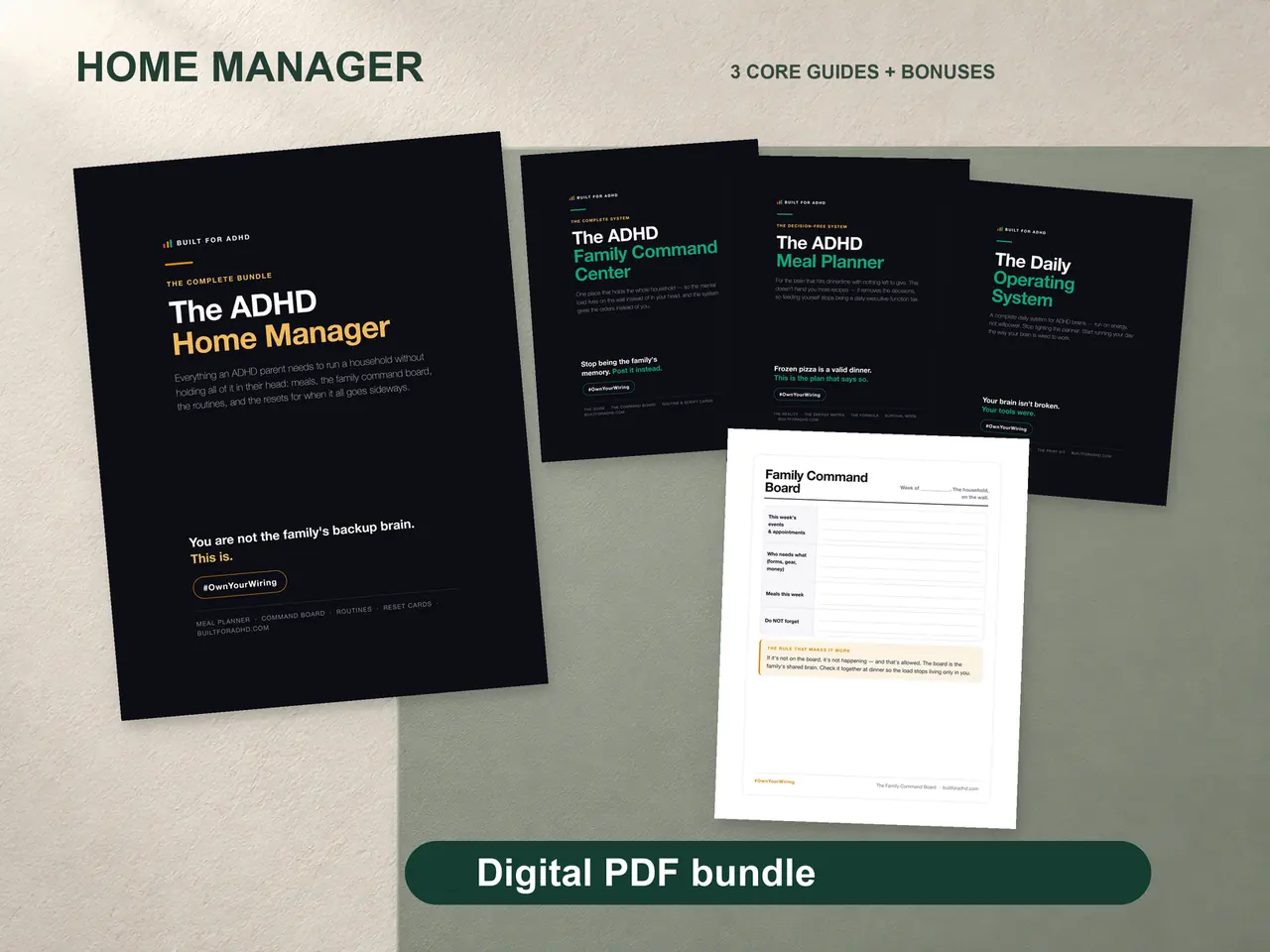
If you want the pre-built version — the Family Command Board this runs on, the nag-free scripts, plus the meal and daily-planning pieces that feed the same wall — that’s the ADHD Home Manager, $47. Honest note: it’s a parent-shaped bundle, so if it’s just the two of you with no kids in the mix, half of it won’t apply. The board, the days, and the rule above are free and they’re the part that actually ends the loop.
Related tools
- The free parent starter set — the visible wall surface this is built on
- ADHD household systems — the hub for recurring load that never stays done
- The ADHD chore split — who owns which domain, once nobody is the reminder
- Forgetting what your partner asked — the capture rule for one-off asks
- What RSD feels like — why a question about bins doesn’t land neutrally
- Replying to texts late — the same escalation spiral, in your messages
- Dishes that pile up — for the backlog that predates the board