In this article
She asked me to call the roofer on a Tuesday. I remember where I was standing, I remember saying yes and meaning it completely, and I remember thinking that’s easy, I’ll do it tomorrow.
I did not call the roofer. Not Wednesday, not the following Tuesday, not at any point until it came up again in a conversation with a very different temperature than the first one.
Here’s the part that took me years to understand, and it’s the whole reason this is fixable: I never forgot that phone call. I never had it. It went in as a sound and never became a thing. There was nothing there to forget.
The handoff is where it dies
Walk through what happens when somebody asks you for something out loud.
You are in the middle of your own thing. A sentence arrives. You process it — genuinely, you’re not faking the nod — and you agree. Then the moment ends, they walk out of the room, and your thing resumes.
The request is now stored in exactly one place: working memory. Which is the one storage location an ADHD brain cannot be trusted with, and the one you just agreed to use. Same mechanic underneath time blindness — the information isn’t missing, the retrieval path to it never got built.
Compare it to a text. A text is a thing — it sits there, it has an unread badge, it exists outside your skull. A spoken request has no badge and no surface. It has a feeling of having agreed, and that fades like any other conversation.
Then the second layer, the one that turns a missed phone call into an argument. From the outside, “I forgot” and “I didn’t care enough to remember” are impossible to tell apart. They watched you say yes. They have no view into the part where the yes never became a task. So the fifth time, they stop hearing a memory problem and start hearing an answer about how much they matter — while you’re hearing an accusation about your character over a roofer, and with rejection sensitivity in the mix that lands like a verdict, not a complaint.
Two different conversations, both accurate about their own side.
The six-second rule
The fix is not trying harder to remember. That’s the thing that has been failing this entire time.
The fix is one rule: a request is not agreed to until it exists somewhere outside your head, and that has to happen inside the conversation — not after it.
Six seconds — a sentence out loud and eight words typed into your phone. It has to be inside the conversation because “I’ll write it down in a minute” is the same promise as “I’ll call him tomorrow”, made by the same brain, with the same result. There is only the room you’re standing in.
Three things make it work:
One surface, always the same one. Not whichever app is open. Notes app, shared list, paper pad on the counter — pick one and it’s the only one. If capture requires a decision about where to capture, that decision is the failure point. Mine is a single pinned note, and everything lands there first.
Capture ugly. “roofer” is a valid entry. What is not valid is skipping it because it’s too small to write down — the small ones are exactly the ones that evaporate, and the small ones are most of what this fight is made of.
Say it out loud while you do it. That’s the part that does the relationship work, and I’ll come back to it.
That’s the protocol. It’s embarrassingly simple and it took me about three months to make automatic, which I’d rather say honestly than pretend it clicks in a week.
The three sentences
The capture fixes your side. These fix the other half — the part where your partner can’t see any of it happening.
In the moment: “Hang on, let me put that in my phone.”
Say it, then actually do it while they’re standing there. Six seconds of slightly awkward silence.
It tells the person watching that the request landed in a system, not a promise — and it quietly ends the argument about whether you were listening, because they watched you file it.
For the ask that arrives at a bad time: “I want to get this right — can you text it to me?”
Sometimes you’re driving, or eleven layers deep in a work thing. The honest move is not to nod. Asking for it in writing sounds like a dodge the first time and stops sounding like one by the third, because the things they text you get done and the things said to you in the driveway historically did not.
This one has a limit. If everything goes to text, you’ve moved the whole load onto them in a new format — the invisible-noticing trade wearing a different coat. Use it for the genuinely bad moments, not as the default.
For the one you already dropped: “I lost this one. I’m not going to explain it. It’s in my system now and here’s when it’s happening.”
No paragraph, no history of the week. The explanation is what makes it worse every time — same compounding loop as a text left sitting for eleven days, where the longer it waits the more the reply feels like it has to justify itself, so it waits longer.
Name it, file it, give it a day. Then do it on that day, because this sentence only keeps working if the day holds.
Where the captured things go
Capture without a second step is just a longer list of things you didn’t do. The note fills up, you stop opening it, and you’re back where you started.
So: once a day, fixed time, you empty it. Morning coffee is mine — five minutes, one question: does this have a day yet. Things with a day go on the day. Ten-minute things get done right there. Things that have moved three times don’t need rescheduling, they need a decision: I’m doing this Thursday, or I’m telling her I’m not.
That third category is the one that prevents the pile. An open loop you keep carrying costs more than a no.
Sort the day’s list by what each thing costs rather than how long it takes — a two-minute call to a stranger can be the most expensive item on a list of hour-long tasks, and pretending otherwise is why it’s sat there a week. If something is genuinely stuck, shrink the first step until it’s stupid: find the roofer’s number. That’s the whole task.
And when the daily empty falls apart for a stretch — it will, that’s what every productivity system does to an ADHD brain eventually — the restart is: open the note, anything older than two weeks gets a decision, not a reschedule. Ten minutes. Don’t read the whole thing looking for evidence about yourself.
What working looks like
Not a perfect memory. Working is a Tuesday where she asks for something, you say “hang on, let me put that in my phone,” and neither of you thinks about it again until it’s done.
What actually changes isn’t the hit rate, though that goes up. It’s that the conversation stops being about whether you care. It’s about a note and a day — two things you can both look at, neither of them a claim about who you are.
Start with the sentence. Next time somebody asks you for anything — today, probably — say “hang on, let me put that in my phone,” and then put it in your phone. That’s the entire first week. If you want a printed page for the daily empty, the free adult starter kit has the brain dump sheet the note gets poured into.
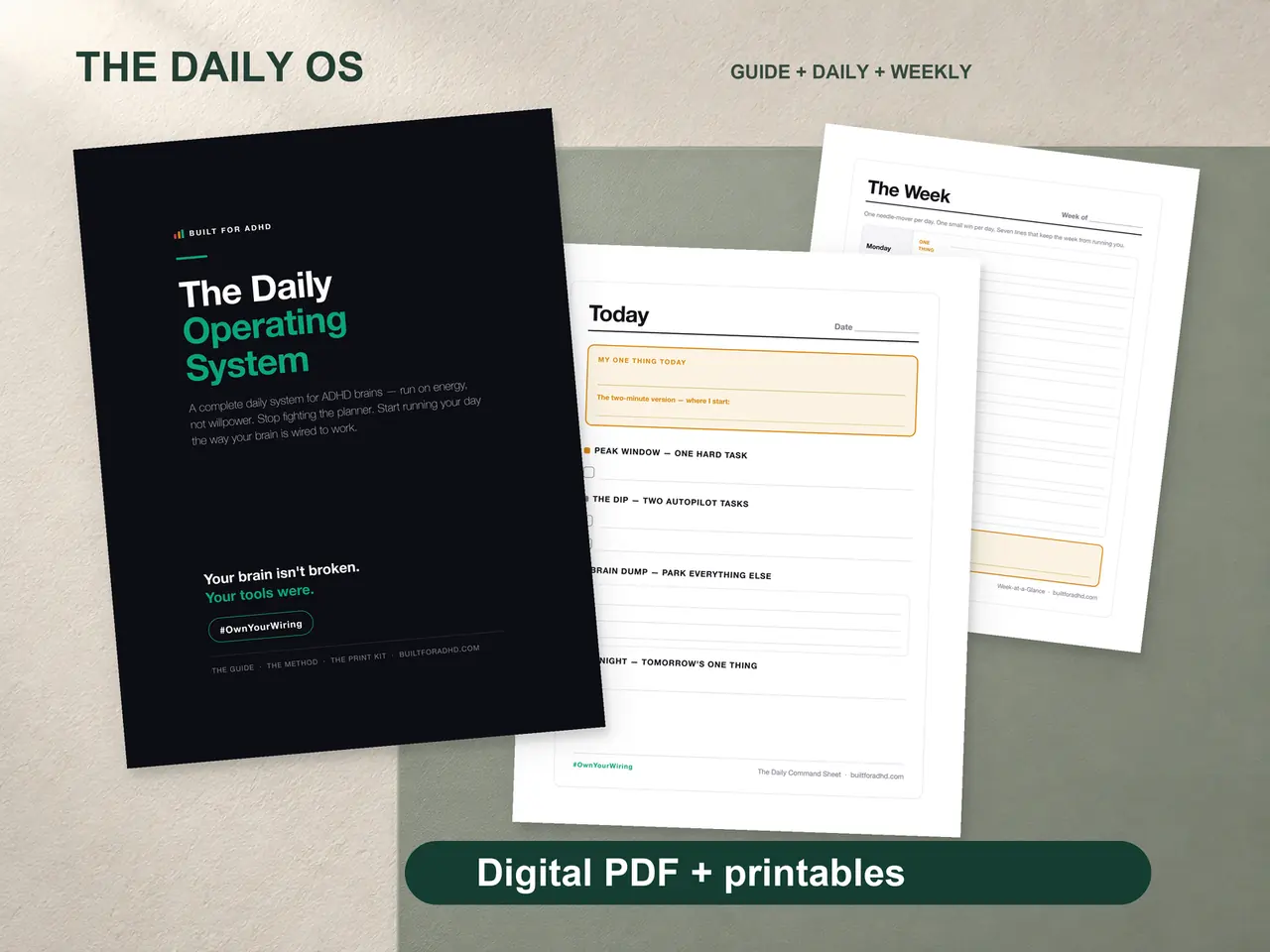
If the real problem is that everything lives in your head and leaks out of it, the ADHD Daily Operating System is where I’d point you. $17. Honest note: there’s no partner-request module in it. What’s in there is the brain dump capture page, the Morning Loop that the daily empty above is built on, and the restart pages for the weeks the whole thing collapses. The capture rule itself is free and you should start it tonight regardless.
Related tools
- The free adult starter kit — the brain dump sheet the daily empty runs on
- ADHD household systems — the hub for the chores and asks that never stay done
- The ADHD chore split — dividing the noticing instead of the tasks
- ADHD time blindness — why “I’ll do it tomorrow” disappears
- What RSD feels like — why a question about the roofer doesn’t land neutrally
- Replying to texts late — the same spiral, in your messages
- The tiny first step method — for the captured thing that still won’t start