In this article
There’s a specific moment I know too well. You go to get a glass of water, there are no clean glasses, and the sink is a leaning tower of bowls with a pan balanced on top like a lid. So you rinse one glass, drink the water, and put the glass back on the pile. (the pile grows by one. the shame grows by more.)
If your sink looks like that right now, here’s what I want you to know first: dishes pile up for an ADHD brain because of how the pile works, not because of who you are. The pile is built to get harder to start the bigger it gets. Once you see the mechanism, you can design around it.
Why dishes snowball
Three things are working against you, and none of them is laziness.
The pile is a threshold problem. One bowl is a thirty-second job. Twenty dishes is a vague, sticky, open-ended job with no clear edge. Every dish added makes the whole thing look bigger to your brain, which makes it less likely you’ll start, which means more dishes get added. It’s a loop that feeds itself, and the same loop runs the pile on the chair and the laundry basket.
Dishes have a trigger, but it’s the wrong one. The only thing that reliably forces the job is running out of something. So the sink gets dealt with at the worst possible time: when you’re hungry, rushed, and need one specific pan that’s at the bottom of the stack.
There’s no clear “done.” Wash, dry, put away, wipe the counter, deal with the one pot that needs soaking. It’s five tasks pretending to be one, and a task with a fuzzy finish line is a task an ADHD brain will avoid starting.
So “just do the dishes every night” fails for the same reason most chore advice fails. It asks for consistency from the part of your brain that runs on interest and urgency, and a sink offers neither.
The sink reset: four steps, in this order
This is for the day the pile already exists. The order matters, because each step makes the next one smaller.
Step 1: Clear one landing zone
Don’t touch the sink yet. Empty the dish rack or the dishwasher first, even if that’s all you do today. A full rack means clean dishes have nowhere to go, and your brain knows that before you do. This is the step that’s secretly blocking every other step.
Step 2: Pull out the easy wins
Silverware, glasses, mugs. The small, fast stuff. Get them out of the pile and washed or loaded. The pile visibly shrinks, and visible progress is the dopamine hit that keeps you going. Start with one fork if one fork is all you’ve got. The tiny first step counts even when it’s embarrassingly small.
Step 3: Soak the hard stuff and walk away
The crusty pan, the pot with the burnt bottom. Hot water, a drop of soap, and leave it. Soaking isn’t avoidance, it’s the pan doing half the work while you’re not there. Set one reminder, or just pair it with the next time you’re in the kitchen anyway.
Step 4: Define done as “sink empty,” not “kitchen clean”
The finish line is an empty sink. Not a wiped stove, not a clean counter, not a mopped floor. If you keep going after that, great, it’s bonus. But if you stop there, you won. A clear finish line is what makes a task startable.
The one rule that stops the pile from coming back
Here’s the rule that changed my kitchen more than any schedule did: nothing goes into the sink.
Dirty dishes go straight into the dishwasher, or into a single wash bin next to the sink if you hand-wash. The sink stays empty, so the sink stays usable, so the first dish never becomes the foundation for the pile.
It works because it removes the threshold problem at the source. A pile needs a place to start, and the sink is that place. Take the place away and there’s nothing to build on. And “put it in the dishwasher” is one motion, the same effort as putting it in the sink.
If the dishwasher is full of clean dishes (it’s always full of clean dishes), that’s the landing zone problem from Step 1 again. Which leads to the one habit worth attaching to something you already do.
Give unloading a trigger
Unloading the dishwasher has the same problem as putting laundry away: nothing beeps to tell you it’s time. So borrow a trigger from something that already happens every day.
Unload it while the coffee brews. Unload it while the kettle heats. Unload it while dinner is in the oven. You’re standing in the kitchen waiting anyway, and the waiting is the free time the job fits into. Once unloading has a trigger, the “nothing goes in the sink” rule actually holds, because there’s always somewhere for the dirty dish to go. The same trick is behind moving the laundry finish line to the dryer.
Make it easier on the hard days
Some days the pile wins anyway. That’s normal, and the system should expect it.
Match the job to your energy. Low tank? Unload the rack only, that’s the whole task. Medium? Easy wins. Actually have something left? That’s the night for the soaking pan. Sorting by energy instead of by schedule keeps the kitchen moving through a rough week instead of collapsing on the first tired night.
Borrow company. Dishes with someone else in the room, even someone doing their own thing, are weirdly easier to start. If nobody’s around, body doubling for cleaning covers the ways to fake it.
Pair it with sound. One podcast episode, one album side, a phone call with a friend. The dishes borrow the dopamine from the thing you wanted anyway.
Lower the bar on purpose. Paper plates during a hard week are a tool, not a failure. So is cooking one-pan meals when you’re running on empty. The goal is a kitchen that works, not a kitchen that proves anything.
If you share the kitchen
In a lot of homes, dishes have a hidden problem: everyone does some of them, and nobody owns them. One person loads, one person unloads when they notice, and the sink quietly belongs to no one. If that sounds familiar, the chore split built around noticing gives the whole dish loop one owner, which ends the standoff over whose turn it is.
Start tonight
Don’t clean the kitchen. Empty the dish rack, and that’s it. Tomorrow morning, while the coffee brews, put one dish in the dishwasher instead of the sink.
If you want the rest of the house running on the same idea (triggers instead of memory, owners instead of reminders), the ADHD household systems hub lays out the whole setup, and the free parent starter set is a printable that lives on the fridge instead of in your head.
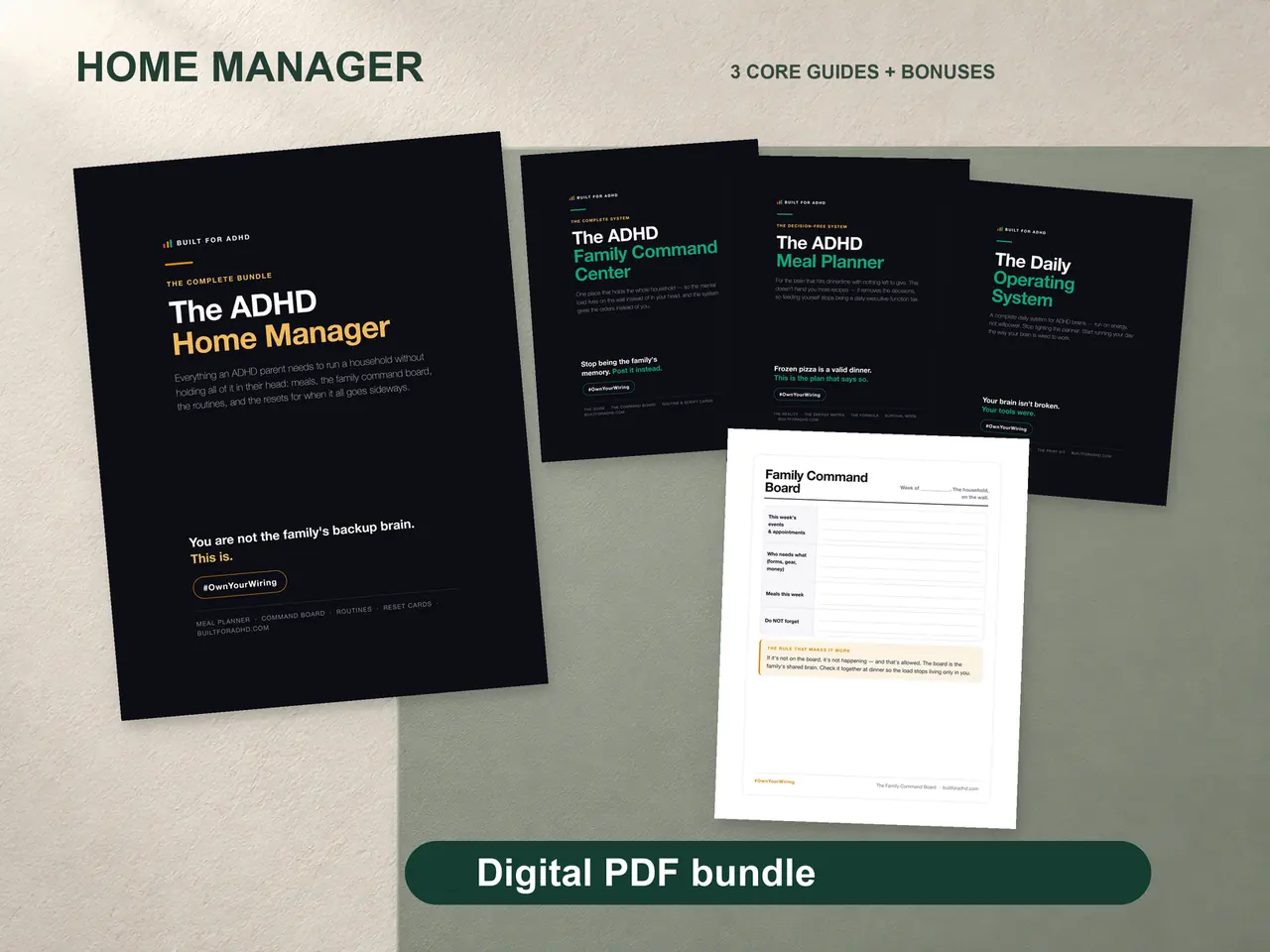
If you’d rather have the household side built for you, the ADHD Home Manager is where I’d point you. $47. Honest note: there’s no dishes-specific worksheet inside it. What it has is the Family Command Center for giving recurring jobs an owner and a trigger, the Meal Planner so dinner stops being a nightly decision, and the Reset Cards for the weeks when the sink wins anyway. The sink reset above is free, and you should try it either way.
Related tools
- ADHD household systems — the hub for the chores that never stay done
- The free parent starter set — a printable for the fridge, not your head
- ADHD laundry that never gets put away — the same finish-line fix, for the basket
- ADHD doom piling — why the pile stays invisible until it’s urgent
- The ADHD chore split — who owns the noticing, not just the doing
- Body doubling for cleaning — borrowing company to start boring tasks