In this article
You’re standing in the kitchen, the counter has disappeared under mail and dishes, and you know exactly what needs to happen and cannot make yourself start. Body doubling fixes this reliably for cleaning specifically, because cleaning is less a motivation problem than a decision problem — and a body double’s real job, whether they’re a person on your couch or an AI in your pocket, is to remove the very first decision: what do I touch first.
The doom pile is a decision problem, not a mess problem
Every doom pile is really a stack of tiny unmade decisions — trash or keep, has a home or needs one — and standing in front of it asks your brain to make all of them at once, which is exactly the kind of overload that produces “I feel frozen” instead of “I’m cleaning.” A body double doesn’t do the deciding for you. What they do is take the very first decision off the table, so your brain only has to handle the second one.
”Tell me what to clean first”
This is the sentence that does the actual work, and it works whether you say it to a person or an AI. To a person on a call or in the room: “Can you just tell me what to clean first? I don’t need help doing it, I need someone to pick.” To an AI, be more specific, because it can’t see the room: “I feel frozen looking at my kitchen. Here’s what’s in it — dishes in the sink, mail on the counter, a bag by the door. Tell me what to clean first, one item, not a plan, and check in with me in ten minutes.” Either way, the moment someone else names the first physical action, the freeze usually breaks, because the hard part was never the dishes. It was choosing the dishes over the mail over the bag.
The 20-minute container
Cleaning without an end time turns into cleaning without a start, because your brain can smell an open-ended task and refuses to engage with it. Twenty minutes is enough time to make a room visibly different and short enough that starting doesn’t feel like a life sentence. Set the timer before you touch anything, tell your body double — human or AI — how long the container is, and treat the buzzer as the actual end of the task, not a suggestion to keep going if you’re on a roll. You can always set a second one. You rarely need to, because 20 minutes of contained, witnessed cleaning usually does more than an entire unstructured afternoon.
The voice-mode variant, in the kitchen
Cleaning is a hands-busy, screen-free task, which makes it the best possible fit for body doubling by voice instead of text. Put your earbuds in, open a voice session, and say something like: “Body double me through the kitchen for 20 minutes. Keep me company while I do it and ask gentle check-in questions — nothing else.” Then narrate as you go: “okay, dishes first, loading the washer now.” You never touch your phone again until the timer goes. The talking keeps the part of your brain that wants to wander occupied, the check-ins arrive without you doing anything, and your hands stay free for the actual cleaning. For the full setup — the exact contract, how often to ask for check-ins, what to do if you report drifting — see the AI body doubling protocol.
The person-on-the-couch script
If a human is around — a partner, a roommate, a friend on a call — you don’t need them to clean with you. You need them to exist nearby. The ask that works: “I focus better when someone’s in the room. Can you just hang out on the couch and read or scroll while I clean the kitchen for 20 minutes? You don’t have to do anything.” Most people say yes immediately, because you’re asking for their presence, not their labor, and that’s a much smaller favor than it sounds like before you ask it.
The two-minute close-out
When the timer goes, don’t just wander off to the next thing — close the session the way a real body double session closes. Say it out loud, to the person or the AI: “Done — counters clear, dishes loading.” Ten seconds, maybe two minutes if you’re also doing a last visual scan of the space. That small completion ritual is what makes the next session easier to start, because your brain gets to file this one under “finished” instead of “trailed off,” and finished sessions are the ones you’re willing to repeat.
Build the system around it
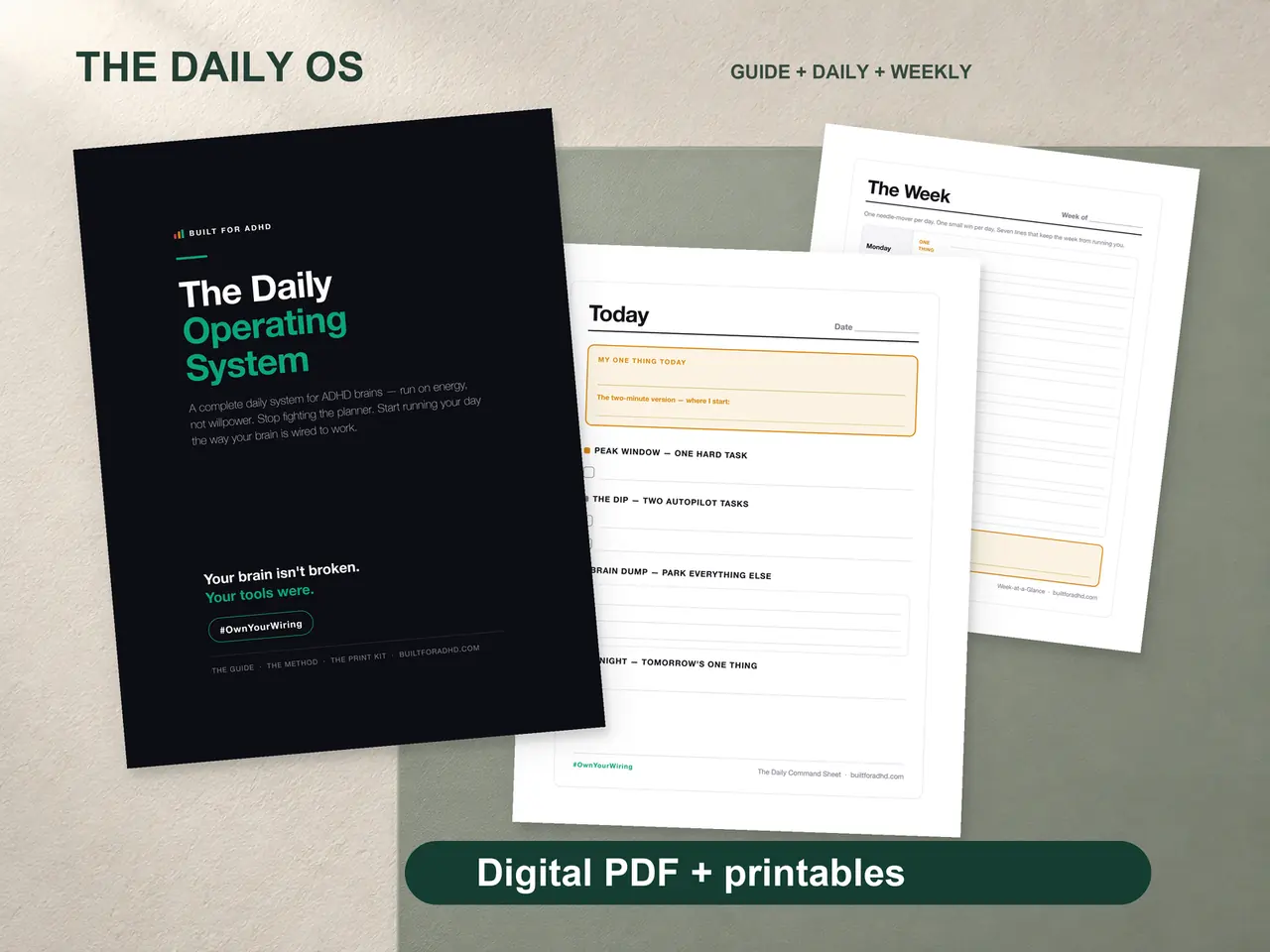
Body doubling gets you moving on one pile, one time. What keeps piles from reforming is a system that gives deferred decisions somewhere official to go — that’s the whole idea behind containing doom piles instead of purging them, and it’s also the logic behind the ADHD Daily OS: tasks sorted by energy, a tiny first step attached to each one before you sit down, and a brain dump page so cleaning doesn’t have to compete with eleven other things you’re holding in your head. $17, printable, one-time. If you’re assembling the rest of a household setup, ADHD household systems rounds up the templates that work alongside this.
FAQ
Does body doubling actually help with cleaning, or does it just feel better? It helps with the specific part of cleaning that’s hardest for ADHD brains — starting — because a body double’s presence, human or AI, removes the first decision and gives the task a witness. As of 2026 the direct evidence on body doubling for ADHD is early-stage and small-sample, but it lines up with what the community has reported for years.
What if I don’t have anyone to ask? Use the AI voice-mode variant — earbuds in, declare a 20-minute session, ask it to tell you what to clean first and check in every ten minutes. It holds the same structure a person would, without needing anyone’s time.
How long should a cleaning body-doubling session be? Twenty minutes is the sweet spot for most doom piles — long enough to see real progress, short enough that starting doesn’t feel like committing to the whole afternoon.
What do I say to ask someone to body double while I clean? Ask for presence, not help: “Can you just hang out while I clean for 20 minutes? You don’t need to do anything.” It’s a smaller ask than it sounds like, and most people say yes right away.
Is it weird to ask an AI to tell me what to clean first? No — you’re using it exactly as designed, as a decision-remover, not a replacement for judgment about your own space. It can’t see the room, so the more specific you are about what’s in it, the better the first instruction it gives you.
Sources
- Cleveland Clinic, “What Is ‘Body Doubling’ and Can It Help With ADHD?” — https://health.clevelandclinic.org/body-doubling-for-adhd
- Linda Anderson, “The ADHD Body Double: A Unique Tool for Getting Things Done,” ADDA — https://add.org/the-body-double/
- Tessa Eagle et al., “‘It Was Something I Naturally Found Worked and Heard About Later’: An Investigation of Body Doubling with Neurodivergent Participants,” ACM Transactions on Accessible Computing (2024) — https://doi.org/10.1145/3689648
Related
- What is body doubling for ADHD? — the full explainer
- Why you can’t stop doom-piling — the mechanism behind the mess
- AI body doubling protocol — the voice-mode setup in full
- ADHD household systems — the templates that pair with this
- ADHD Daily OS — $17: energy-based tasks with the tiny first step built in