In this article
The laundry got washed. The laundry got dried. And then the laundry moved into the basket at the foot of the bed, where it lived for the next week while I got dressed out of it like it was a very disorganized dresser.
At some point the clean basket and the dirty basket were sitting next to each other and I genuinely could not tell you which was which. (I smelled a shirt to find out. we’ve all smelled the shirt.)
If this is your house, here’s the thing that finally made it make sense to me: laundry doesn’t break at the washing. It breaks at the last step, and the last step is designed badly for an ADHD brain. That’s a design problem, not a character problem, and design problems have fixes.
Why the loop breaks at “put away”
Walk through the four steps of a load and notice what’s different about the last one.
Wash has a trigger: the hamper is overflowing, or you’re out of socks. Dry has a trigger: the washer beeps. Fold is borderline, but at least the dryer beeping gets you standing in front of the clothes.
Put away has no trigger at all. Nothing beeps. Nothing overflows. The basket of clean clothes is, technically, a finished state. You can wear things out of it indefinitely, so nothing in the environment ever forces the final step.
And it’s the most boring step, with zero payoff. Washing feels productive. Pulling warm things out of the dryer is almost nice. Putting socks in a drawer delivers nothing. An ADHD brain running on interest and urgency has no reason to start it, which is the same reason the pile on the chair never gets dealt with until company is coming.
Then the third problem: put away is secretly dozens of tiny decisions. Where does this go. Does this still fit. Is this mine or my partner’s. Hanger or drawer. Every item is a small choice, and a basket of fifty small choices reads to your brain as one enormous vague task. So you walk past it, and walking past it forty times makes it heavier, not lighter.
None of that gets fixed by feeling bad about the basket. It gets fixed by changing what “done” means.
The fix: move the finish line to the dryer
The standard advice is “fold and put away immediately.” That advice assumes the last step feels like the easy part. For a lot of us, it’s the hardest part, so asking for more of it at the exact moment our interest is lowest is a plan to fail.
Instead, shrink the distance between “out of the dryer” and “put away” until they’re almost the same motion. Three stations.
Station 1: No-fold bins
Most clothes don’t need folding. Underwear, socks, workout clothes, pajamas, kids’ clothes, towels: these go in open bins, unfolded, one bin per category. No lids. A lid is a step.
Open a drawer and look at it honestly. If you already dig through the folded stuff and unfold it in the process, the folding was never doing anything except making put-away take longer.
Station 2: Hang straight from the dryer
Anything that wrinkles goes on a hanger the second it comes out, standing at the dryer. Keep a stash of empty hangers right there, not in the closet. Carry the hangers to the closet in one trip. Hanging something takes a few seconds; folding it well takes longer and delivers a worse result.
Station 3: One “later” basket, with a trigger
The stuff that actually needs a decision (the mystery sock, the sweater you’re not sure about, the thing that belongs in a different room) goes in one small basket. That basket gets a trigger, because a job with no trigger runs on memory and memory is the part that isn’t working. Pick an existing anchor: the Sunday reset, the night before trash day, whatever already happens weekly. If you run a weekly reset, the later basket is just one line on it.
With those three in place, put away stops being a separate task. It becomes the last thirty seconds of unloading the dryer.
Make the start smaller than the resistance
Even with the stations, some days the basket still sits there. That’s normal. Here’s what works on those days.
The one-category rule. Don’t put away the basket. Put away the socks. That’s the whole task. If you keep going, great. If you stop, socks are done and that counts. This is the tiny first step move, pointed at one pile.
Pair it with something you already want. Put away laundry during the first ten minutes of an episode, a podcast, or a call with a friend. The boring task borrows the dopamine from the thing you were going to do anyway.
Get a body double. Folding with someone else in the room, even someone doing their own thing, is weirdly easier. If there’s nobody around, body doubling for cleaning walks through the ways to fake the company.
Sort by energy, not by day. Low-energy evening? Hanging only. Medium? Bins. Actually have something in the tank? That’s the day for the later basket. Matching the task to the energy you have keeps the system running through a rough week instead of collapsing the first time you’re tired.
If you share the laundry with someone
In a lot of households, laundry quietly has three owners. One person notices it needs doing, one person runs the machines, and nobody owns putting it away, which is exactly why it never happens. If that sounds familiar, the chore split built around noticing breaks laundry into wash, dry, fold, and put away and gives the whole loop one owner.
For kids, the no-fold bins are even better. A kid can dump socks into a sock bin. A kid cannot fold a fitted sheet (neither can I, honestly). One labeled bin per category, low enough to reach, and put-away becomes a job they can actually finish.
What working looks like
Not a Pinterest linen closet. Working is: you can find a clean shirt without smelling it, the clean basket is empty most of the week, and when it isn’t, you know exactly which small step gets it moving again.
Start tonight with one thing. Take the empty hangers out of your closet and put them next to the dryer. That’s it. Next load, see what happens.
If you want the rest of the house running on the same idea (triggers instead of memory, owners instead of reminders), the ADHD household systems hub lays out the whole setup, and the free parent starter set is a printable you post on the fridge, so it lives on the wall instead of in your head.
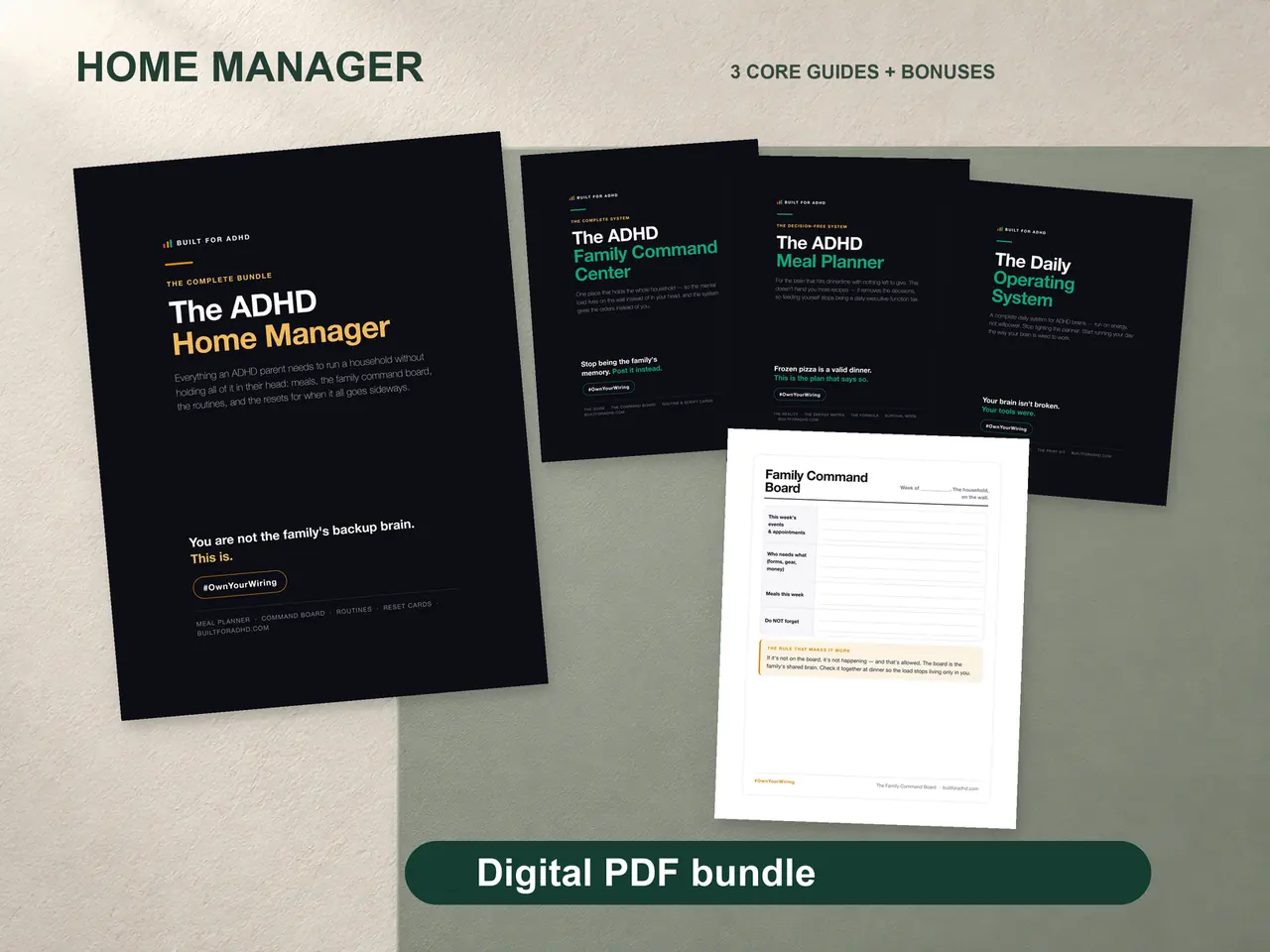
If you’d rather have the household side built for you, the ADHD Home Manager is where I’d point you. $47. Honest note: there is no laundry-specific worksheet inside it. What it has is the Family Command Center for giving recurring jobs owners and triggers, the Daily OS for your own day, and the Reset Cards for the weeks when the basket wins anyway. The three stations above are free, and you should try them either way.
Related tools
- ADHD household systems — the hub for the chores that never stay done
- The free parent starter set — a printable for the fridge, not your head
- ADHD doom piling — why the pile stays invisible until it’s urgent
- The ADHD chore split — who owns the noticing, not just the doing
- Body doubling for cleaning — borrowing company to start boring tasks
- Energy-based task management — matching chores to the tank you have