In this article
Two years ago I paid $44 in expedited shipping on a $30 gift, on December 22, for someone I had been meaning to buy for since the second week of November. I had thought about that gift probably forty separate times. Every one of those times I decided I needed a better idea than the one I had, closed the tab, and went back to whatever I was doing.
That is the whole failure, and the usual diagnosis of it is wrong. I was not disorganized, and I was not avoiding it out of dread. I was holding an open loop with no container and no visible deadline, re-opening it forty times, paying a little tax each time until the bill came due in overnight shipping and a gift nobody was thrilled about. (The year-round version of that tax is what the ADHD money management guide is for.)
Gift shopping is a near-perfect trap for an ADHD brain. The deadline is real but invisible until the week it becomes a wall. The task has no defined finish line, because “a good gift” is an open-ended search that can always be improved. And every single person on the list is a separate decision, which means a list of nine people is not one task. It is nine, and decision fatigue is a real budget that runs out long before the ninth one.
So the fix is not “start earlier” — that just re-opens the loop for six weeks instead of three. The fix is one page that closes it.
The page
Four columns. One row per person. That’s it.
Name · Number · Idea · By
Draw it on paper tonight, or make it a note on your phone if paper will get lost. Do not make it pretty, and do not spend the evening hunting for a template slightly better than the one you just drew. The page is the container. Everything below is how to fill the four columns in the right order — and the order matters more than anything else here, because doing it backwards is what ruins it.
Column one: the names, tonight, ten minutes
Write every person you are buying for. All of them. Including the ones you’ll think of on December 18 — the teacher, the neighbor who takes the bins in, whoever hosts the thing you go to.
Then cap it. Ask which of those are actual gifts and which are gestures — a card, a tin of something, a text saying you were thinking of them. Moving six names into the gesture column is not cheapness. It is the highest-leverage move on this page, because each of those names was a full decision you were going to spend energy on.
This column takes ten minutes and it is the only one that needs a clear head, so do it now rather than in December. November’s tank is already smaller than the calendar thinks it is, and December’s is worse.
Column two: the number, before any ideas
This is the step everyone skips, and skipping it is why gift shopping so often ends in a January statement you don’t want to look at.
Write a dollar amount next to each name before you have any idea what you’re buying. Then add the column up. If the total is a number that makes you flinch, cut it now, on paper, in a calm room — not at 11pm on a product page with your card already saved.
The number first converts an infinite search into a bounded one. “Something good for my brother” has no edges and no stopping rule. “Something good for my brother, $40” has both. You’ll be done in nine minutes instead of forty, and the nine-minute gift is usually just as good — a fact I resisted for years.
If looking at the running total is itself the thing you flinch from, that is its own well-documented pattern and it has a fix that is not willpower. The avoidance of looking at the number is almost always worse than the number.
Column three: the idea, with a default
Fill this in fast and allow yourself to be boring.
For every name, write one idea. If you have no idea after about thirty seconds, write your default instead. A default is one thing you are willing to give almost anyone: a good candle, a specific coffee, a gift card to the place they actually go, a nice pair of socks. Pick your default now, in advance, and then the thirty-second rule is survivable.
The default is the load-bearing part of this system. Without it, a blank row stays open and re-enters your head at 2am for six weeks. With it, no row can stall — worst case it gets the default, which is a real gift a real person will be happy with.
A rule I had to learn the expensive way: an idea in this column is final unless a better one arrives unprompted. Going back to improve a gift you already chose is the forty-tabs behavior wearing a productive costume. (the improvement is almost never worth the second search)
Column four: by when, worked backwards
Here is where the invisible deadline becomes visible.
For each row, write the date it has to be bought by — not the date you give it. Work backwards from the handover:
- Giving it in person on the 24th, shopping locally? Buy by the 20th.
- Shipping it to someone? Buy by the 12th, which is roughly the last comfortable week for standard shipping before carriers get ugly.
- Mailing it overseas or to a military address? That date is already in the rear-view by early December. Buy this week.
Then take the earliest date on the page and put that one date somewhere you will physically see it. One date, not nine. That is the actual deadline, and the reason this works is that the thing you could not see is now a number on a wall.
Late fees, missed windows, and expedited shipping are all the same tax in different clothes — the cost of a deadline that stayed invisible until it was urgent.
Buy in one block, not in tabs
Then put a single ninety-minute block on the calendar and buy the whole page in one sitting.
One block beats six weeks of browsing for a reason that has nothing to do with discipline. Browsing re-opens the loop every time, and each re-opening spends a decision you need for the rest of December. One block closes nine loops at once, in context, with the numbers already made.
Check off rows as you go, and leave the finished page where you can see it — the checked-off page is the dopamine, and it’s what you reuse next year.
What to let go of
The perfect gift. Nobody remembers the year you nailed it. They remember the year nothing came.
The handmade plan. If it’s November and it isn’t underway, it’s a C-list item, the same as the homemade rolls on the Thanksgiving cut list.
The idea that December has normal capacity. It doesn’t. Gift shopping is one line inside the whole-month load, not a project with its own fresh energy.
What to expect, honestly
You’ll still buy something late. Probably one row, probably the hardest person. The page doesn’t prevent that; it makes it one row instead of nine, and keeps the $44-shipping version off five gifts at once.
And next year this takes fifteen minutes, because the names are already written and you already know your default.
Do this today
One sheet. Four columns. Names tonight, numbers before ideas, a default picked in advance, and one date on the wall.
If you want the money side already drawn, the ADHD 48-hour rule tracker is the pause that keeps the “while I’m here” extras off the December statement, and the free adults starter is the one-page capture sheet to write the names on tonight.
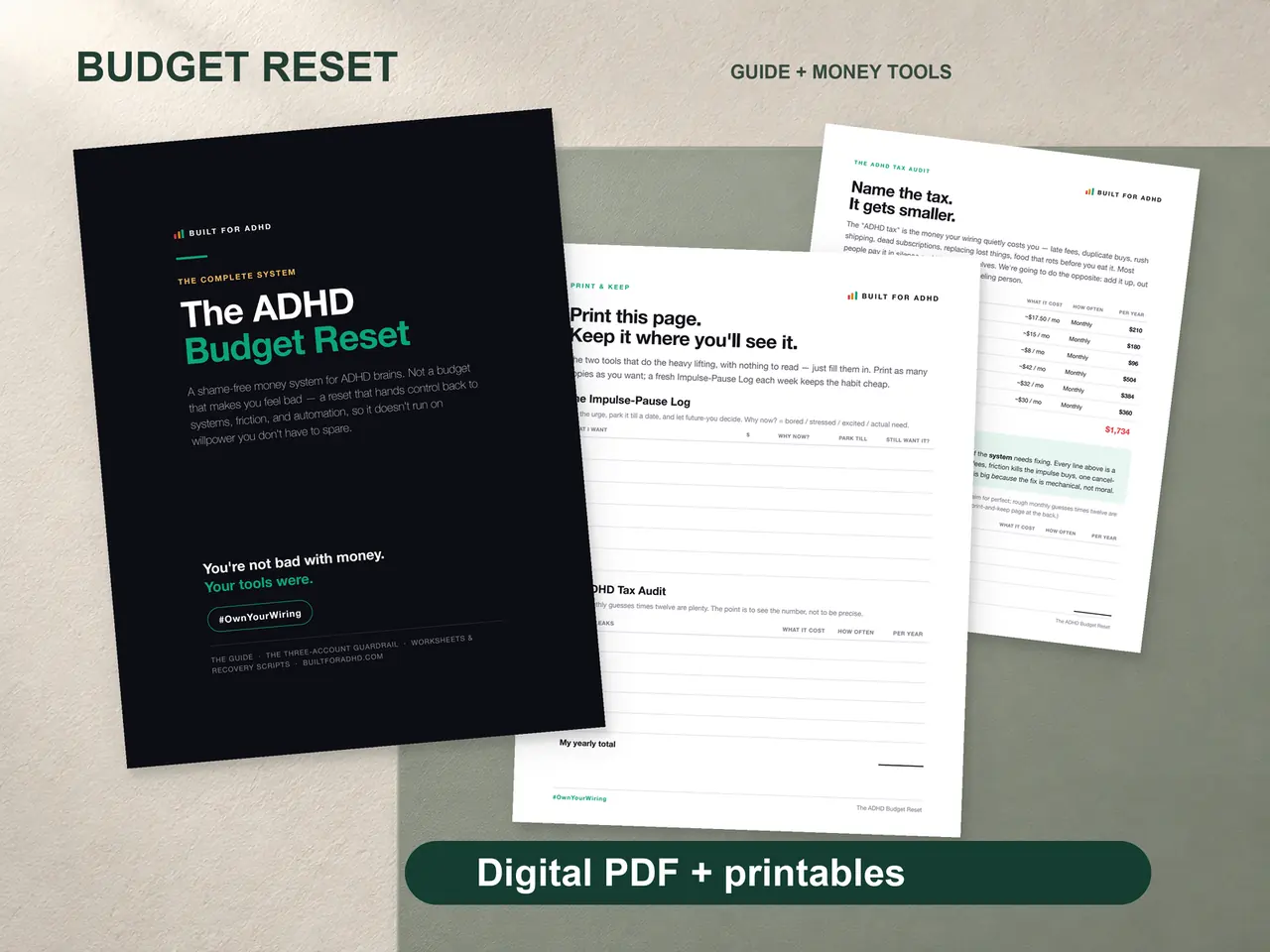
If the gift page shows you a total you’d rather not have seen, the broader fix is the ADHD Budget Reset, $7 — the ADHD tax audit, the three-account guardrail, named fun money, and the impulse-pause log. Honest note: there is no holiday worksheet in it. It’s the everyday money system that makes a December total survivable instead of a surprise. The four columns above are free and they work on paper.
Related tools
- The ADHD 48-hour rule tracker — the pause that keeps extras off the statement
- The free adults starter — a one-page capture sheet for tonight
- Holiday overwhelm in an ADHD family — the whole-December plan this sits inside
- ADHD Thanksgiving hosting — the same cut-list logic, one month earlier
- ADHD decision fatigue — why nine names is nine tasks
- ADHD money avoidance and the ostrich effect — when the number is the thing you’re avoiding
- The ADHD winter energy routine — the smaller tank this is planned against