In this article
There was a stretch last year where I did not open my banking app for nineteen days. I know it was nineteen because I counted afterward, the way you count things after they’re over and safe.
Nothing dramatic was happening. I had money coming in. I just didn’t know the number, and every day I didn’t know it, the number got heavier — until opening the app stopped being a two-second task and became A Thing I Would Deal With, which is the exact category where tasks go to die.
Then I opened it, on a Tuesday, for no particular reason. The balance was fine. Genuinely fine. Nineteen days of low-grade dread over a number that was fine.
That’s the part nobody tells you about money avoidance: the dread is almost never proportional to the number. It’s proportional to how long you’ve been away from it.
What you’re actually avoiding
You are not avoiding a balance. You are avoiding a verdict.
Somewhere along the line the number in that app stopped being information and became a score — a summary judgment on whether you’re a competent adult. And you already suspect the answer, because you know about the takeout, and the duplicate charge you never disputed, and the thing you bought at 11pm in a good mood. So the app isn’t a tool anymore. It’s a performance review you administer to yourself.
Nobody opens a performance review casually. Of course you’re not opening it.
The mechanism has a name outside ADHD circles — the ostrich effect, the habit of not looking at financial information precisely when it feels bad. It’s not an ADHD invention. But three things make our version worse, and each has a different fix.
Out of sight is genuinely out of mind. For most brains, an unchecked balance nags. For ours, it can vanish entirely for a week and then arrive all at once at 2am. There’s no steady background pressure building toward “I should look” — just silence, then flood. (The same object-permanence quirk that makes money invisible the second it’s in a savings account works in reverse here.)
Looking is a decision-loaded task, not a glance. Opening the app doesn’t cost you two seconds. It costs you two seconds plus every decision that comes attached — should I move that, should I cancel this, why is that pending. Your brain prices the task at the full cost of the aftermath, and it’s running on an already-overdrawn decision budget. So it declines.
The number arrives as evidence in an existing case. If some part of you already carries a file labeled I’m bad with money, a bad balance isn’t data. It’s a confirmation, and it lands hard enough that the sensible move is not to look. This is also why the gap compounds: each day away raises the stakes of the eventual look, which makes the next day’s avoidance more rational, not less.
What the gap actually costs
Every dollar this costs is spent on not knowing, not on overspending. Overdraft fees are charges for not knowing the balance. Late fees are charges for not knowing what was due. The subscription you’d have cancelled in March but caught in August is eleven months priced entirely in avoidance. Your budget could be perfect and every one of those still lands.
Which is good news, structurally. You don’t have to fix your relationship with money to stop the bleeding — you just have to shorten the gap between looks. That’s a much smaller problem, and unlike a budget, it’s one you can solve with a script.
The Five-Minute Look
The whole trick is to separate looking from fixing. They feel like one task. They are not, and welding them together is what made looking unaffordable.
So this protocol does one thing: it gets the numbers into your head and then makes you stop. No decisions, no transfers, nothing cancelled. You are taking a reading, not solving a problem.
1. Set a timer for five minutes. On your phone, before you open anything. The timer isn’t for productivity — it’s a promise about the ceiling. This will end, and that promise is most of what makes it possible to start.
2. Write down three numbers. Only three. Checking balance. Total on credit cards. What’s due before your next paycheck. On paper, or the same note every time. Writing them beats reading them, because a number you wrote is one you’ll actually remember on Thursday.
3. When something needs a decision, write it on the Later line. Not in your head — on the page, one line, no detail. Weird $60 charge. Card due Friday. That subscription. This is what makes the no-decisions rule survivable: your brain will only skip past an alarming thing if it’s confident the thing got recorded somewhere.
4. Close the app when the timer goes. Even mid-thought. Especially mid-thought. The looking is done and it took five minutes, which is the point you’re proving to yourself.
5. Do the Later line at a different time. Whenever you next have capacity for decisions. A balance check is a low-energy task; deciding things is not. Splitting them means neither waits for the other.
Five steps, five minutes, no verdict.
The two rules that keep it alive
Same day, same time, whatever the number says. Pick a low-stakes slot — mine is Wednesday morning, coffee already made, nothing else scheduled. Not Sunday night, when everything feels like an indictment. The day is fixed so the decision to look is never made fresh, and the number gets no vote in whether it happens again next week.
A look counts as done when it’s written, not when it’s resolved. This is the rule the whole thing stands on. If “done” means fixed, then a bad week means you failed the habit, and one failure is enough to send the whole practice back into the drawer. If done means written down, then a terrible balance and a great one are the same amount of success — you looked, you wrote three numbers, that’s the job. (This is the same reason a habit tracker has to survive a missed day to be worth keeping at all.)
Miss a week and you’ve broken nothing. There’s no streak to protect. You just do the next one.
The first look, when you’ve been away a while
If it’s been a month, the first look is the hard one, and I’m not going to pretend the script makes it painless. It makes it finite, which is different and enough.
Two adjustments. Give it ten minutes instead of five, because there’s more to read. And do it with something running in the background — music, a show, someone else in the room. Not to distract you. To keep the room from going quiet and serious, which is when the number starts sounding like a verdict again.
Expect a Later line with six things on it. That’s normal after a gap and it measures nothing except elapsed time. Do one of the six that day — the cheapest, fastest one. Leave the rest for the next look. Six problems written down are a different category than six carried around unnamed, and that difference is most of the relief.
Then set the next look for one week out, before you close the app. That one will be smaller. They all are, after the first.
Do this today
Open the app. Set the timer. Three numbers on a page, anything alarming on the Later line, close it when the timer goes.
If you want the three numbers to add up to something over time, the ADHD tax expense tracker is a place to put them where the pattern becomes visible — the fees and forgotten charges land in one column, and after a couple of months the total makes a better argument for weekly looks than I can.
I’m at about eleven months of Wednesday mornings now. The balance is sometimes bad. Twice this year it was genuinely alarming, and both times I knew within six days instead of six weeks — the entire difference between a problem and a crisis.
Nineteen days is the record and it’s staying the record. Not because I got disciplined about money. Because looking stopped being a verdict and became a chore, and chores I can do.
Related tools
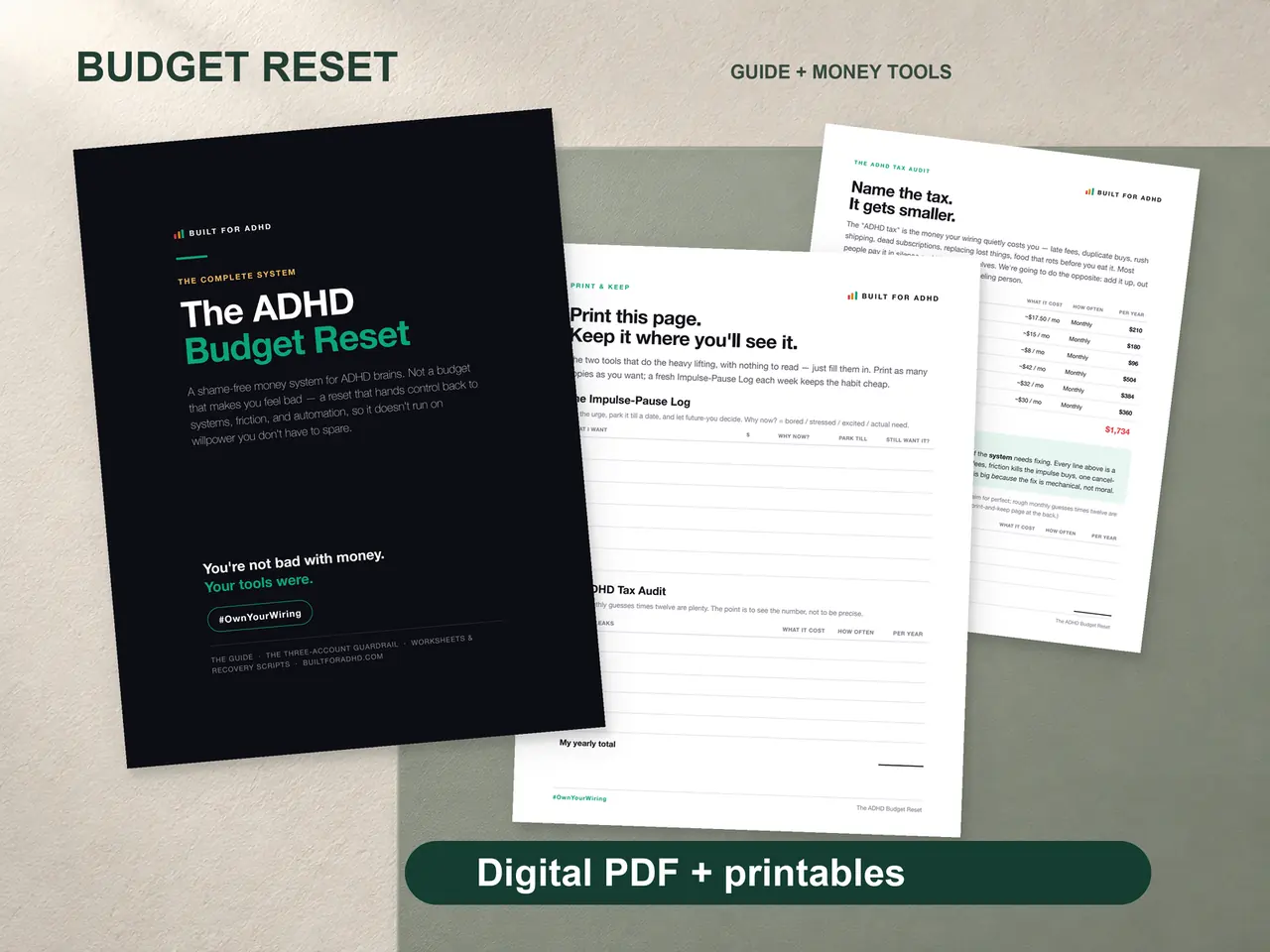
- ADHD Budget Reset — $7: the three-account setup and the ten-minute weekly money date
- What is the ADHD tax — what the not-knowing gap actually costs, itemized
- How to stop an ADHD debt spiral — when the avoidance loop has already compounded
- Why your savings account never sticks — the object-permanence problem running the other direction
- ADHD late fees and forgotten bills — the due-date half of the same gap
- How to budget with ADHD — what to do once looking is routine
- ADHD tax expense tracker — where the three numbers go
If the Later line keeps filling up faster than you can clear it, the ADHD Budget Reset is the next step — $7. Honest caveat: it won’t make you want to open the app. It’s a three-account setup plus a ten-minute weekly money date, which is the structure that makes the five-minute look boring, and boring is the goal.