In this article
Here’s the loop, in case you need to see it written down by someone who isn’t judging you:
You can’t face the bank app, so you don’t open it. Because you don’t open it, a payment slips. The payment slipping costs a late fee and a little interest. The fee makes the number worse, which makes the app harder to open. Repeat, monthly, until the balance is a monster under the bed you’ve never actually measured. (The way out is a system, and the rest of it lives in my ADHD money management guide.)
That’s a debt spiral, and the ADHD version has a specific shape: it runs on avoidance, not overspending. Plenty of people in this loop don’t even buy much. The debt grows in the dark, on autopay-less bills and late fees and subscriptions nobody remembers — the compound interest of the ADHD tax.
If that’s you: you are not bad with money. You have a brain that flinches away from shame-flavored information, wired into a banking system that delivers all its information shame-flavored. The way out is not “be braver.” It’s making the system need less bravery.
Why “just look at your accounts” doesn’t work
The standard advice assumes the looking is neutral. For an ADHD brain it isn’t — every glance at the balance is a hit of you did this, and brains do not voluntarily return to a stove that burns them. Add time blindness (the future where the debt matters isn’t emotionally real yet) and out-of-sight-is-out-of-mind (an unopened bill genuinely stops existing), and avoidance isn’t a character flaw. It’s the predictable output of the machine.
So every move below is designed around one principle: take your memory and your courage out of the loop. The system should run even on the weeks you can’t look at it.
The first four moves
1. One look, with a timer, to get the real number. Not a budgeting session — a reconnaissance mission. Fifteen minutes, timer on, write down three things per account: balance, minimum payment, due date. That’s it. You are allowed to feel nothing and fix nothing today. The monster under the bed is almost always a different size than the one in your head, and even when it’s worse, a measured monster is the first one you can fight.
2. Automate every minimum before you feel ready. This is the move that stops the bleeding. Autopay the minimum on everything, due dates moved to just after payday if the lender allows it (most do, and it’s a five-minute call). Minimums-on-autopilot means the spiral’s engine — missed payments breeding fees — shuts off even during your avoidance weeks. You’ve stopped digging. Everything after this is just climbing speed.
3. Pick the smallest debt and point everything at it. The math-optimal strategy is paying the highest interest rate first. The ADHD-optimal strategy is usually the smallest balance first — because your brain runs on visible wins, and a debt hitting zero in eight weeks is fuel in a way that 0.3% less interest never will be. One debt gets extra payments; everything else stays on minimums. One target, not seven. (This is the snowball method, and it wins for the same reason tiny first steps win: momentum is the resource, not efficiency.)
4. Find the leaks before you cut the joy. The instinct is to punish yourself — no coffee, no fun, monk mode. Skip it. Shame-based austerity is a streak, and you know what your brain does to streaks: one slip, total collapse, worse than before. Run the audit instead: subscriptions you forgot, fees you’re paying for mistiming, impulse patterns with a cheaper off-ramp. Most ADHD budgets leak more through the tax than through the treats — and canceling a forgotten $14.99 doesn’t cost you a single drop of willpower. Fun money gets its own small envelope, on purpose, because a plan with zero joy in it is a plan you’ll abandon by the 12th.
The restart rule
You will fall off this. A card will get swiped in a bad week; an avoidance month will happen. The rule that makes this system different from every one you’ve tried: a slip costs the slip, and nothing else. No “I ruined it, why bother.” The autopay kept running while you were gone — that’s the whole point of move 2. You reopen the list, you point at the target again, zero shame, and the spiral stays broken because the system never depended on your streak in the first place.
Where this system lives
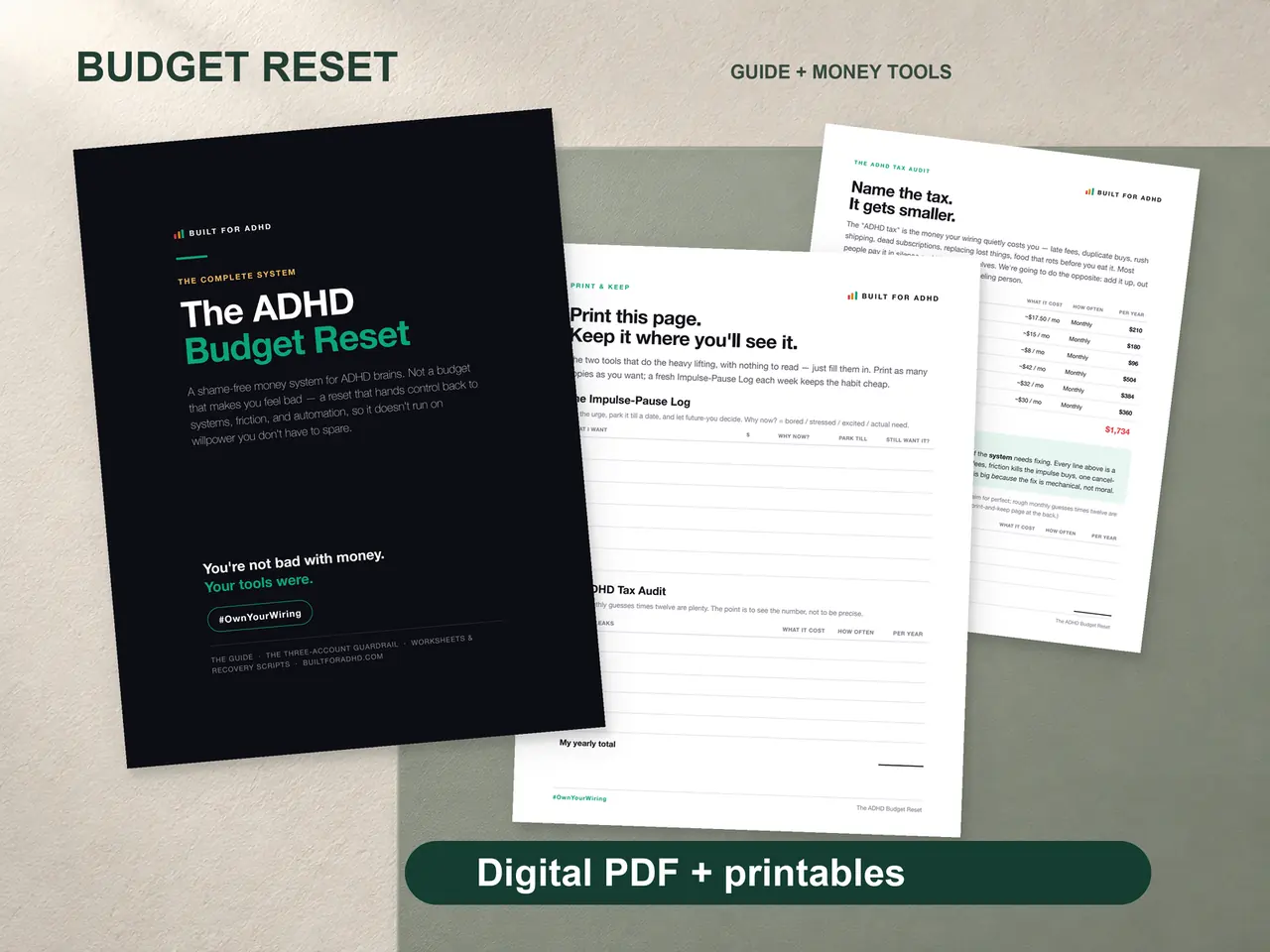
The measured version of all four moves — the ADHD Tax Audit, the impulse pause, the envelopes, the one-page debt target — is the ADHD Budget Reset: a $7 printable workbook with the shame surgically removed. It’s the first money tool built for the brain that flinches. (When you’re ready for the bigger machine — daily system, sleep, and money in one — it grows into the ADHD Life System for $37.)
If $7 is a decision you don’t want to make today, start with the free move: the debt payoff template guide walks the smallest-first setup at no cost.
Related tools
- ADHD Budget Reset — $7: the audit, the pause, the envelopes
- What is the ADHD tax? — the leak underneath most ADHD debt
- Late fees and forgotten bills — the autopay fix, in detail
- ADHD debt payoff template — the free smallest-first walkthrough