In this article
Somewhere in your bank statement right now is a monthly charge for something you do not use. You know it’s there. You’ve seen it — you noticed it two statements ago, said “I need to cancel that,” felt briefly responsible, and moved on with your day.
It billed again this morning.
Maybe it’s the meditation app from the January version of you. The streaming service you kept for one show that ended. The premium tier of something whose free tier you wouldn’t even miss. Individually they’re small. Together, quietly, they’re one of the biggest lines in the ADHD tax — and the reason they survive isn’t laziness. It’s that canceling a subscription is the single most perfectly anti-ADHD task ever designed. (The system that beats it comes from the same playbook as the rest of ADHD money management and the ADHD Budget Reset — externalize, automate, stop relying on memory.)
Why your brain will never “get around to it”
Look at what canceling actually requires, through the lens of how ADHD initiation works:
It has no deadline. Nothing happens if you don’t do it today. Or this month. ADHD brains run on urgency — a task with no due date lives permanently in not now, and not now auto-renews right along with the subscription.
It’s boring with extra steps. Find the login. Reset the password you don’t have. Navigate to Settings → Billing → Manage → a cancel button the designer was paid to hide. Every step is friction, and friction is where task initiation goes to die.
The cost is invisible at the moment of decision. You never hand over the $12.99. It leaves silently, at 3 AM, without asking. There’s no purchase moment for your brain to flinch at — which means no dopamine event, no pain signal, nothing to react to. The charge is designed to be unfelt, and your brain specializes in not feeling unfelt things.
Noticing isn’t remembering. This is the cruelest mechanic. You see the charge, you form the intention, and the intention evaporates the moment your attention moves — the same working-memory eviction that loses your keys loses “cancel Hulu” just as cleanly. You can notice the same zombie charge six months in a row. Ask anyone with ADHD. They’ll name the subscription without checking.
Subscription businesses know all of this. Auto-renewal is a bet that canceling requires more executive function than staying subscribed — and against an ADHD brain, that bet pays every single month. This isn’t a moral failing on your part. It’s a business model aimed at your wiring.
The sweep: one sitting, everything dies at once
The fix is not “be more diligent about reviewing charges.” Monthly diligence is a recurring task, recurring tasks need initiation, and initiation is the broken step. The fix is a single event — do it once, while the energy is there, and let structure handle the future.
1. Corner them all
Open the last three months of bank and card statements. Yes, even the account you avoid — dread washes off faster when the number is in front of you. Write down every recurring charge: name, amount, date it bills. Phone app-store subscriptions too — that list alone is usually worth the whole exercise. Fifteen minutes, one page.
2. Sort with the three-question test
For each one: Did I use it in the last 30 days? Would I sign up again today at this price? Does canceling scare me for a real reason? Two or three noes — it goes on the kill list. No agonizing; the 60-second version of this decision is as accurate as the 20-minute version and costs 19 fewer minutes.
3. Kill them in the same sitting
This is the rule that makes it work: the sweep and the executions happen in one session. The moment “cancel these five” becomes a separate task for later, it inherits every no-deadline, multi-step property that created the zombies. Login walls, retention screens, “are you sure” guilt pages — push through while momentum exists. Twenty minutes of tedium, once.
4. Make the survivors visible
The keepers get written on one page — name, amount, renewal date — posted where money decisions happen. That’s the anti-3AM move: charges that were designed to be invisible become a list you can see. Next January-you can add to it; the page does the remembering.
5. Dodge the re-accumulation
New subscriptions will happen — that’s fine, some are great. Two habits keep the graveyard from refilling: free trials get canceled the day you start them (you keep access to the end anyway, and future-you is not a reliable narrator about remembering), and anything new goes on the visible page the day it starts.
This is one drawer of a bigger cleanup
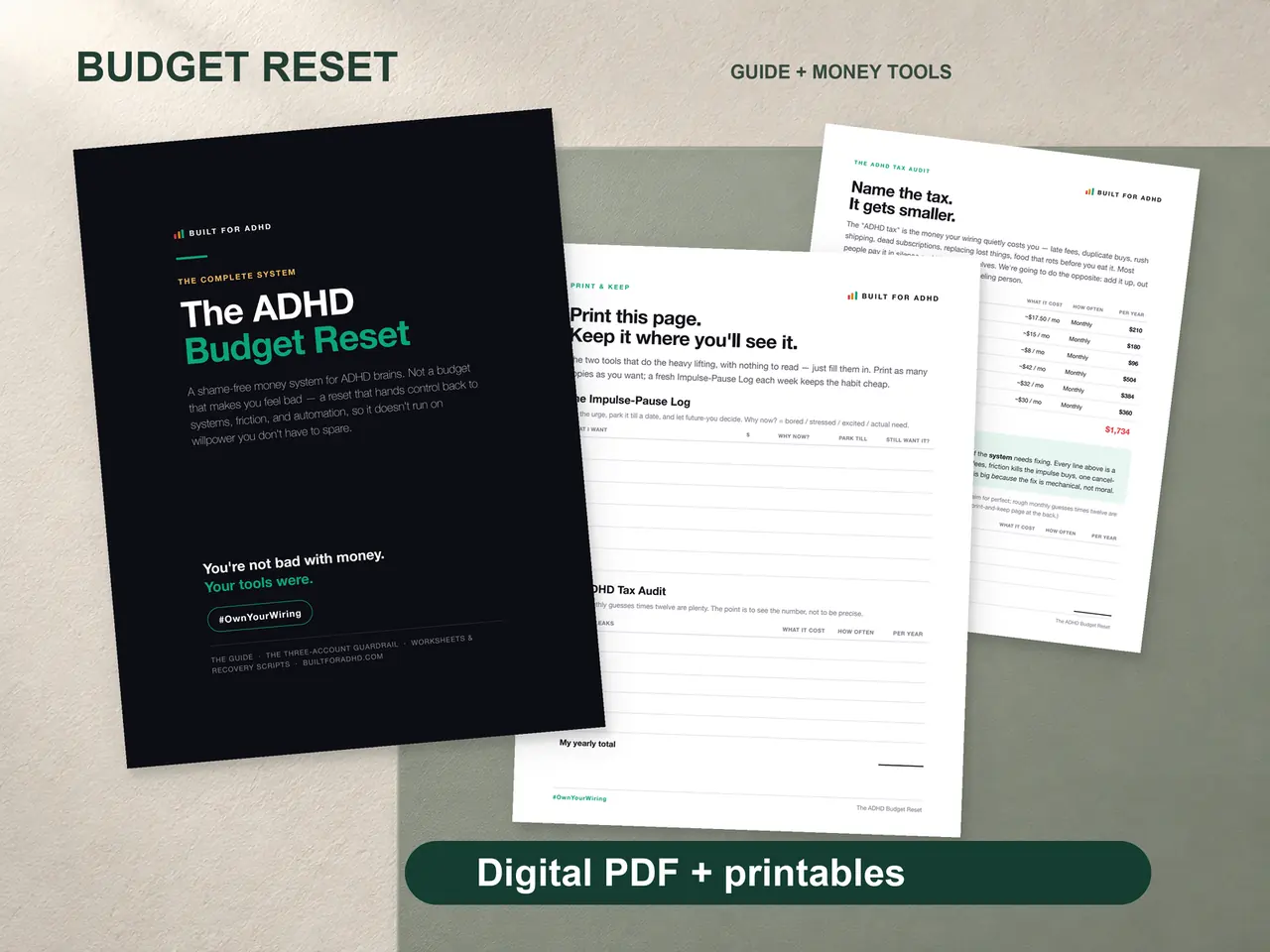
The sweep handles subscriptions. The same audit energy, pointed at late fees, impulse charges, and the rest of the leak map, is the ADHD Tax Audit — the centerpiece of the ADHD Budget Reset, a $7 printable workbook that also gives you the impulse-pause log and fun-money envelopes so the fix holds without willpower. It’s the cheapest thing on the site because it’s the one that pays for itself before you finish the first pass.
And if opening the statements is the wall itself — if money-dread is one thread in a much bigger tangle — start further upstream: dump the whole swirl onto a page first. Tasks stop being terrifying once they’re ink instead of static.
Related tools
- ADHD Budget Reset — $7: the Tax Audit, the pause log, the envelopes
- What is the ADHD tax? — the full map of where the money leaks
- The 24-hour impulse buy rule — the front-door version of this fix
- The free ADHD Brain Dump sheet — for when the dread is bigger than the statements