In this article
The first year I hosted, I had the whole thing in my head and I was genuinely proud of that. I knew the turkey timing. I knew what went in which oven and when. I had it.
At 1:40 that afternoon I was standing in the kitchen holding a bag of potatoes, unable to remember whether I had started them, while someone asked me where the extra chairs were and the oven timer went off for something I could not identify. I had not done anything wrong. I had just tried to run a forty-decision day out of working memory, in front of an audience, on three hours of sleep. (The everyday version of that problem, the family calendar living in one person’s head, is what the ADHD command center guide is for.)
That is the actual shape of the problem, and it’s worth naming correctly because it changes the fix. Hosting Thanksgiving is not a cooking challenge. It’s a scheduling and sequencing challenge wearing a cooking costume, and sequencing under pressure while people talk to you is close to the worst possible task to hand an ADHD brain.
So the plan below is three pages, written before the week, and the whole point is that on the day itself you are reading, not deciding.
Page one: the cut list
Do this one now, weeks out, because it’s the only page that requires a clear head.
Write down everything you are picturing for the day. Every dish, every piece of the house, every nice touch. Then put a letter next to each line:
A — the day fails without it. Honestly. Not “it’s tradition,” but this is why people came. B — real, but it survives being bought instead of made, or done at half size. C — you added it because you pictured a version of the day that nobody else is picturing.
Then cut every C, and buy every B you can.
The C list is where the day actually goes wrong. Mine, that first year, included homemade rolls and a cleaned-out garage. Nobody came for the rolls. Nobody opened the garage. Those two lines cost me four hours and most of the morning’s patience, and I spent them because the picture in my head had them in it.
Cap your A list at six lines. If you have nine, three of them are Bs and you’re negotiating with yourself about which — which is a thing you should do now, on paper, instead of at 1:40 in the afternoon with potatoes in your hand.
The buying is not a compromise. Decision fatigue is a real budget and it runs out — every dish you make from scratch spends from the same account as “where do the chairs go.” A store pie protects the part of the day you actually care about.
Page two: the run of show, built backwards
This is the page that does the work, and the only trick is the direction.
Write dinner time at the bottom of a sheet. Then work up the page, placing each A and B item at the hour it has to start in order to land there. Not the hour you’d like to start it — the hour it must.
It looks like this:
- 4:00 — eat
- 3:30 — carve, reheat sides, drinks out
- 3:00 — turkey out, rest (this hour is not optional and it is the one people steal from)
- 12:30 — sides in
- 11:00 — turkey in
- 10:00 — turkey prepped, out of the fridge
- 9:00 — counters cleared, oven empty, dishwasher empty
- 8:00 — coffee, nothing else
Two rules make this survivable.
One oven slot per hour block. The classic hosting collapse is four dishes that all need 375 at the same time, discovered at noon. Writing it backwards surfaces the collision while you can still move something to the stovetop or the slow cooker.
Leave two blank hours in the middle. Not buffer in the abstract — two literally empty rows on the page. Something will take ninety minutes longer than it should. If the page is full, that failure cascades through the whole afternoon. If there are two empty rows, it just uses one.
Print this and tape it inside a cabinet door at eye level, where you will be standing anyway. Not on your phone. The whole reason a printed page beats a reminder is that it can’t get buried under seventeen other things, and a cabinet door is already in the path of your hands.
Page three: the hand-off sheet
The third page is a list of jobs with a name next to each one, written before anyone arrives.
This exists because of a specific failure. When someone says “what can I do?” at 2pm, answering that question is itself a task — you have to scan the entire day, find something separable, and explain it, all while tracking four other things. So the honest answer that comes out is “nothing, I’ve got it,” and then you do have it, all of it, by yourself, resentfully.
Write the list in advance instead. Ice and drinks. Chairs and the table. The thing that needs stirring for twenty minutes. Taking coats. Keeping kids out of the kitchen between 2 and 3. Dishes after.
Then put a name on each line before the day. Not a volunteer sign-up — an assignment you made in a calm room. When they ask, you point at the page.
If you are the one who always hosts, this page is also the clearest evidence you’ll ever have of what you’ve been absorbing invisibly. The mental load doesn’t show up in anyone else’s view of the day until it’s written down, and a sheet with eight jobs and one name on all of them is a conversation starter.
What to let go of entirely
The deep clean. Guests see the entry, the main room, and the bathroom. That’s it. Do those three and close the door on the rest — the room-by-room version is a January job, not a Thanksgiving-morning job.
Hosting on a short night. Everything above gets harder on no sleep and the day is long. Going to bed is part of the prep.
The idea that November has normal capacity. It doesn’t. The tank is smaller this month and the calendar hasn’t noticed, which is exactly why the cut list goes first.
What to expect, honestly
Something will still go wrong. A dish will be cold, or late, or forgotten in the microwave until Friday. The plan doesn’t prevent that — it keeps one thing going wrong from taking the other six with it, because the other six are written down and not living in your head.
And the pages are reusable. Next year you edit page two instead of rebuilding it, which is the real compounding win. Sorting the day by what it actually costs you rather than by what seems urgent is the same frame underneath, just applied to one very loud Thursday.
Do this today
One sheet, three sections. Cut list with letters. Dinner time at the bottom of page two and work up. Eight jobs with names on page three.
Fifteen minutes, weeks early, and the day stops living in working memory.
If you want the hosting-day version already drawn, the ADHD birthday party planner is the same backwards run of show for a different event, and the free parents starter is the one-page version you can fill in tonight.
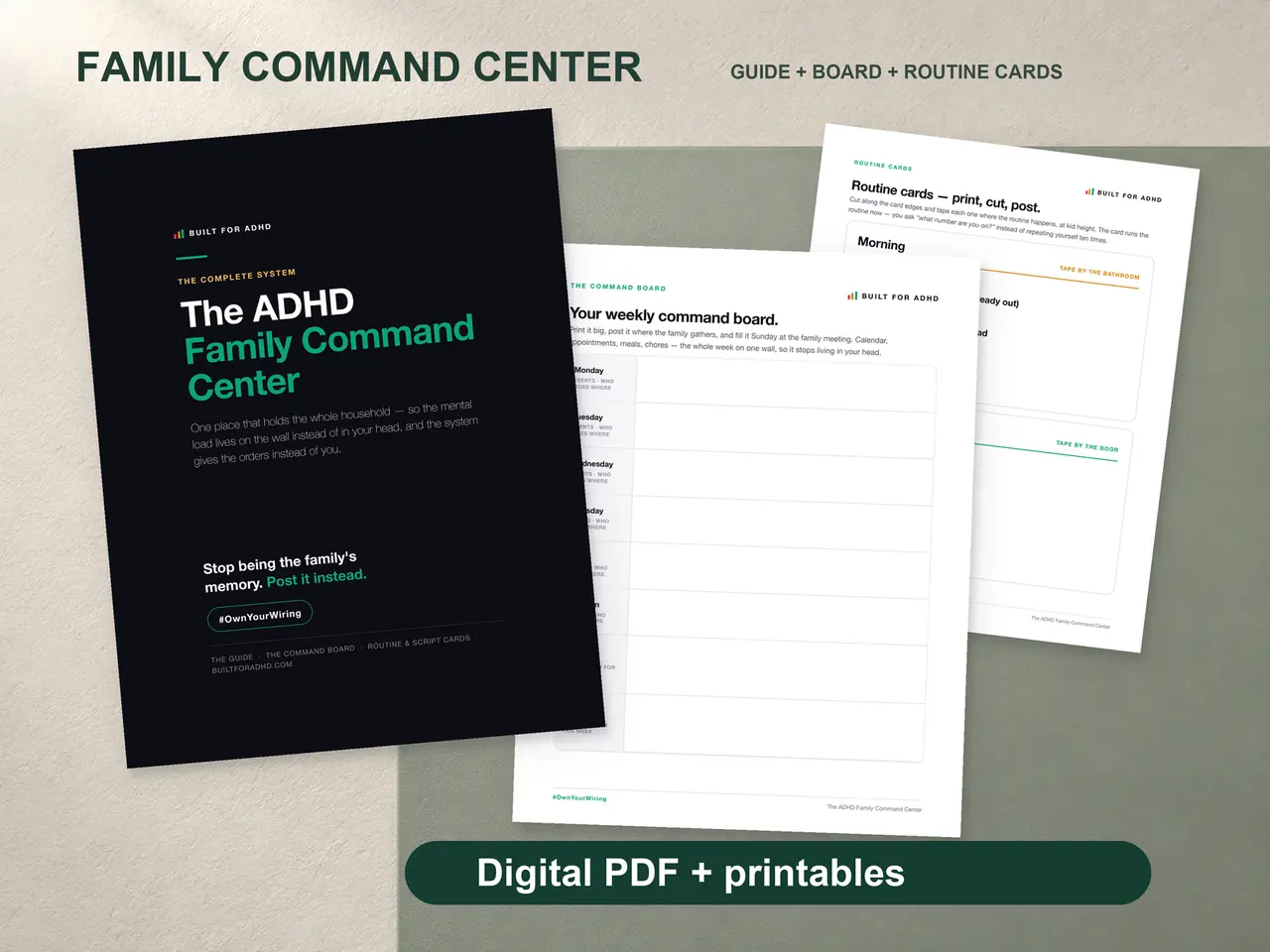
If you’d rather not draw the board yourself — the one-page command board, a worked example of a real family week, the routine cards for the chaos points, and the nag-free scripts for getting help without a fight — that’s the ADHD Family Command Center, $19. Honest note: there is no Thanksgiving worksheet in it. It’s the everyday family board, which is the thing a hosting day is a hard week of. The three pages above are free and they work on paper.
Related tools
- The ADHD birthday party planner — the same backwards run of show, for a party
- The free parents starter — a one-page version for tonight
- Holiday overwhelm in an ADHD family — the whole-December plan this one sits inside
- ADHD decision fatigue — why the cut list comes first
- The mental load and the default parent — what page three makes visible
- The ADHD winter energy routine — the smaller November tank this is planned against