In this article
The question that finally landed was not about a chore.
It was: do you know when the car inspection is due? And I did not. Not approximately, not what month, not whether it had already lapsed. Somebody in this house knew. It was not me, it had never once been me, and I had been walking around feeling like a reasonably contributing adult the entire time.
I had been measuring my contribution in tasks completed. The actual load was somewhere else.
The default parent is not the one doing more
The phrase gets used as though it means “does more chores.” It doesn’t — and that misread is why so many households reach for a chore chart and get nowhere.
The default parent is the person whose head the household runs out of: the one who knows the shoe size, the dentist’s cancellation policy, when the registration lapses, what is left in the freezer, which form was due Friday. They are the fallback for every question nobody wrote down. Everything routes to them not because they volunteered, but because they are the only copy.
And here is the part that matters if you have ADHD: that load is not work, it is holding — a background process that never terminates, and exactly the kind of thing an ADHD brain cannot do and will not notice it isn’t doing.
So two things are true at once. I am not the default parent, and that is not personality — working memory that drops a verbal request in nine seconds is structurally disqualified from being anyone’s backup copy. And the person who is the default was carrying something I could not see, because the job is invisible when it’s going well.
This is not the chore conversation — who owns which domain is separate and more solvable. It isn’t the reminder loop either, where one of you became the other’s alarm clock. This is the layer under both: who is required to know.
The inventory, which is the actual artifact
You cannot redistribute something you’ve never looked at. So before any conversation, one of you writes a list — and the prompt is deliberately not “what do you do.” It’s:
What does this household know that exactly one person knows?
Five categories, ten minutes. Items, not feelings.
Dates and deadlines. Renewals, inspections, enrollment windows, picture day, the thing to be mailed by the fifteenth — anything with a calendar consequence living in one skull.
Sizes and specifics. Shoe sizes, the allergy, the brand of the one cereal that gets eaten, the login for the school portal.
Relationships and context. Which teacher to email about what. Which neighbor has the spare key. The social situation in progress that decides whether a sleepover is a good idea.
Supply state. What is running out — not a shopping list, the running awareness that produces shopping lists.
Decisions-in-flight. Whether to switch dentists, whether to sign up for the thing, what to do about camp. Each takes up space whether or not you’re working on it.
When I did this the list ran to about forty items and I could account for four. That number is unflattering, and it’s the most useful thing I got out of it — it turned an argument about effort into a list of facts.
Transfer the knowing, not the doing
Here is the move that makes this different from every “help out more” conversation.
The instinct is to take tasks. Take tasks and nothing structural changes — the default parent still has to know the task exists in order to hand it to you, so they are still the only copy, and now they’re managing you on top of it. You added a step to their job and called it help.
What has to move is the knowing. Which means it moves to a surface, not a person.
Every item on that inventory gets written down somewhere both of you can read. Not in an app one of you opens — a surface. A page on the fridge, a board on the wall, a printed sheet in a drawer everyone opens. The test is whether the other adult in the house can answer the inspection question without asking a human being.
Ownership follows the write-down, not the other way around. Once the dentist’s number and cancellation policy exist on paper, “you own dentist appointments” is a real sentence. Before that it’s a wish.
Maintaining the surface belongs to the person who wasn’t carrying it. That’s the whole deal. If the default parent is also keeping the board current, you gave them a new chore and renamed nothing.
It is slower than taking the laundry, and it’s the only version that reduces what the other person is holding rather than just what they’re doing. The weekly system that survives the chaos is the same principle on a seven-day loop, and the back-to-school checklist is where I’d start, because September generates more single-copy knowledge than the rest of the year combined.
The three sentences
Scripts, because this conversation goes badly when improvised and it goes badly in a specific direction: toward a tally of who does more.
To open it: “I want to write down everything you’re the only one who knows. Not to take it over yet — just so it exists somewhere that isn’t your head.”
No defending, no comparing, no claim that you’re about to fix it. You are offering to make the invisible thing visible — a smaller promise, and the only one you can keep on day one.
When the list lands and it’s long: “I didn’t know about most of this. I’m not going to pretend I did.”
Resist the explanation. The urge to narrate why you didn’t know turns a shared document into a referendum on your character — which is how a neutral fact lands when rejection sensitivity is in the room.
To close it: “I’ll keep the board current. Tell me when I’ve let it go stale.”
That last clause is the honest term of the deal. You will let it go stale, and explicit permission to say so is cheaper than the alternative: them quietly resuming the job.
Where this breaks
The list becomes a weapon. Forty items and four accounted for is a fact, not a verdict. If the inventory becomes the evidence file for an argument you were already having, stop and have the argument instead.
You write it down and nothing changes. Knowledge on a wall nobody consults is decor. The surface has to be what you check before asking a person, every time, until asking stops being the reflex.
The surface decays in week three. It will. Staleness is the failure mode, not refusal, and the fix is a standing ten-minute pass each week, not a heroic rebuild each quarter. This is how parent burnout compounds — not one dropped thing, but going back to being the only copy after briefly not being.
The honest limit: in my house the kid half of this is still hypothetical. Being the adult whose partner was holding forty things alone is not. The load is the same shape at any household size, and so is the fix.
What working looks like
Not an even split. Probably never one.
What changed is that a question with a factual answer now has somewhere to be answered that isn’t a person. She can be out of the house and the inspection date still exists. That’s the whole win, and it’s the first time what she was carrying got lighter rather than just differently distributed.
Start the inventory tonight, and make it the other person’s list of what they know — ten minutes, five categories, items only. The free parent starter set has the wall surface I’d put it on, and the household systems hub has the rest of the recurring-load pieces.
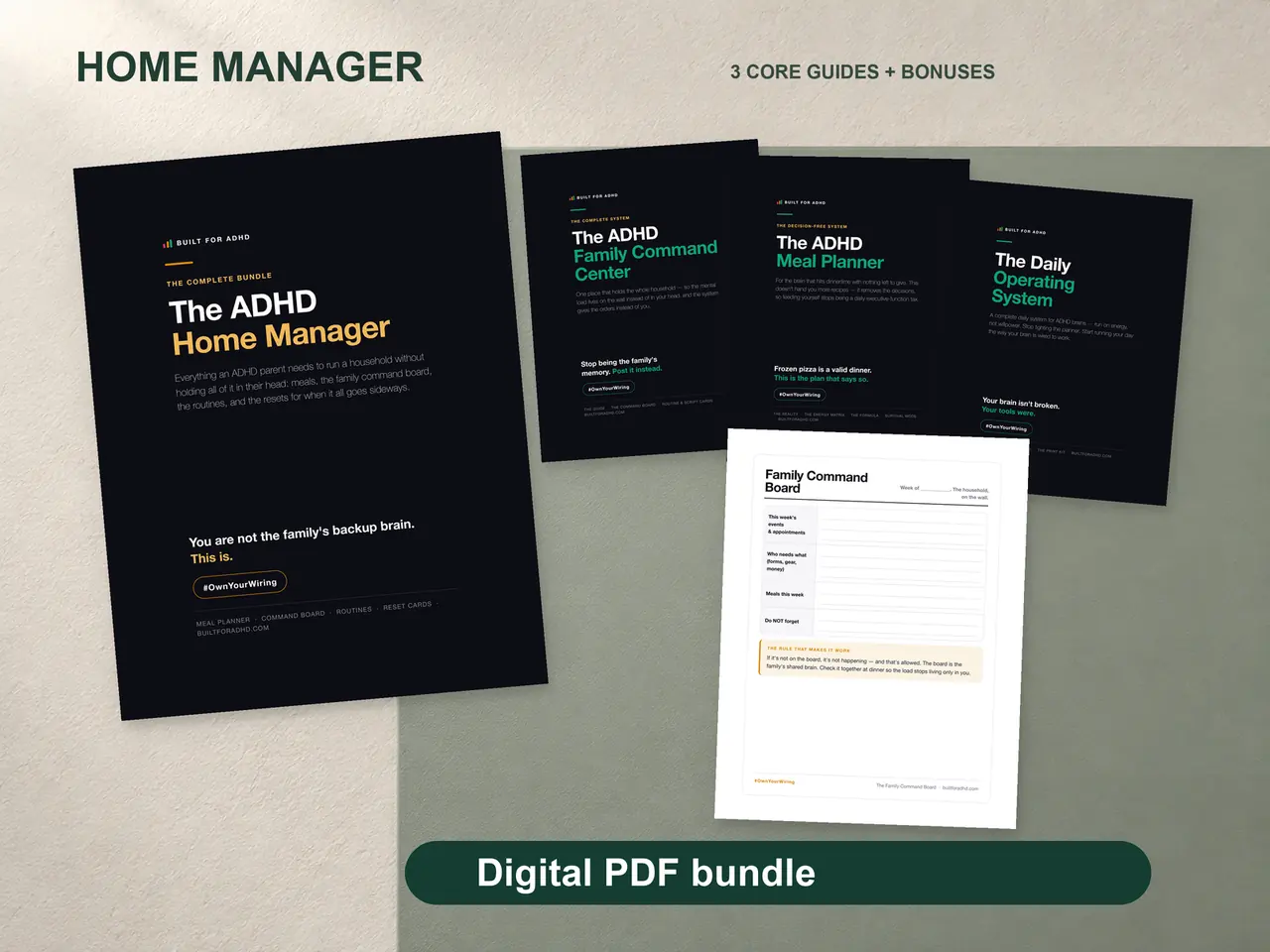
If you want the built version — the Family Command Board this lives on, the weekly pass that keeps it from going stale, plus the meal and daily-planning pieces that feed the same wall — that’s the ADHD Home Manager, $47. Honest note: it’s parent-shaped, so if there are no kids in your mix a chunk of it won’t apply. The five categories and the transfer rule above are free, and they’re the part that actually moves the load.
Related tools
- The free parent starter set — the visible surface this inventory goes on
- ADHD household systems — the hub for load that never stays done
- The ADHD chore split — dividing the doing, once the knowing has moved
- The ADHD nagging cycle — for when one of you has become the reminder system
- Forgetting what your partner asked — the capture rule for one-off asks
- ADHD parent burnout — what being the only copy costs over years
- The weekly planning system — the seven-day pass that keeps the surface current
- Back-to-school checklist — the single biggest generator of single-copy knowledge