In this article
Every August, the same trap. You print the supply list, buy the folders, label the water bottle — and feel prepared. Then the first real school morning arrives and the actual back-to-school problems show up: nobody can find shoes, breakfast is a standoff, the permission slip is somewhere, and you’re doing 7:40 AM crisis management with a kid whose brain does not do transitions and a parent brain (hi) that’s running on the same wiring.
Here’s the reframe: school supplies are 10% of back-to-school. The other 90% is four daily systems — the morning launch, the after-school landing, homework, and bedtime — and summer quietly dismantled all four. The families who have a smooth September aren’t more disciplined. They rebuilt the systems in August, while the stakes were still zero.
This is the checklist for that. Print it, do one section per week, and skip anything that already works.
Week 1: The morning launch (the big one)
Mornings fail at the search-and-decide steps, so delete them the night before:
- Build the launch pad. One spot by the door — hooks or a bin per kid. Backpack, shoes, jacket. The rule that makes it work: things live there the moment they come off, not in a nightly roundup. The morning search party ends because nothing was ever “put down somewhere” — it was landed.
- Clothes decided the night before. Including socks (the sock hunt has ruined more mornings than the alarm clock). For younger kids, a five-slot hanging organizer loaded on Sunday kills five decisions a week.
- Post the morning sequence on the wall — five steps, pictures for pre-readers, kid height. Then your job changes from engine to referee: not “brush your teeth!” ten times, but “what number are you on?” once. (The full version of this trick is in the school morning routine guide.)
- Practice it once before day one. A Thursday dry run in week 3 of August — wake, dress, launch pad, out the door, get donuts. It sounds silly. It converts the first school morning from a cold start into a rerun.
Week 2: The after-school landing
The 3-7 PM stretch is where ADHD families lose the year. School spent every drop of your kid’s regulation budget; they walk in the door empty. The fix is a landing sequence, not a lecture:
- Bag and shoes hit the launch pad (same spot, closing the morning loop).
- The folder dump happens at the landing, not at 9 PM. Every paper out of the backpack into one wall pocket — permission slips, homework, the crumpled newsletter. This one habit ends the “it was due today?!” genre entirely. (Pair it with a parent-teacher tracker if communication slips are a pattern.)
- Snack and movement before any demand. Twenty minutes of decompression isn’t a reward for good behavior — it’s the refill that makes the rest of the evening possible.
- Full sequence with the why behind each step: the after-school routine template.
Week 3: Homework without the war
- Same time-slot, same spot, every day — not “when you feel ready,” which for an ADHD brain means never. After the decompression window, before screens. The order is the rule; the clock can flex.
- Timer on, expectations small. Ten focused minutes beats forty minutes of supervised suffering. Start with the easiest item on the page — momentum is the resource, not efficiency.
- A homework caddy (pencils, sharpener, calculator) that lives at the spot — because “I need to find a pencil” is a fifteen-minute derail wearing a two-second costume.
- Bigger structure for bigger kids: the homework routine template.
Week 4: Bedtime, moved earlier
Summer bedtime drifted an hour late — that’s not a moral failing, it’s July. But an ADHD kid running a school schedule on a summer sleep debt is a meltdown subscription. Two weeks before day one, walk bedtime back 15 minutes every few nights, and rebuild the wind-down as a posted sequence with a landing at the end — the book, the snuggle, tomorrow’s one fun thing said out loud. The full system (and why routines die in week two without it) is in the ADHD bedtime routine guide.
The part nobody puts on the checklist: you
The whole September machine usually runs on one parent’s working memory — yours. Every system above is really one move repeated: get it out of your head and onto a wall. The launch pad, the folder pocket, the posted sequences, the family calendar where school events land the day the newsletter arrives — that’s a command center, and it’s the difference between running the school year and being run by it. (Here’s the full setup if you’re building from scratch.)
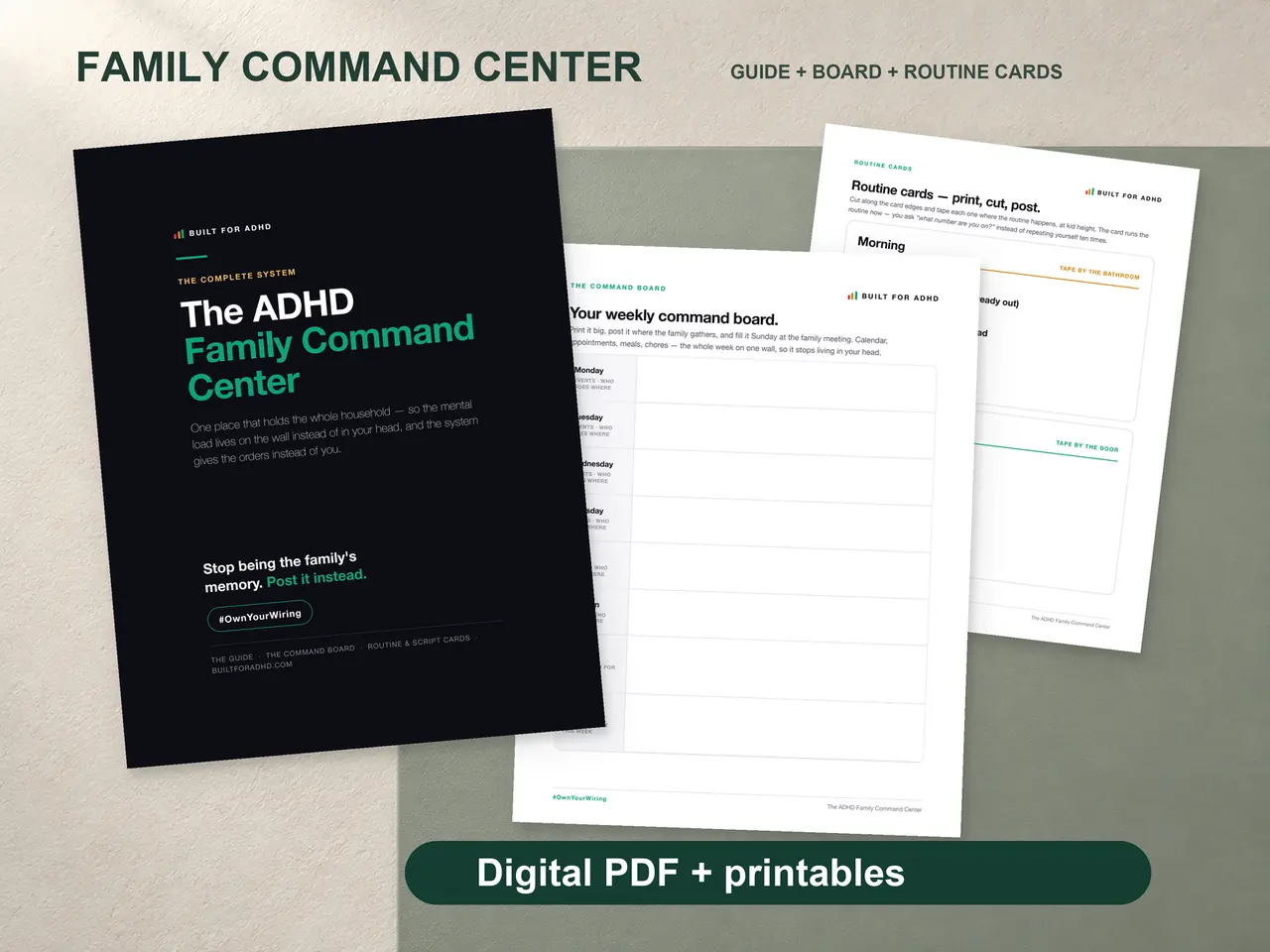
The done-for-you version is the ADHD Family Command Center: the command board, the launch pad setup, printable routine cards (morning, after-school, bedtime), and the nag-free scripts — $19 once, printed tonight, on the wall before the first bell. Or start free: the parents’ starter kit has the first routine pieces, and August is exactly when to hang them.
Related tools
- Free ADHD parents’ starter kit — first routine pieces, printable tonight
- ADHD Family Command Center — $19: the board, the cards, the scripts
- ADHD back-to-school planner — the planning template, in depth
- ADHD bedtime routine for kids — week 4, expanded