In this article
For about two years my bedroom was the room I entered with my eyes half closed, and that was not an accident. (it is easier to not see a floor than to clear one.)
The rest of the apartment was fine. People came over. The bedroom was where everything went that I had decided not to decide about — a chair that had not been sat in since spring, a floor with a path through it, a nightstand holding four glasses and a charging cable for a device I no longer owned.
Here’s what I got wrong: I thought the room reflected how tired I was. It was the other way around. The room was making the landing harder every night, and I was reading that difficulty as my own failure to wind down.
Why the bedroom is the last room to get fixed
Nobody is ever going to see it. Every other room has a guest trigger. The kitchen gets reset because someone might stand in it; the living room gets reset because someone might sit down. The bedroom has no audience at all, which means it has no deadline, which means it never gets a turn. It’s the same doom-pile mechanism with the lights off.
You only arrive there with nothing left. This is the one that matters. You walk in at the end of the day, at the exact moment your tank is emptiest, and the job waiting is a hundred small sorting decisions. The room can only ever be fixed at the hour you are least able to fix it. Of course it loses.
The bed is the best surface in the house. It’s big, it’s flat, it’s waist-height, and it’s right there. Clean laundry lands on it. The bag lands on it. Anything that needs a home and doesn’t have one lands on it — and then at bedtime you move the pile somewhere else, which is the laundry-never-gets-put-away loop in a smaller box.
None of that is a willpower problem. It’s three mechanisms stacked, and you can take them apart one at a time.
The four-surface reset
“Clean your room” fails because it has no finish line, and a job with a fuzzy finish line is one an ADHD brain will not start. So this names four surfaces, in order, and done means done.
Surface 1: The bed
Clear it completely, then make it — loosely. Pull the duvet up, straighten the pillow, walk away. You are not doing hospital corners.
Two minutes, and it’s first on purpose: the bed is the biggest visual block in the room, so clearing it changes how the whole space reads before you’ve touched anything else. Visible wins are the fuel for the next three surfaces.
Surface 2: The floor path
Not the floor. The path — the line from the door to the bed to wherever you stand to get dressed. Everything on that line goes into one of three places: the hamper, the trash, or out the door in your hand.
Narrowing it to the path is the whole trick. “Clear the floor” is unbounded and you’ll stall in the middle of it. The path is a line you can see, and when nothing on it needs stepping over, it’s finished.
Surface 3: The nightstand
Hardest one for its size, because it’s the surface you actually touch at night. Three things earn a spot: a lamp, a glass of water, and whatever you genuinely use in the dark. Everything else leaves — including the glasses from previous nights, which I promise are there.
Anything paper goes out in your hand, not into a pile. A nightstand is where the unopened envelope goes to become a late fee.
Surface 4: The one chair
Every ADHD bedroom has a chair, or a bench, or a corner of the dresser doing chair duty. It holds the clothes that are neither clean nor dirty, and it holds them forever, because that category has no destination.
Give it one instead of a verdict: a single hook or basket, labeled in your head as worn once, wearing again. The chair then empties in about ninety seconds, because the clothes finally have somewhere to be.
Done is: four surfaces, nothing else
Not vacuuming. Not the closet. Not the drawer you opened by accident. Four surfaces and you stop — and that includes not unpacking the stuff you carried out of the room. Where it lands is a different task on a different day.
Make the reset depend on putting away three bowls and a jacket and it stops happening, because it’s two jobs wearing one name.
The landing zone that keeps the floor clear
The reset is the easy half. The part that held for me past week two was giving the room somewhere for things to land that isn’t the bed.
One open basket, inside the door, permanently. Not a storage system, not bins with labels — one basket. Everything that comes into the room and doesn’t live there goes in it instead of on the bed or the floor. When it’s full, the job is “empty the basket,” which is one clear task instead of a sorting project.
This attacks the mechanism, not the symptom. The pile was never about tidiness; it was about items having no destination. The basket is a worse surface to sleep on and a better one to land on, and it takes the same single motion.
Then the smaller rule: nothing leaves the room empty-handed. On your way out, grab one thing — a glass, a hoodie, a wrapper. No quota, no streak, and nothing happens on the days you forget.
Match it to the tank, not to a day of the week
A fixed weekly bedroom day will die the first week you’re wrecked on that day. Sorting by energy instead of by schedule is what keeps this alive through a bad stretch:
- Low tank: the bed only. That’s it, that’s the whole job, and it counts.
- Medium: bed and the floor path.
- Something actually left: all four surfaces.
And pick a trigger that already exists instead of a time. Mine is plugging my phone in to charge — I’m standing there doing nothing, so the bed gets cleared then. Anchoring to something you already do beats remembering, and starting embarrassingly small is still starting.
Why this belongs in the wind-down and not in the chores
A cleared room does one specific thing: it removes the last set of decisions standing between you and lying down. Nothing to step over, no pile to move off the bed, no chair to look at. The off-ramp has fewer obstacles on it.
That’s a real effect and a modest one. The room isn’t why your brain is writing emails to people from 2015 at midnight — that’s an open-loops problem with a different fix, and the screens question has its own answer that isn’t “just stop.” Four clear surfaces won’t quiet a racing brain. They stop the room from adding to the pile.
If you share the room
Shared bedrooms fail predictably: both people contribute and neither owns the reset, so it turns into scorekeeping. One basket each, and the reset belongs to whoever is standing up — not to whose turn it was. A split built around who owns the noticing ends that standoff faster than a chore chart does.
Do this tonight
Don’t reset the bedroom. Put one empty basket inside the door, and clear the bed. That’s the whole assignment.
The rest of the house runs on the same two ideas — landing zones instead of surfaces, triggers instead of memory — and the ADHD household systems hub lays that out. If the nights are the actual problem, the free sleep starter is a printable off-ramp you can keep on the nightstand instead of in your head.
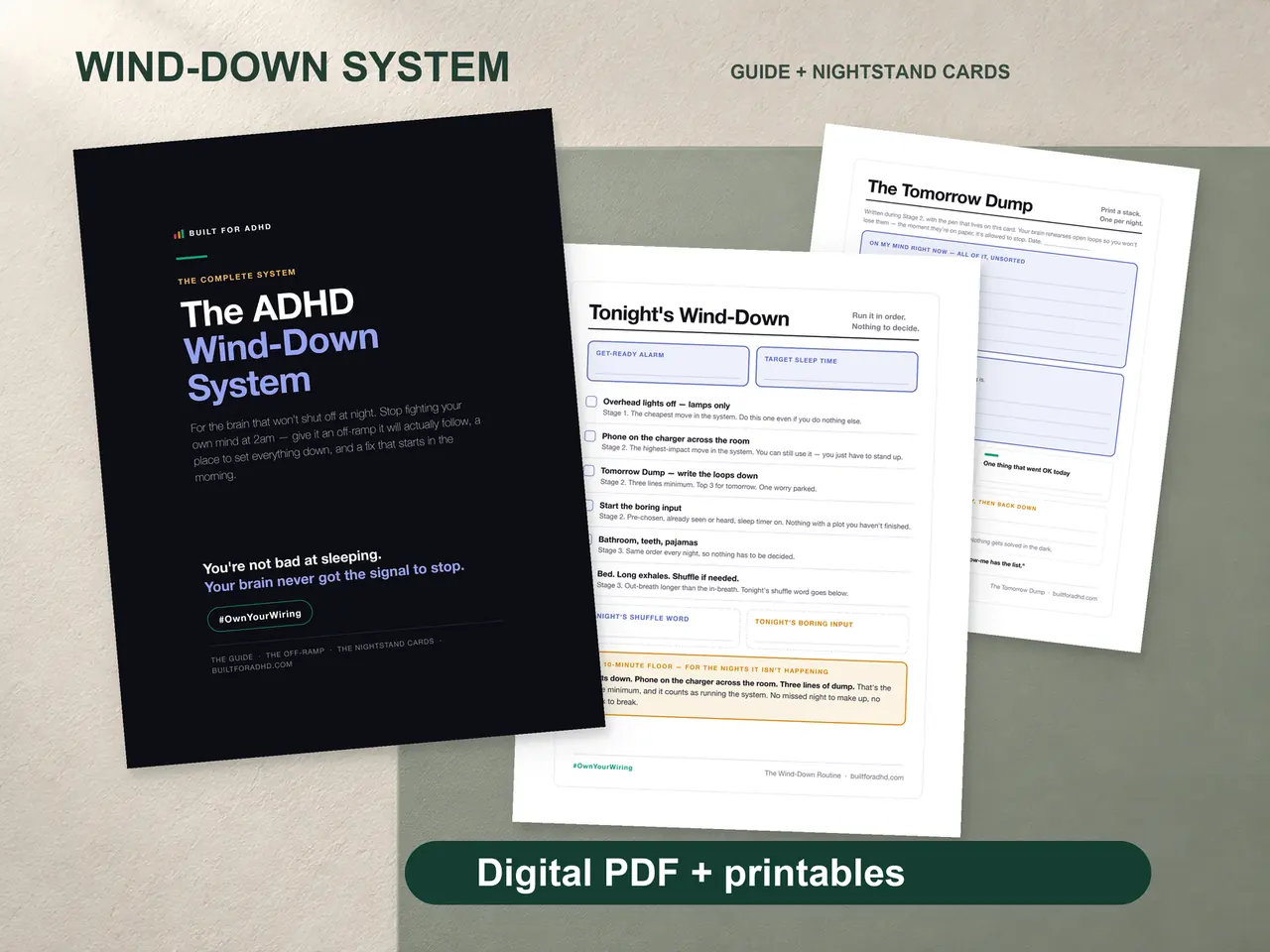
If you want the evening side built out properly, the ADHD Wind-Down System is where I’d point you. $12. Honest note: there is no bedroom-cleaning worksheet in it — it’s the evening off-ramp, the Tomorrow Dump for the loops your brain won’t release, a 3am wake-up protocol, and two nightstand cards. It’s a planning tool, not a treatment for sleep problems. The four-surface reset above is free and works on its own.
Related tools
- ADHD household systems — the hub for the jobs that never stay done
- The free sleep starter — a printable off-ramp for the nightstand
- ADHD doom piling — why the pile stays invisible until it’s urgent
- An ADHD cleaning schedule that holds — one zone at a time, sized to your tank
- When the laundry never gets put away — the clean-pile loop and how to break it
- Why your brain won’t shut off at night — the open loops a clear room can’t fix
- Revenge bedtime procrastination — when the night is the only time that felt like yours