In this article
The first time I told a manager, I talked for nine minutes.
I had rehearsed it in the car. I explained working memory. I explained why the thing in August had happened. I used the phrase “executive function” twice and then apologised for using it. By the end I had delivered something closer to a legal defence than a sentence, and the only thing my manager said was: “Okay — so what do you need?”
Which was a fair question, and the one I had not prepared for — because I had spent two weeks preparing to be believed and zero minutes preparing to be taken at my word.
That is the mistake, and it is almost universal. We rehearse disclosure as a confession that has to survive cross-examination, when in practice it is one piece of information handed to someone who will put it down and ask what happens next. (For the “what happens next” part, the complete guide to ADHD tools for adults covers the systems that make an ask concrete.)
(Worth saying plainly: I am not an HR person or a lawyer, and nothing here is about what any employer owes you — rules and cultures differ enormously. This is only about the words: what to say, to whom, and how much.)
First: this is a separate decision from the ask
These two things get welded together and they should not be.
Asking for a change at work — a protected block, decisions in writing — is a request, and it works whether or not you ever say the word ADHD. I wrote that out in how to ask for ADHD accommodations: a specific working condition gets approved on its own merits. Nobody needs a diagnosis to say yes to a calendar block.
Telling someone is a different decision with a different payoff. It is not leverage for the ask. It buys one thing: you stop running the second job on top of your actual job, the one where you track what you have let people assume. That cost is real and mostly invisible (if you have been paying it for years you may not notice until it stops).
So decide them separately. You can make the ask this week and never disclose. You can disclose and never ask for anything. Welding them together is what produces the nine-minute version.
Three things worth knowing before you decide
It is a one-way door. Not dramatically, but you cannot un-tell someone, and you cannot control which words get repeated in a room you are not in. That is not a reason not to do it. It is a reason to pick the person on purpose, rather than because the moment got emotionally available at 4:50pm on a Friday.
Almost nobody needs to know. One person — your direct manager, usually — covers nearly every practical benefit. A team does not need it. Disclosing widely feels like honesty and functions like load, because now you are tracking several versions of the conversation instead of one.
Timing beats wording. A calm Tuesday beats the debrief after something went wrong, by a distance. Say it inside the post-mortem of a missed deadline and it lands as an explanation for the miss no matter how carefully you phrase it — the one framing you cannot walk back. Say it on a week where nothing is on fire and it lands as information. Same sentence, different week, different meaning.
And if you are new, this is not a week-two conversation. The first 90 days of a new job is about buying credibility first — disclosure spends better once you have some.
The three scripts
Pick by how much you trust the person and how much you want them to do differently. Shorter is not more cowardly — shorter is usually better.
1. The one-liner. For a manager you trust reasonably and who does not need the backstory.
“Quick thing for context — I have ADHD. It mostly shows up as needing things in writing rather than verbally. Nothing I need from you right now, I just didn’t want it to be a secret.”
Twenty-eight words. It is information, it names one practical implication, and the last clause does most of the work: it tells them no action is required, which stops a well-meaning manager inventing a response. Most people say “thanks for telling me” and move on — that is a success, not an anticlimax.
2. The paragraph. When you want one specific thing to change and you want the reason attached.
“Something I want to name: I have ADHD. The practical version is that I lose things that arrive verbally — hallway asks, decisions made out loud in meetings. If actionable things come to me in writing, I’m reliable. If they come in conversation, I’m genuinely not. That’s the one adjustment that would make a difference, and it’s a small one.”
The structure is: the fact, one concrete mechanism, one ask, a size reassurance. Notice it names what is reliable as well as what is not. That is not spin — it is the accurate shape of the thing, and leading only with the deficit invites someone to quietly revise their estimate of you downward.
3. The conversation. For a manager you actually trust, where there is history to re-frame.
This one is not a script, because it should not be. It is the one-liner plus a willingness to answer questions, and the only preparation that helps is deciding in advance what you are not going to discuss. You do not owe anyone a tour of your worst years. “I’d rather keep the medical side private, but I’m happy to talk about how it shows up at work” is a complete sentence, and nobody has ever pushed past it on me.
What to leave out
The nine-minute version failed because of what was in it, not what was missing.
Cut the explanation. They can look it up. An explanation signals that you expect disbelief, and expecting disbelief invites it.
Cut the retroactive accounting. Do not relitigate the thing in August. Attach disclosure to a past failure and you have made it an excuse — and handed over a list of misses they had half-forgotten.
Cut the apology. The hardest one — if you are prone to over-apologising it will attach itself to every draft. “Sorry, I know this is a lot” tells your manager the news is heavy before they have decided whether it is. Delete it and put nothing in its place.
Cut the hedge. “It’s pretty mild” and “I’m not using it as an excuse” each introduce a doubt that was not in the room yet.## After
Write down the date and what you said, in a file you keep. One line:
Oct 27 — told [name]: ADHD, asked for actionable items in writing. Fine with it.
Managers change, reorganisations happen, and in fourteen months you will want to know whether the current one knows. It is the same file the performance review self-evaluation gets written from — things written down in the calm moment so you are never retrieving them in the expensive one.
Then watch what happens. If the response is good, that is one less thing to manage. If it is bad, you have learned something real about this job rather than something you suspected — information worth having, and part of what makes the job-hopping pattern break differently next time. And if you are reading this already running on empty, disclosure is not the fix; work burnout recovery is separate work.
In the next ten minutes
Write script one. Twenty-eight words, your own phrasing, one practical implication instead of mine. Do not send it — just get the sentence out of your head and into a note. What keeps this conversation six months away is not courage. It is that there is no sentence yet, so every time you think about it you start drafting from zero.
If you want somewhere for that note and the dated record to live, the free ADHD starter kit for adults is the ten-minute version of the setup.
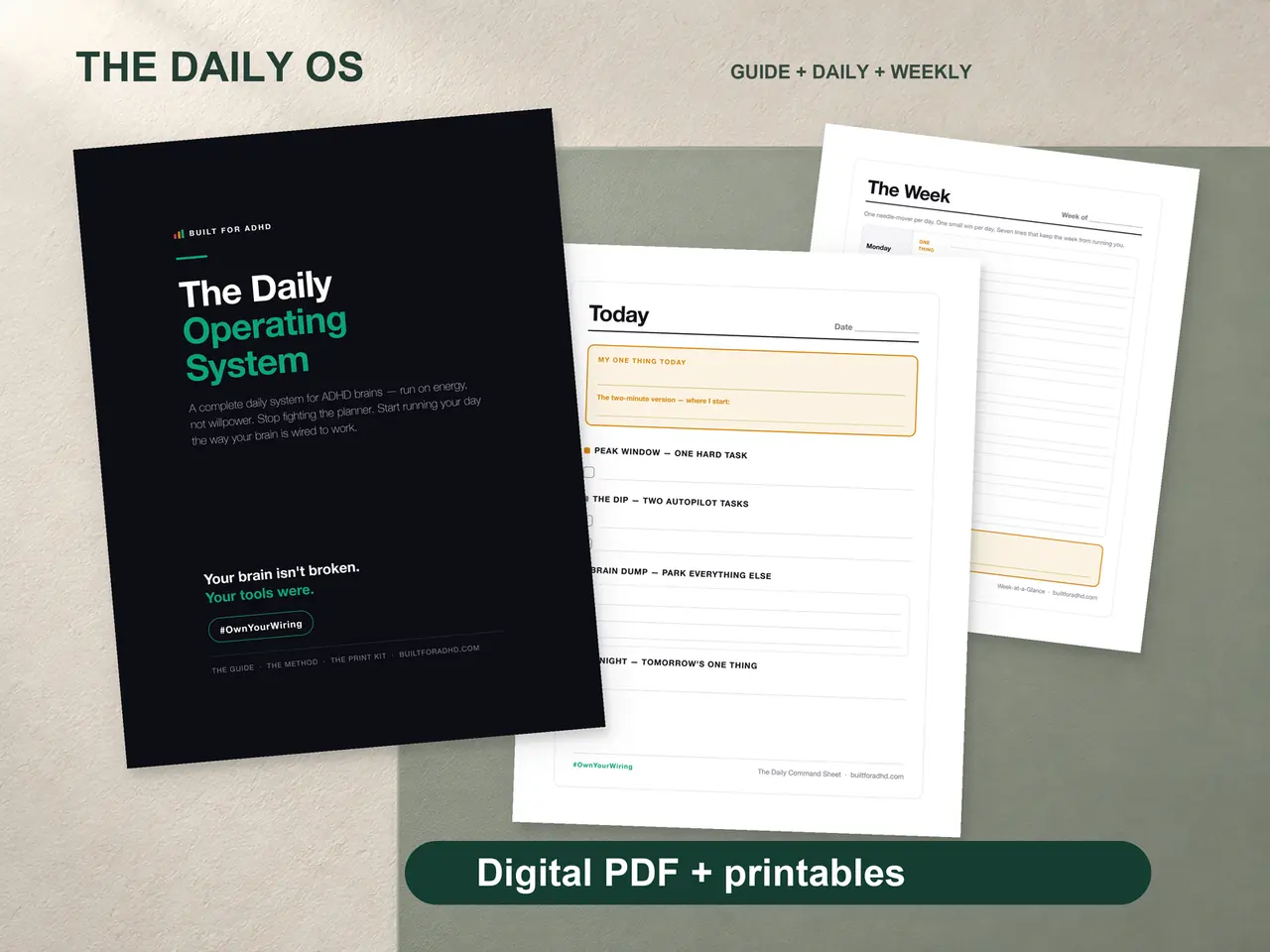
If the thing you actually need is a daily system that runs on energy instead of willpower — the surface where the writing-things-down habit lives — that is the ADHD Daily Operating System, $17. It will not make the conversation easier. It does mean that when your manager asks “so what do you need?”, you already know.
Related tools
- How to ask for ADHD accommodations at work — the request, which is a separate decision from this one
- The ADHD work-from-home productivity system — the working surface underneath both
- ADHD and the first 90 days of a new job — why this is not a week-two conversation
- ADHD performance review self-evaluation — what the dated file turns into