In this article
Week three of a job I had wanted for a year, I sat down at my desk and realized I had no idea what I was supposed to be doing that day.
Nobody was angry. I had been great for two weeks — in every meeting, remembering every name, reading every document handed to me, visibly thrilled. And then on a Tuesday the thrill was simply gone, and underneath it there was nothing. No list. No routine. No sense of which of the forty things I had been told actually mattered. I had spent fourteen days being an extremely enthusiastic new person and zero days building anything that would still work once being new wore off.
That gap is the whole problem, and it is not a character flaw. It is a predictable consequence of how novelty works in this brain — and it arrives on a schedule you can plan around.
Novelty is a real resource, and it has an expiry date
A new job is the richest dopamine environment you will ever be handed. Everything is unfamiliar, every conversation is information, every small task is interesting because you have never done it here before. Hyperfocus has infinite material. For roughly two weeks, you are the best version of yourself at work, effortlessly.
Then it metabolizes. The building stops being new, the people stop being new, and tasks that felt like discovery on day four feel like admin on day nineteen. The engine that was carrying you is gone, and whatever you built while it was running is what you are left standing on.
For most people this handoff is invisible — they spent those two weeks absorbing structure that was already there. For me it is a cliff, because time blindness meant the two weeks felt like three days, and because nobody labels anything for a new hire. You get told things. You are not given a map. It arrives as conversation, in hallways, out of order, and then it is assumed you have it.
So the plan below is built around one idea: the first 90 days is not a performance window, it is a construction window. You are not there to be impressive. You are there to build the thing that makes you good at the job in month four, while the novelty is still paying for the labor.
The three blocks, one job each
Thirty days, thirty days, thirty days. Each block does one thing, and trying to do all three at once is how I have blown it before.
Days 1–30: capture everything, build nothing
One document. Not a system — a bucket. Every name, every acronym, every “oh, we always do it this way,” every file path mentioned once. You are not organizing it. You are refusing to lose it.
The temptation here is to immediately build a beautiful setup, and it is the wrong instinct: on day six you do not yet know what the job is, so a system designed then is designed for an imaginary job. Just brain dump it into one place, every single day, and let it be ugly.
One artifact is worth making properly in this block, because it pays off immediately:
The Who sheet. One line per person. Name · what they actually own (not their title) · how they want to be reached.
Dana · owns the deploy calendar, not the roadmap · Slack, replies instantly Marcus · signs off on anything touching billing · email only, two-day lag
Titles do not tell you who to ask. That sheet is the most useful page I have ever made in a new job, and it takes twenty minutes spread across three weeks.
Days 31–60: turn the pile into a week
Now you know enough to build. The goal of this block is not productivity — it is a repeatable week, so that the job stops requiring a fresh decision every morning about what the job is.
Read back the capture doc, which will be chaos, and pull out the things that repeat. The Monday thing. The report somebody needs Thursdays. The meeting you have to arrive at having read something. Those are not tasks, they are the skeleton, and they go into a standing shape: which recurring block covers them, and roughly what energy each one takes.
Sort by energy, not by hour. The deep thing goes where your attention actually lives — mine is the first two hours and nowhere else — and the shallow replying-to-people work goes in the trough. It matters more in a new job, because you have not yet earned the slack to recover from a badly stacked day.
This is also the block to deal with the question problem. Asking someone fourteen separate questions across a Tuesday feels, to them, like being interrupted fourteen times, and feels to you like exposure. So batch them: one running list per person, one ask. “Got five quick ones when you have ten minutes” is an entirely different event from five drive-bys, and it is the version that makes you look like you are keeping track — which you are.
Days 61–90: make the work visible
Here is the thing nobody tells you. At the end of the first 90 days somebody forms an opinion about how it went, out of whatever is in front of them. If you cannot recall what you did, that opinion gets made out of vibes.
So in this block you add one thing, and it takes four minutes a week:
The Friday Five. Five lines, every Friday, in the same file forever. What I shipped · what I unblocked · what I am waiting on · what I learned · one number if there is one.
That is the entire practice. It takes almost no energy and it is the only reason I can now answer “so how’s it going?” with something other than “good, yeah, busy.” It is also exactly the raw material a performance review self-evaluation needs, which means the hardest document of the year gets written in increments while you still remember the details.
Same principle as the one-page sheet you brought into the interview: write it down in the calm moment, so you are never asked to retrieve it in the expensive one.
Three rules that keep it from collapsing
Do not volunteer in the honeymoon. Everything sounds doable in week two, because you are running on borrowed fuel and you want to be useful. The commitments land in week seven, when the fuel is gone. My rule now is a hard no to anything optional before day 30 — not “let me think about it,” an actual “not yet, I want to get solid on the core job first.” Nobody has held that against me.
Schedule the drop. Put a recurring thirty-minute block on day 21 called rebuild the week. You will not notice the cliff while falling off it; you will just feel vaguely bad at your job. A calendar event noticing for you is worth more than any amount of willpower.
Protect one block, not the whole calendar. You cannot defend a new job’s schedule — too many people need too much of you, and you have no standing yet. Pick one recurring block, make it the deep one, and let everything else be negotiable. One defended hour survives a new workplace. A perfect calendar does not.
What to do in the next ten minutes
Open one blank document, name it something you will find again, and write three lines: one name, what that person actually owns, how they prefer to be reached.
That is it. The capture doc now exists, which was the whole bar for day one. Everything above is what happens to that document over twelve weeks.
And if you are somewhere in week three right now, sitting at the desk with the novelty gone and the quiet panic starting — nothing has gone wrong. The fuel ran out on schedule, exactly as it does. You just have not built the thing underneath it yet, and you have about ten weeks of extremely good conditions in which to do it.
If you want the surrounding structure — somewhere for the capture doc and the defended block to live — the free ADHD starter kit for adults is the ten-minute version.
Related tools
- The ADHD work-from-home productivity system — the working surface all three blocks sit inside
- ADHD job interview prep script — the one-pager that got you here
- ADHD performance review self-evaluation — what the Friday Five turns into
- AI meeting notes for ADHD — for the first-month meetings you cannot take notes in and listen at the same time
- The ADHD email inbox overwhelm system — because a new job hands you a new inbox on day one
- How to fix ADHD time blindness — why two weeks felt like three days
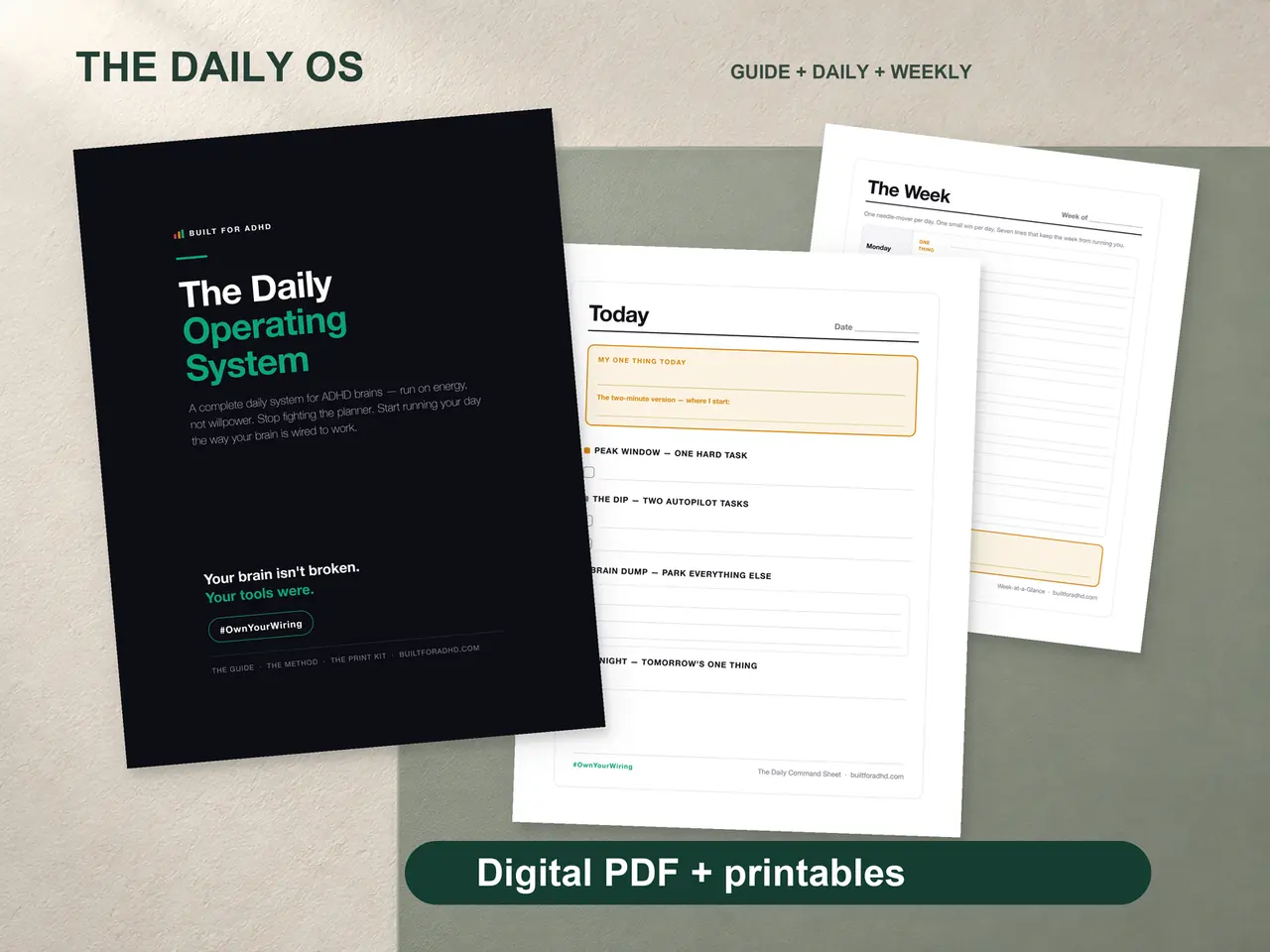
If you want the system the repeatable week is built on — energy-sorted days, the brain dump, and a one-page Command Sheet — that’s the ADHD Daily Operating System, $17. The three blocks above work fine on plain paper; the Daily OS is just the version that already has the pages.