Hyperfocus can get eight hours of real work done before lunch. It can also spend those eight hours on the wrong thing entirely — a website redesign nobody asked for while the invoice that pays your rent sits unsent. Using hyperfocus well isn’t about getting more of it. It’s about aiming the wave you already have, and knowing what it costs you afterward. This is one piece of the wider self-employed organization system — the part that deals with your actual working hours, not just the admin around them.
Hyperfocus Is an Asset With a Bill Attached
Nobody talks you out of loving hyperfocus, and they shouldn’t — it’s the closest thing an ADHD brain has to a superpower. Locked in, you can out-think, out-build, and out-produce almost anyone in the room. The problem was never the quality of the work. It’s that hyperfocus doesn’t check with you before it picks a target, and it doesn’t warn you what the bill looks like when the wave breaks.
Left unaimed, hyperfocus treats “interesting” and “important” as the same thing. It will happily spend a Tuesday perfecting a logo while the client who owes you three thousand dollars gets a “let me get back to you” for the fourth week running. That’s not a discipline problem. It’s a targeting problem — and targeting is fixable in a way willpower never was.
The cost isn’t only the missed invoice, either. A full-day hyperfocus block on the wrong target also spends the one resource you can’t get back that day: your best hours. Every hour hyperfocus gives to the interesting-but-unimportant thing is an hour it can’t give to the thing that was actually due, which is why the same brain that can produce brilliant work can still end a week feeling like nothing that mattered got done.
The Revenue Filter
Before letting a hyperfocus wave pick its own target, run whatever’s calling to you through three questions: does it move money, is it something only you can do right now, and is today actually the day for it. Score it honestly — three yeses earns the block today, two gets a capped block instead of an open one, one or zero goes to a parking lot instead of your calendar.
The filter isn’t there to talk you out of the interesting thing. It’s there so the interesting thing has to prove it’s also the important thing before it gets your best hours. Some tasks pass the filter on paper and still shouldn’t get the block — the playbook’s handed-to-you test exists for exactly that: work you’re already three weeks into, where the honest question isn’t “should I start” but “should I keep going.”
The Handoff Note
The most expensive part of a hyperfocus session isn’t the hours it takes — it’s the hours it costs everyone waiting on you while you’re in it. Before you disappear into a block, leave a handoff note: what you’re doing, when you’ll surface, and what happens if a client or a deadline needs you before then.
It takes ninety seconds and it does two things at once. It buys you permission to actually go dark, because the people around you aren’t left guessing. And it forces you to name, out loud, whether the thing you’re about to lock into is actually worth going dark for.
A handoff note can be as short as a single line to a client or a business partner: what you’re heads-down on, roughly when you’ll surface, and who to ping if something can’t wait. The point isn’t formality — it’s that saying the plan out loud, even to no one but yourself, catches the sessions that don’t actually deserve the next four hours before they start.
The Crash After
Hyperfocus doesn’t end — it crashes. The same intensity that got the eight hours of output also empties the tank completely, and the hours right after a session are often the least productive of your entire week, not the most. Planning anything demanding in that window is planning to fail at it.
Build the crash into the schedule instead of being surprised by it every time. After a big block, expect low output, not none — and don’t read the crash as a sign the whole system failed. It’s the second half of the same wave, and it passes.
The Hobby-Cycle Trap
Hyperfocus doesn’t only show up in your business — it also shows up as the new hobby that eats every evening for three weeks and then vanishes, leaving a closet full of equipment and a half-finished course behind it. The ADHD hyperfixation intake checklist is worth reading alongside this guide, because the same wave that can build your business can just as easily route around it if you don’t notice which one you’re riding.
The difference between the wave that builds something and the wave that just burns three weeks is whether it ever gets pointed at revenue. Turning hyperfocus into revenue walks through what that redirection actually looks like in practice, task by task.
What This Looks Like on Paper
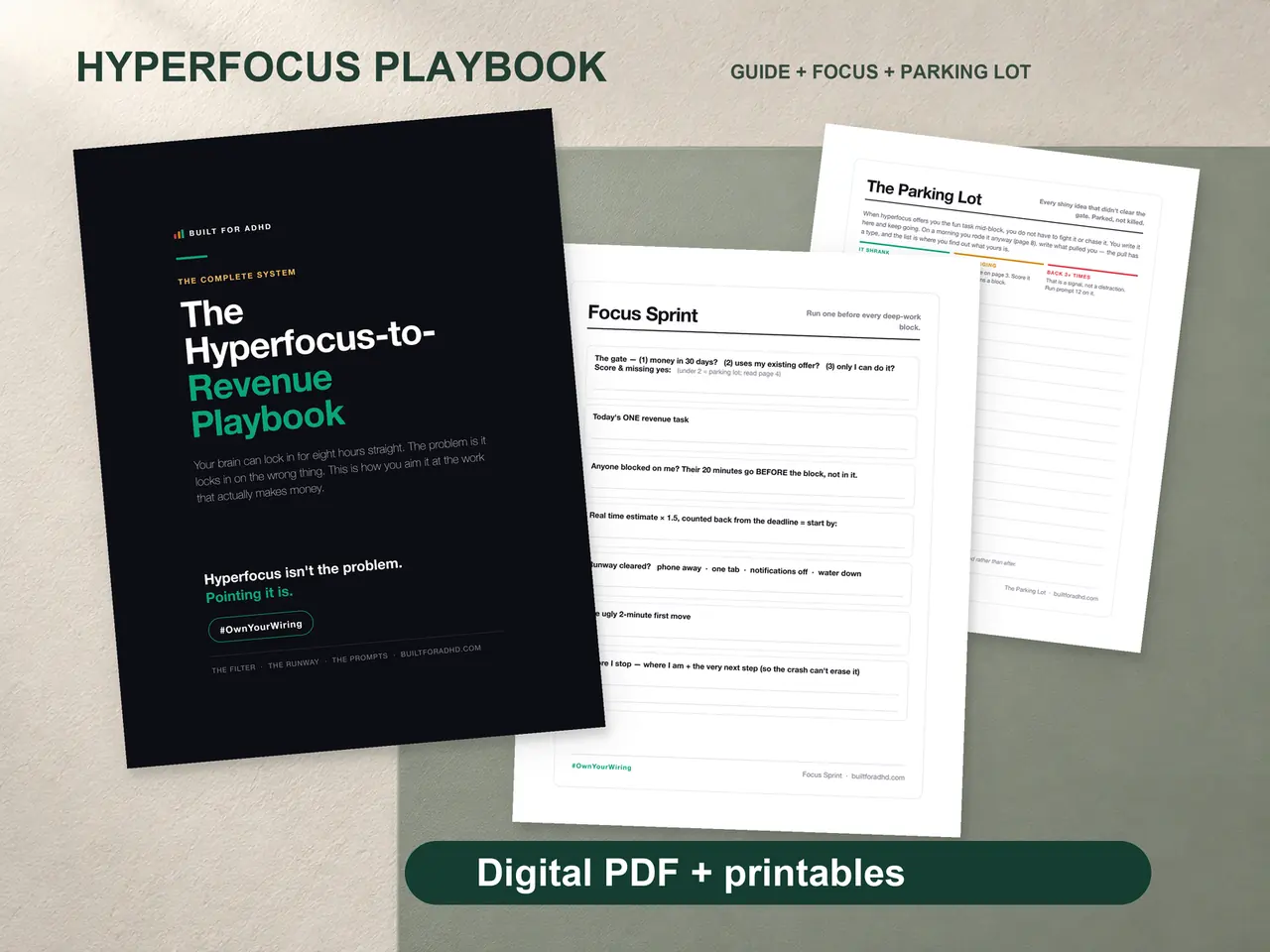
The Hyperfocus-to-Revenue Playbook puts the whole system on paper: the scored Revenue Filter, the handed-to-you test, the handoff note, a recovery page for the week hyperfocus ate, and twelve founder AI prompts for the moments the wave won’t start on its own. It’s built to sit on your desk, not in an app you’ll forget to open mid-block.
Hyperfocus was never the problem. An unaimed one is. Point it at the thing that pays, leave a note on your way in, and plan for the crash on your way out — and if you haven’t read the rest of the self-employed organization system this belongs to, that’s the next stop.