In this article
I once billed a client for twelve hours on a project I am fairly sure took me closer to thirty.
Not because I was being generous. Because I genuinely did not know. The work had happened in a smear of late nights and one Saturday that disappeared entirely, and when it came time to put a number on the invoice I did what I always did — sat there trying to reconstruct a month from memory, felt the whole thing turn to fog, and picked a figure that felt safe. Safe meaning low. Safe meaning I would not have to defend it.
That is the part nobody warns you about. The failure mode of not tracking your hours is not getting caught overbilling. It is quietly undercharging yourself for years, because a number you cannot evidence is a number you will always round down.
Time trackers are built for people who notice time passing
Open any of them. Toggl, Harvest, the timer in your project tool — every one is built on the same two assumptions: that you will press start when you begin, and that you will notice you have begun.
Both of those are the exact capacities that time blindness takes away. I do not drift past the start button because I am careless. I drift past it because the transition into work is the hard part, and the moment I finally get traction is the single worst moment to interrupt myself with an administrative step. Pressing start costs me the thing I just spent forty minutes building.
And then there is the other direction. Hyperfocus does not have a clock in it. That is most of what makes it valuable and all of what makes it unbillable — a running timer is irrelevant to a state whose defining feature is that you stopped perceiving duration. I have left timers running overnight. I have left them running through dinner, a phone call, and an entire unrelated task, and then had to decide what fraction of nine hours was real.
So you get the two classic ADHD timesheet outcomes: a tracker with almost nothing in it, or a tracker full of numbers you do not trust. Both end at the same invoice.
Stop tracking duration. Mark edges.
Here is the reframe that finally made this work for me: I am not trying to measure time. I am trying to leave evidence.
A timer tries to capture a continuous quantity, which requires me to be present at both ends of it. An edge is a single moment — one line, written once, at a point where I am already stopping anyway. Stopping is when I have attention back. That is the only reliable window I have, and the whole system is built to use it.
The log: three fields, one line per session
One page. A notebook, a notes file, the back of the project folder. Three fields, in this order:
Date · Project · What happened — and roughly how long.
That is it. Written when you stand up, not when you sit down.
Oct 14 · Mercer site · built the pricing page and fixed the nav, long afternoon, ~4h Oct 15 · Mercer site · two rounds of revisions off their email, ~1h Oct 15 · Hale rebrand · first pass at logo variants, got lost in it, ~3h?
Note what is missing. No start time. No stop time. No decimal hours. No category dropdown. The question mark on that last one is allowed and it is important — an honest “~3h?” is infinitely more useful at invoice time than a blank, and it is the only thing you will actually write at 11pm.
“What happened” is the field doing the real work. Minutes without a description are unusable three weeks later, because you cannot defend them to a client and you cannot defend them to yourself. One clause about what you produced turns a vague number into a line item. It is also the thing that lets you fix the number later — if I read “two rounds of revisions” I know whether an hour sounds right in a way that staring at “1.0” never tells me.
The three rules that make it survive a bad week
Write it on the way out, not on the way in. The log gets filled in at the end of a session, during the two minutes where the work is over but you are still in the chair. Not at the start, when the entry fee is highest and the task is most fragile. Every other system I tried failed here, and this inversion is the whole trick.
Round generously and say so. “~4h” for something between three and five. You are keeping a record for billing and defending, not a lab notebook. Precision you have to fake is worse than approximation you can stand behind — and the tilde is a promise to yourself that an unsure entry still counts.
A missed session gets reconstructed the same day or written off. If you forget, you get one shot at it from memory while the day is still warm, and if that fails, the line reads “Oct 13 · Mercer site · worked, unlogged.” That entry has value. It tells future you that the invoice is an undercount, which protects you from the thing I did for years — treating an incomplete log as a complete one and billing the gap away.
The point of all three rules is to keep the floor low enough that the log survives the weeks when everything else does not. A tracker you abandon in March has told you nothing about March.
The weekly roll-up, which is where this turns into money
Once a week — attach it to whatever already happens, the same slot every time — you read down the log and total each project. Fifteen minutes, maximum, and it does two separate jobs.
First, the obvious one: each project gets a number and a short description, which is what goes on the bill. If you have a standing billing day, the roll-up feeds it directly — the log answers what should this invoice say, and the unbilled tracker answers did I send it. Those are two different failures and they both cost real money.
Second, and this is the one I did not expect: the log is the only honest record of scope creep you will ever have. When a fixed-price project quoted at twenty hours shows up in the log at forty-one, that is not a feeling you have to argue about. It is a list of sessions with descriptions attached. I have had exactly one calm, factual, entirely non-awkward conversation about a scope increase in my life, and it was the one where I had the lines in front of me.
Hourly or fixed-price does not change this. If you bill fixed-price, the log is what sets next quarter’s quote honestly instead of from the same optimistic guess that burned you last time.
What to do in the next ten minutes
Not all of it. Two things.
Open one page and write today’s line. Date, project, what happened, rough hours. If you worked on something earlier this week you can still remember, add those too — but today’s line is the one that matters, because a log that starts tomorrow is a log that starts never.
Then pick the slot for the weekly roll-up and put it where your other business review already lives. If you do not have one of those yet, the free entrepreneur starter set has the one-page version and takes about ten minutes to set up.
You are not bad at tracking your hours. You were handed a tool that bills you an executive-function tax at the exact moment you can least afford it, and then asked to pay it four times a day. Write one line on the way out instead. It is a worse record than a perfect timesheet and a much better one than the fog, and the fog is what you have been invoicing from.
Related tools
- The printable self-employed organization set — the paper surface this log lives on
- ADHD and forgetting to invoice clients — the next step: the unbilled tracker and billing day
- ADHD freelancer boundaries and scope creep — what the log gives you evidence for
- The ADHD entrepreneur’s productivity system — the layer this sits inside
- Turning hyperfocus into revenue — the state that eats the clock
- Separating business and personal money — what makes the billed number visible
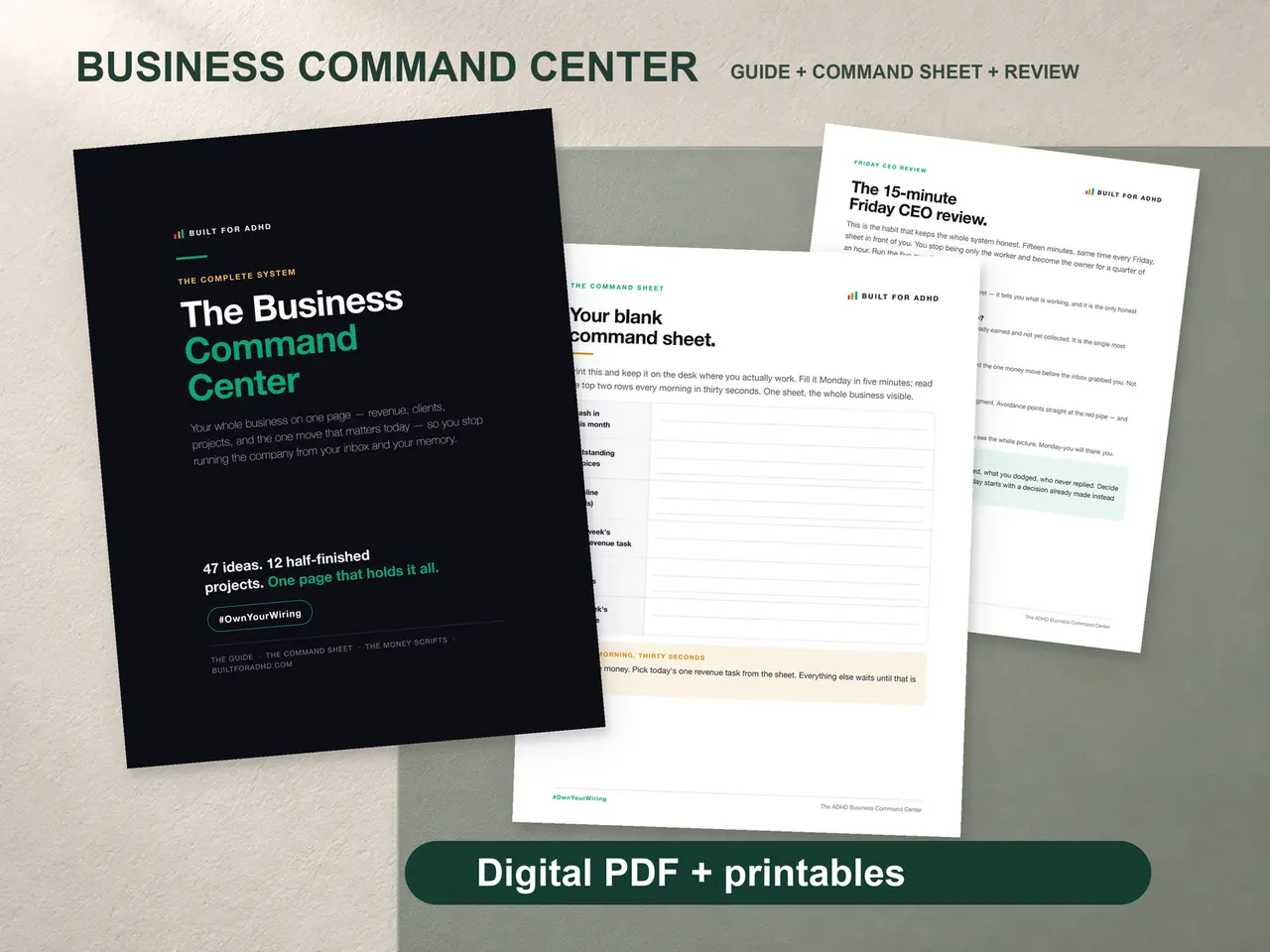
If you want the pre-built version — the session log, the unbilled-work tracker, the weekly review, and the one-page Command Sheet they all feed — that’s the ADHD Business Command Center, $19. The log above is three fields on a blank page and it works fine on its own.