In this article
I once found an unsent invoice from a project I had finished, delivered, and been thanked for — eleven weeks earlier. The work was done. The client was happy. The money was just sitting in a draft nobody would ever open, because the part of the job that pays me is the part my brain files as over.
That’s the specific failure, and it isn’t laziness or bad math. It’s that finishing the work and getting paid for the work feel like the same event to an ADHD brain, and only one of them actually happened.
If you run anything solo — freelance, contract, a whole business out of one ADHD brain — unsent invoices are the most expensive version of the ADHD tax you will ever pay. Not $39 in late fees. Thousands of dollars of work you already did, permanently. (The printable version of everything below lives in the self-employed organization tools if you’d rather just go get it.)
Why invoicing specifically is the step that dies
The dopamine ends at delivery. The interesting part was the work. Hitting send on the deliverable is the finish line your nervous system recognizes — the tension breaks, the reward lands, the file closes. Invoicing is a boring administrative errand that arrives after the closure, which is the exact moment there is nothing left in the tank to run on. Every other task you do gets fueled by the thing that comes before it. This one gets scheduled after your fuel ran out.
“I’ll invoice at the end of the month” is a deadline your brain cannot see. Three weeks out is not a real date when you don’t feel time passing. It’s a vague future that stays vague until it becomes a vague past. And nothing external corrects it — no client will email asking why you haven’t billed them.
The money it produces disappears into the pile. When client payments land in the same account as groceries, billing does not visibly change anything — the balance just gets slightly better sometimes, which is a terrible reward for a task your brain already resists. Separating business and personal money is what makes billing day’s number legible, and a legible number is most of what makes it repeatable.
There is no one waiting on it. That’s the quiet killer. Almost everything else you drop gets caught by someone else’s follow-up. Invoices are the only task in your business where forgetting is completely silent and the punishment is delayed by months.
And some of them are emotionally loaded. The project that went a little sideways. The scope that grew and now the number is higher than what you quoted. The client who was slow to reply. RSD turns “send a bill” into “ask someone to judge whether I was worth it,” and that reframe is enough to move it to tomorrow indefinitely. The invoices that sit longest are almost never the complicated ones. They’re the ones with feelings attached.
The fix has two pieces, and neither is a reminder
Reminders don’t work here for the same reason they don’t work on bills — a notification demands you convert an interruption into an action, using the exact initiation machinery that dropped the task the first time. What works instead is making invoicing visible and making it scheduled, so it never depends on you noticing anything.
Piece 1: A two-column tracker on one page
Not accounting software. Not fourteen fields. One page, two columns, and it can live in a notebook, a spreadsheet, or on your wall:
Column one: UNBILLED. Every piece of work that is done or in progress and has not had an invoice sent. Client, what it was, the amount, and the date you finished. Nothing else.
Column two: SENT — AWAITING PAYMENT. Client, amount, the date you sent it, and the date it’s due.
That’s the whole thing. An item moves from column one to column two when you hit send, and off the page entirely when the money lands. The only rule that makes it work: nothing is done until it’s in column one. You do not finish a project. You finish a project and write the line. Thirty seconds, while the file is still open — which is the only moment you will ever reliably have the context.
Two columns is not a simplification for its own sake. It’s because the load-bearing information here is what have I not billed for, and in every accounting tool ever built that number is four clicks deep behind a dashboard you don’t open. Put it on one page you can see without deciding to look.
Piece 2: One standing billing day
Pick a day. Friday afternoon, or the 1st and the 15th, or whatever matches your energy — but the same day, permanently, attached to something that already happens. Fifteen minutes. Column one gets emptied into column two, and column two gets a glance for anything past due.
The reason this works when “invoice at the end of a project” doesn’t: you are no longer asking yourself to start a boring task at the worst possible moment. You are asking yourself to run a small recurring ritual at a time you chose while you had energy to choose things. The task stops being a decision and becomes a rhythm, which is the whole tiny-first-step principle applied to money — the step isn’t “invoice everyone,” it’s “open the page.”
Make the fifteen minutes pleasant on purpose. Coffee, a specific playlist, the good chair. Billing day is the highest-dollar-per-minute work you do all week and it should not feel like a punishment.
The three things that make billing day fast
Templates, made once. An invoice you build from scratch is a project. An invoice you duplicate is a two-minute task. Make one template per type of work you do, with your terms and payment link already in it, on a day when you have energy — then never write one again. Same principle as keeping canned replies ready for the emails that always stall.
A payment link, not bank details. Anything that lets the client pay in one click removes a step from their side, and steps on their side become follow-ups on yours. Follow-ups are the part you’ll drop.
Two scripts, written in advance. The scope-grew invoice: “Here’s the invoice for the project — it came in above the original quote because of the added [X]. Breakdown below, happy to talk it through.” Neutral, factual, no apology paragraph. And the late-invoice-you-forgot: “Invoice attached for the work completed in June — apologies for the delay on my end getting this over.” One line, no explanation. Nobody has ever been angry at a freelancer for billing them late. Write both once, on a good day, so billing day never requires composing emotional tone from scratch.
What to do in the next ten minutes
Not all of it. Two things.
Open a blank page and write down every piece of finished work you have not invoiced for. Everything. That’s column one, and it’s the only step today that has a dollar figure attached — the list is almost always longer than people expect, and the number on it is usually genuinely large.
Then put billing day on the calendar as a repeating event, and send the oldest thing on the list right now, before you close the page. Not because urgency is a virtue — because the item you send today is the proof the system does something, and an ADHD system that hasn’t paid you yet doesn’t survive its first week.
The rest of the business setup — where the day’s actual priorities live so admin isn’t the thing you do by default — is the free entrepreneur starter set, which takes about ten minutes.
You don’t need better discipline about invoicing. You need the bill to be a scheduled event instead of a thing you’re supposed to remember at your least resourced moment.
Related tools
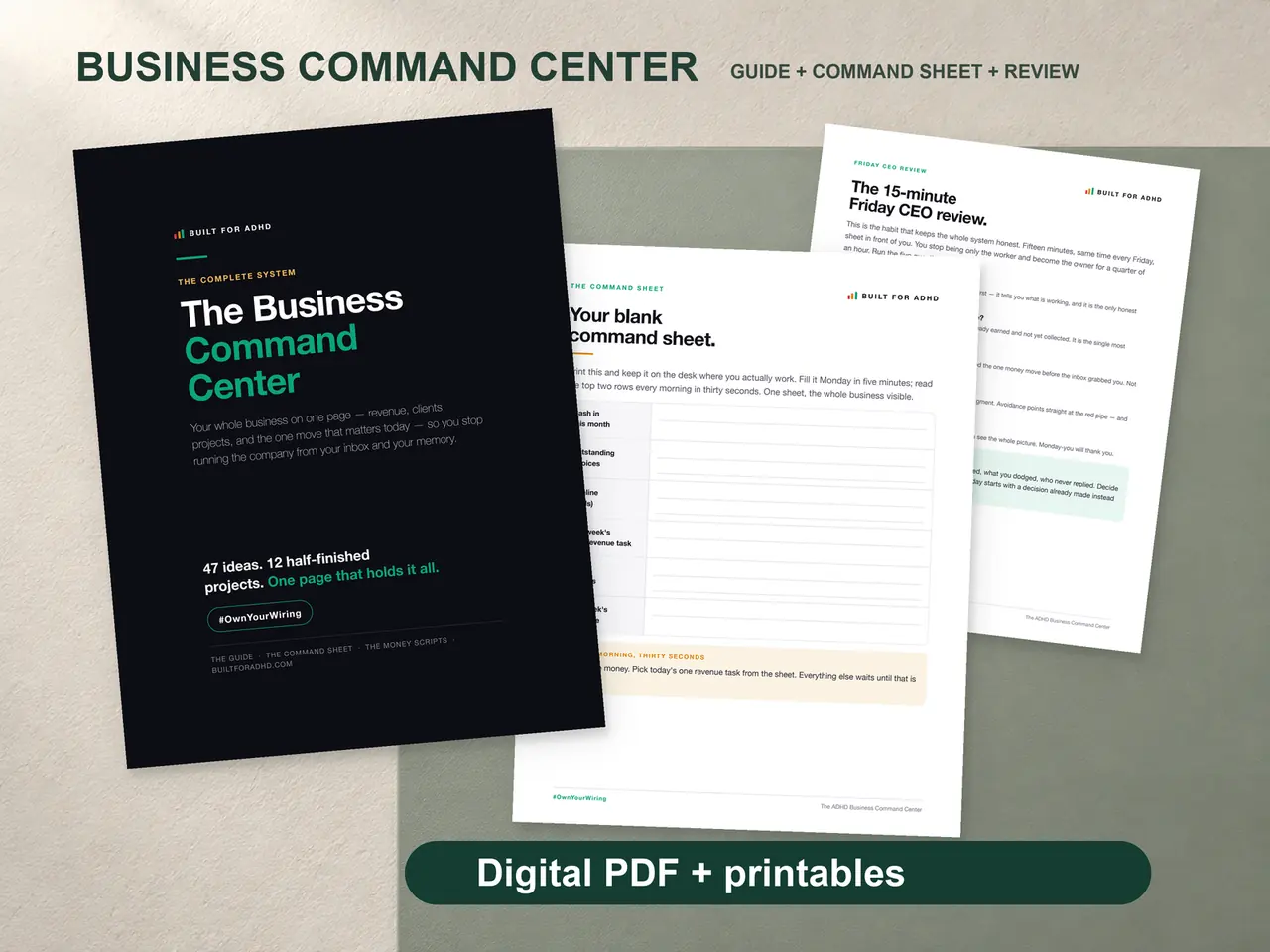
- ADHD Business Command Center — $19: the one-page business cockpit, the five zones, and the copy-ready money scripts
- The ADHD entrepreneur’s productivity system — the layer this sits inside
- Turning hyperfocus into revenue — aiming the energy that does the billable work
- The email system that doesn’t run on willpower — where the invoice follow-ups live
- Separating business and personal money — the four-account layout that makes the billed money visible
If you want the whole solo-business version — the Command Sheet, the Friday review, the money-avoidance scripts, and the unbilled-work tracker as an actual printable page — that’s the ADHD Business Command Center. One page, entire business, no willpower required.