In this article
There is an email in my inbox right now that has been there for eleven days. It takes ninety seconds to answer. I have opened it four separate times, read the whole thing, felt the specific chest-tightening of I should have replied to this a week ago, and then closed it without typing a word — because now the reply also has to apologize for the delay, which makes it a harder email than it was on day one.
That’s the loop. Not laziness, not disorganization. A ninety-second task that gets more expensive every time you look at it and don’t do it.
If you run anything solo — clients, a side business, a whole company out of one ADHD brain — the inbox is where the wheels come off first, because it’s the one system nobody else is maintaining for you. The fix isn’t discipline and it isn’t a new app. It’s changing what the inbox is. (If you want the printable version of this and the rest of the solo-business setup, it lives in the self-employed organization tools.)
Why email specifically wrecks ADHD brains
An inbox is a to-do list written by strangers, sorted by accident. Every other list you keep is at least yours — you chose the items, you put them in an order. Email is a pile of tasks authored by other people, arriving in the order they felt like sending them, with no indication of which ones matter. The sorting work is entirely on you, before any of the actual work starts.
Every message is a decision, and decisions are the expensive part. Reply now, reply later, delegate, ignore, archive, “I need to think about this.” Forty unread messages is not forty tasks — it’s forty decisions stacked on top of forty tasks, and decision fatigue is what actually empties the tank. This is why you can spend twenty minutes “doing email” and end with the same number of unread messages and less energy than when you started.
Opening it isn’t the same as processing it. The read-and-close move is the email version of picking something up off the floor, holding it, and putting it back down in a slightly different spot. Your brain files it as “handled.” The message files it as “still here.” Do that on enough messages and you’ve built a doom pile out of pixels.
The hard ones are hard for emotional reasons, not logistical ones. The invoice nobody paid. The client who sounded a little short. The reply you owe someone you like. RSD turns a neutral message into a threat assessment, and threat assessments get avoided. Which is why the emails that sit longest are almost never the complicated ones — they’re the ones with feelings attached.
Then it becomes an avoidance object. Past a certain unread count, the inbox stops being a tool and becomes a monument to how behind you are. You stop opening it. Things get worse in there. Late replies cost money, goodwill, and re-sent invoices — a pure, recurring ADHD tax with a red badge on it.
The system
The whole thing rests on one rule: the inbox is not your to-do list, and inbox zero is not the goal. The goal is that nothing important is invisible and nothing sits long enough to grow an apology.
1. Two passes, not one. Sorting and answering are different jobs, and doing them at once is what makes email feel impossible. Pass one is triage only — you open nothing, type nothing, and decide only which of three buckets each message lands in: needs a reply from me, needs an action that isn’t a reply, needs nothing. Ten minutes, no writing. Pass two is where you actually write, from a much shorter list you already sorted. Splitting these turns one enormous ambiguous task into two small clear ones, which is the entire tiny-first-step trick applied to a mailbox.
2. Three folders. That’s it. Reply. Waiting. Done/archive. Not fourteen nested labels — you will build them in a burst of energy and never use them again. Three folders is few enough to sort into without deciding, and “Waiting” is the load-bearing one: everything you’ve handed off, sent an invoice for, or asked someone about goes there, so your working memory stops being the only record that you’re owed something.
3. Give it two windows a day, and put them somewhere real. Not “when I have time” — 10 AM and 4 PM, or whatever matches your actual energy. Email checked continuously is a slot machine wired directly to your attention; email checked twice is a task with edges. Outside those windows the tab is closed. This one is unglamorous and it does more than the other five combined.
4. Kill the two-minute rule; use the two-line rule. “If it takes under two minutes, do it now” is a trap for ADHD brains — nothing takes two minutes once you’re inside the thread. Replace it with a cap on the output: most replies get two lines, maximum. “Yes, Thursday works. Sending the file this afternoon.” Done. The reason your inbox is full is not that you write too few emails; it’s that you’re drafting essays in your head before you write any.
5. Have three canned replies ready to paste. The delay apology (“Thanks for your patience on this — here’s where things stand”), the invoice nudge, and the polite no. These are the three that always stall, and they always stall for the same reason: you’re composing the emotional tone from scratch every single time, while feeling bad. Write each one once, on a good day, and never write it again. If you want help drafting them in your own voice, that’s exactly the kind of thing an AI assistant is genuinely good at — it will happily produce a warm, non-groveling apology at 11 PM when your brain has nothing left. Same for the reverse: paste a message you’re dreading into a chat and ask it to tell you plainly what’s being asked and what a reasonable reply is. Half the dread evaporates once the threat assessment comes back neutral.
6. Declare bankruptcy on everything older than 30 days. Select all, archive. Nothing is deleted, everything is searchable, and the genuinely important ones will come back — people follow up on things that matter. What you’re actually clearing is the guilt layer, and that layer is what keeps you from opening the inbox at all. Do this once, today, before you build the rest. Starting a new system on top of an eight-month backlog is why the last four systems died.
What “working” looks like
Not an empty inbox. Working looks like: you know what you owe people, you know who owes you, nothing important is hiding, and opening your mail doesn’t cost you anything emotionally. The Reply folder has four things in it and that’s fine. The Waiting folder is why you remembered to chase the $3,000 invoice.
Start with the bankruptcy archive and the two folders — Reply and Waiting. Not all six steps, not today. Just those, and then one triage pass tomorrow morning before you write a single reply. If you want the front end of this — where the day’s actual priorities live so email stops being the default thing you do — the free entrepreneur starter set is the ten-minute version.
And go answer the eleven-day email. Two lines. No apology paragraph.
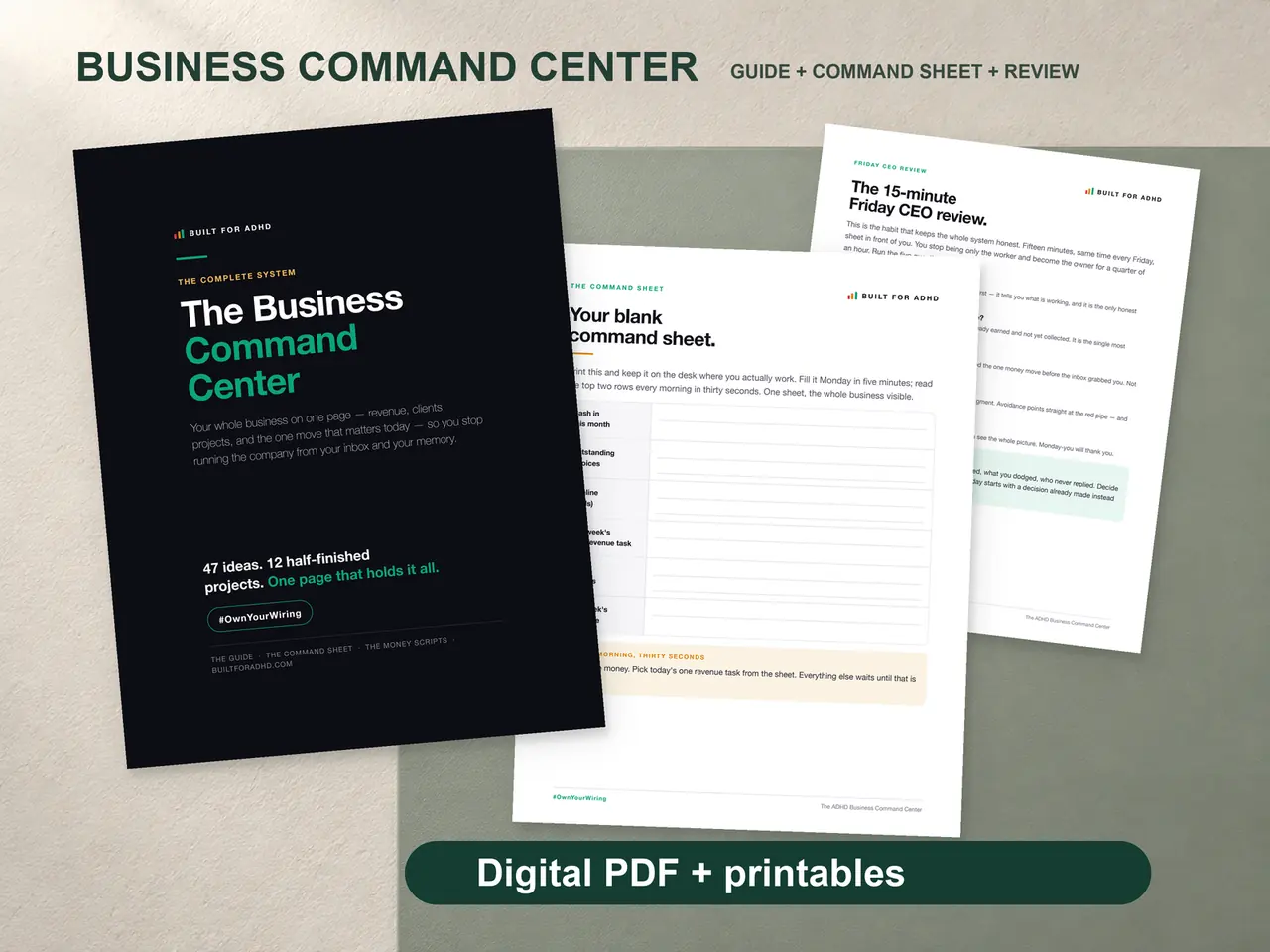
If you want the whole solo-business version — the Command Sheet, the five zones, the Friday review, and the copy-ready money-avoidance scripts for the payment emails you keep not sending — that’s the ADHD Business Command Center. One page, entire business, no willpower required.