In this article
I once sat in an interview and could not remember a single thing I had ever done.
Not a thinking pause. A white-out. The man across the table asked me to walk him through a project I was proud of, and my brain — which had spent the entire previous night rehearsing exactly this question — returned nothing at all. I said something about having “worked on a lot of different things, really.” I watched him write that down. Then I got in the car and remembered four genuinely good answers within the first six minutes of the drive home, which is the specific cruelty of the whole format.
Here is what took me years to understand. An interview is not a test of whether you can do the job. It is a test of whether you can retrieve your own career, out loud, on demand, in front of a stranger who is visibly evaluating the answer. Retrieval under social pressure is the first thing to go. So the preparation that works is not more rehearsal — it is building something you can read.
The format asks for the one thing that is hardest to produce on command
Think about what a behavioral question actually requires in the four seconds after it lands. Parse it. Search years of unlabeled memory for a matching example. Pick the strongest one. Sequence it into a beginning, middle, and end. Deliver it in a steady voice. All while a second process runs underneath, reading the other person’s face for signs it is going badly.
That last process is the expensive one. Rejection sensitivity does not wait for the rejection — a neutral expression is enough to start it, and once it starts it is consuming the same attention the recall needs. This is why the answers arrive in the car. In the car, nobody is watching you, and the search finally runs clean.
There is also the simpler problem that you genuinely do not remember. Not because the work was unremarkable, but because time blindness flattens a career into an undated pile. Was the migration last year or three years ago? Was that the role where I led it or the one where I cleaned up after it? Nobody can search a pile that has no labels on it, and an interview gives you four seconds to try.
So the standard advice — practice your answers, know your stories — fails at the point where it matters. You are not short on stories. You are short on access.
Stop rehearsing. Write the page.
The reframe that fixed this for me: I am not preparing to remember. I am preparing so that I do not have to.
You build one page, before the interview, in a calm room, with your actual work in front of you. Then you bring it. On video calls it sits beside the camera. In person it goes on the table — and I want to be direct about this, because it is the part people flinch at: nobody has ever thought less of me for bringing notes to an interview. Not once. Reading a figure off a page looks prepared. Saying “worked on a lot of different things, really” does not.
The one-pager: six stories, three lines each
One page. Not a document, not a slide deck, not a folder of research you will never reopen. A single sheet you can take in with one glance.
Six stories. Three lines each, in this order: the situation, what I specifically did, and the outcome with a number in it if one exists.
Inventory system, Mercer, 2024 · warehouse count was three weeks behind and nobody owned it · I rebuilt the intake sheet and trained the two people doing it · count got current in six weeks, stayed current after I left
The client who nearly walked, 2023 · comms had gone silent for a month before I picked it up · set a standing Friday update, wrote the first five myself · renewed, and they named the updates as the reason
Six is the number because almost every behavioral question is a re-skin of the same handful: a time you solved something, a time you failed, a time you disagreed with someone, a time you led, a time you handled pressure, a time you learned something fast. Six well-chosen stories cover nearly all of it, and the matching happens before the interview, not during it.
Write them from artifacts, not memory. Old emails, your calendar, shipped work, the files themselves. This is the single highest-value hour of the whole process, because it is the hour where the pile gets labels on it — and the sheet you end up with is nearly identical to the one that makes a performance review self-evaluation survivable, so it is worth keeping.
Then four more lines, and the page is done
Your opener, written out verbatim. Two sentences for “tell me about yourself.” This is the only answer worth scripting word for word, because it is the one you will deliver while your hands are shaking and it sets the tone for everything after.
Three questions you are asking them. Written down, because decision fatigue at minute fifty is real and “no, I think you’ve covered everything” is what comes out when the page is blank.
Your number. The salary figure, written where you can see it. Not to open with — just so the number you say out loud is the one you decided on in a calm room rather than the one that feels safe in the moment. I have talked myself down four thousand dollars in real time. Having it written down is the whole defense.
Three rules that keep it from falling apart
One page, hard limit. The moment it becomes four pages it becomes unsearchable under pressure, which puts you back in the white-out with extra paper.
Rehearse out loud exactly once, the day before. Once is enough to find the sentences that do not work in a mouth. More than that and you start trying to memorize, which rebuilds the dependency on recall that the page exists to remove.
Protect the ninety minutes before, not the week before. Interviews are an energy event, not a study event. Block the slot before it, do not schedule anything draining that morning, and spend the final twenty minutes reading your own page — not researching the company, not re-reading the job posting. You already did that. Arrive with attention left to spend.
That last rule is the one I ignored longest. I used to cram until ninety seconds before the call and arrive already depleted, then wonder why the retrieval failed.
What to do in the next ten minutes
Not the whole page. One thing.
Open a blank page and write one story, three lines: situation, what you did, outcome. Pull it from a real artifact — an old email, a file, a calendar week you remember. One story, and the page exists. Five more is a job for Saturday, and it goes much faster once the first one has shown you the shape.
If you want the surrounding structure — somewhere to put the prep block so it does not get eaten by the week — the free ADHD starter kit for adults has the one-page version and takes about ten minutes to set up.
You did not blank because you are unqualified, and you did not blank because you failed to prepare hard enough. You were asked to perform live retrieval under observation, which is the one thing this brain reliably refuses to do on cue. So stop asking it to. Write the page in the quiet room, where your memory actually works, and bring the quiet room with you.
Related tools
- The ADHD work-from-home productivity system — the working surface this prep block sits inside
- ADHD performance review self-evaluation — the same six-story sheet, used once you have the job
- What RSD actually feels like — the process running underneath the one you are trying to run
- How to fix ADHD time blindness — why the career pile has no dates on it
- ADHD decision fatigue — why the end of the interview is the hardest part
- ADHD over-apologizing and RSD — the reflex to watch for in the follow-up email
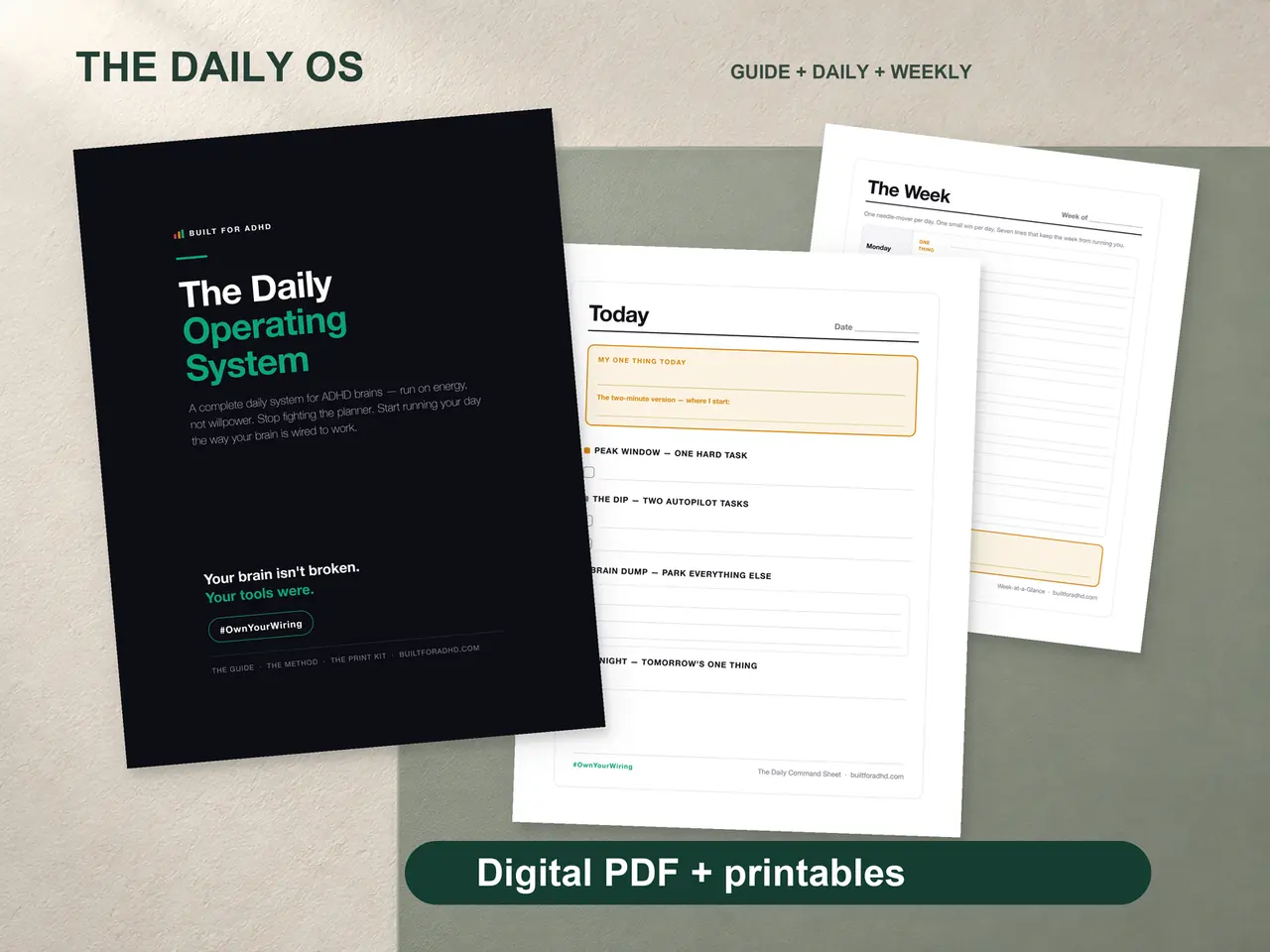
If you want the system the prep block lives in — energy-sorted days, the brain dump, and a one-page Command Sheet that keeps a week like this from eating everything else — that’s the ADHD Daily Operating System, $17. The one-pager above is six stories on a blank sheet and it works fine on its own.