In this article
The box said list your key accomplishments this review period and I sat in front of it for forty minutes and typed one sentence I later deleted.
Not because the year had been bad. It had been a good year — I knew that in a vague, unusable way, the way you know a movie was fine. What I could actually retrieve was: the thing I dropped in August, a meeting where I talked too much, and a deadline I made by about nine minutes. Three items, all failures, all recent.
Here’s what I got wrong for years: I thought that blank box was a verdict on the year. It was a retrieval test, and retrieval is the specific thing my brain does worst. Those are not the same test, and I was failing the one nobody was grading.
The self-evaluation is a memory exam disguised as a performance exam
Three things are happening in that box at once, and none of them is about how good you are at your job.
Twelve months is far past where the recall drops off. Ask me what I shipped last week and I can tell you. Ask me about February and there is nothing there — not a hazy version, nothing. The information isn’t missing from the world; the path back to it doesn’t exist in my head. Same mechanism as walking past a pile twelve times without seeing it: out of sight, genuinely out of mind, and sitting there harder won’t produce it.
The bad stuff has a shorter path than the good stuff. The dropped ball in August comes back instantly and in high definition. The project that went fine in March doesn’t come back at all, because nothing about it carried a spike of alarm. So the list your brain hands you for “the year” is a list of near-misses, which reads as a bad year, which makes the box harder to open at all. If you already know what RSD does to a neutral piece of feedback, you know what it does to a form that asks you to grade yourself.
The work that was easy doesn’t register as work. This one costs the most money. Something you did in a two-hour hyperfocus run doesn’t feel like an accomplishment, because it didn’t hurt — so it never makes the list, while the thing that took three agonizing weeks does, even if nobody needed it. You end up reporting your suffering instead of your output.
Stack those three and the summary is: a self-evaluation written from memory will reliably under-report your year. Not modesty — a broken retrieval path. So stop retrieving, and go get the receipts.
The receipts harvest: six places, forty-five minutes, no remembering
You already left evidence everywhere. You don’t need to recall the year — you need to read it back off the surfaces that logged it for you.
Open a blank page, set a timer, and go through these six in order, pasting in anything that was a thing with its date. No judging whether it counts; that’s a separate job for later.
- Your sent mail. Search your own outbox by quarter, not by keyword. The subject lines are a diary of what you were actually doing in April.
- Your calendar, backwards. Recurring meetings tell you what you owned; one-off meetings tell you what you fixed.
- Chat, searched for your own name. Every “thanks for sorting that,” every “can you look at” — those are other people’s records of your work, which is exactly what the form is asking for.
- Whatever tracks the work. Tickets, cards, docs, repos. Filter to assigned-to-you and closed.
- File dates. Sort a shared drive by modified and scroll. Decks and spreadsheets you forgot you built are sitting right there with timestamps on them.
- Your own capture, if you have one. A notes app, a voice brain dump, a half-kept journal.
You’ll finish with sixty or eighty lines. The gap between that and what you could remember unaided is the whole reason this post exists.
The four-line format for each item
Now sort. Pick the eight or ten biggest lines and write each in exactly four lines — enough to be concrete, few enough that you’ll finish.
- What changed. The outcome, in the organization’s language, not yours. “Onboarding went from six days to two,” not “I worked on onboarding.”
- What I did. Your specific move. Built, negotiated, rewrote, caught, unblocked.
- What it cost or saved. A number if one exists — hours, dollars, tickets, people. If no number exists, say what it prevented instead. A pulled number beats an adjective every time.
- Who saw it. The name of whoever benefited. This is the line that survives being read by somebody two levels up who doesn’t know what you do.
Keep that order. It leads with the result rather than the effort, which is why most self-evaluations read as a list of chores.
The growth-areas section is not a confession
This is where I used to do real damage. Asked what I needed to improve, I’d hand over a tidy paragraph of self-criticism — because over-apologizing is the reflex, and because saying it first felt safer than hearing it. That paragraph goes in a file and gets read back to you next year.
Write three sentences instead:
One real thing, stated as a mechanic. Not a character flaw. “Long-horizon deadlines slip unless I break them into dated pieces” is a mechanic. “I’m bad at time management” is a verdict, and you just wrote it down about yourself.
The system you’ve already put on it. Name the actual fix you run — the dated reverse-engineering of deadlines, the single visible surface, the capture rule. “I now work backwards from the deadline in dated chunks” is a sentence about an operator, not a patient.
One concrete thing you want. Earlier notice on project start dates. Written requirements instead of a verbal handoff. A standing fifteen minutes instead of ad-hoc check-ins. Ask for the specific, cheap, practical thing — that’s a working conversation, and a different one from a formal accommodations request, which has its own process and isn’t what this form is for.
Keep the file so next year takes twenty minutes
The harvest works and it’s a genuinely unpleasant forty-five minutes. Do it once, then never again.
Open one file called receipts. Every time something lands — shipped, thanked, a number that moved — paste one line in with the date. Ten seconds, no format, no streak to keep up. Mine lives next to my task list, which is the only reason it survives.
Anchor it to something that already happens rather than to a day of the week. Mine is the weekly reset: when the week gets closed out, anything worth a line gets a line. A file that runs on remembering to update it is a file with nothing in it by March.
And match the harvest to the tank, not the calendar — sort by energy rather than by schedule. Low day: one source and stop, because sent mail alone will get you twenty lines. Good day: all six in one sitting. Partial isn’t failure, it’s the version that gets done.
What good looks like
Good isn’t a beautifully written self-evaluation. Good is a box you open with a page already next to it, so the job is editing instead of remembering.
Do this today, even if your review is in March: make the receipts file and paste in three things from the last month. Ten seconds each. That file is the difference between next year’s version of this and the forty minutes I spent typing one sentence I deleted.
If you want the weekly surface this hangs off, the free adults starter is the printable version, and the work-from-home productivity hub covers the rest of the workday systems.
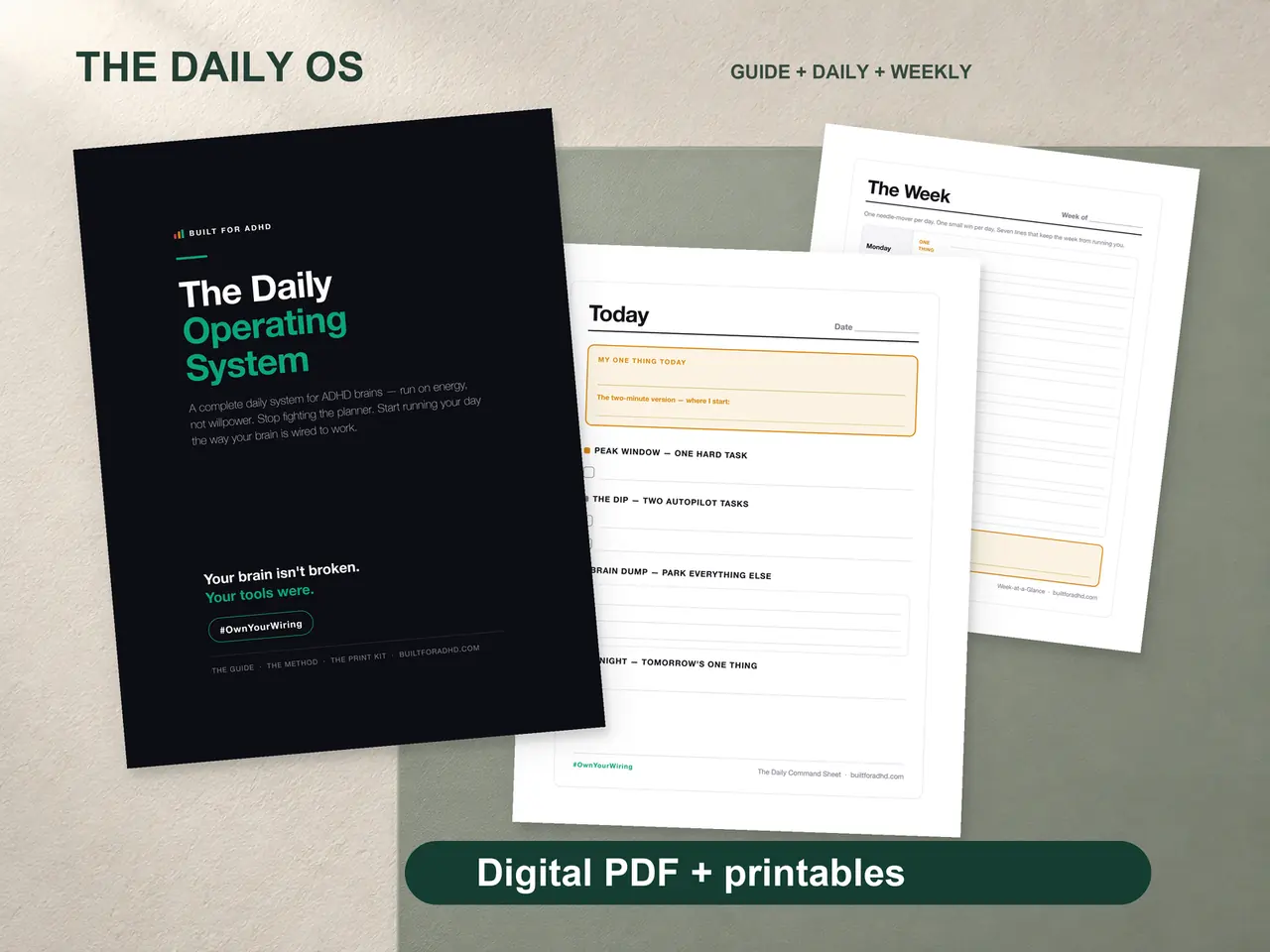
If you want the week built out properly — the energy sort, the brain dump page, the weekly review the receipts line hangs off — that’s the ADHD Daily Operating System, $17. Honest note: there’s no performance-review worksheet in it. It’s the daily and weekly operating surface; the harvest and the four-line format above are free and work on their own.
Related tools
- The free adults starter — the printable weekly surface the receipts file sits next to
- ADHD work-from-home productivity — the hub for the rest of the workday
- What RSD feels like — why a self-grading form doesn’t land neutrally
- ADHD over-apologizing — the reflex that wrecks the growth-areas box
- Meeting deadlines by reverse-engineering them — the mechanic to name instead of a flaw
- Energy-based task management — how to size the harvest to the day
- Turning hyperfocus into revenue — why the easy wins never make the list