In this article
I have written the same three things on a notepad maybe forty times this year. Not because I forgot them. Because writing them down is the part that costs me something, and by word four of “call the insurance about—” my brain has already left to think about the dishwasher.
That’s the quiet failure of the brain dump. Everyone tells you to get it out of your head, and they’re right — the swirl is heavy specifically because you’re holding all of it with working memory, which is the thing ADHD is stingiest with. But nobody mentions the toll booth on getting it out. A blank page is a demand: pick a first item, phrase it in complete words, spell it, line it up under the last one. On a good morning that’s nothing. On a Tuesday at 4 PM with eleven open loops, that toll is the entire reason the dump doesn’t happen.
So stop typing it. Say it out loud to a chatbot and let it do the writing.
I know how that sounds — like a gimmick, or like one more thing to set up. It isn’t. It’s the same brain dump method that’s been the foundation of this whole site, minus the toll booth. And once I switched, I went from dumping maybe twice a week to doing it most days, which is the only metric that has ever mattered.
Why talking works when typing doesn’t
Speech is the channel that’s already open. Most of us with ADHD are not short on words. We’re short on the executive step between having the thought and formatting the thought. Talking skips it. You don’t have to decide where the sentence starts, and you can absolutely say “okay so there’s the thing with the car, no wait, first — the dentist, they called twice” and have it come out fine on the other end. Try typing that and you’d have gone back to fix “wait” into a proper line, and the fixing is where you’d lose the next four items.
It’s faster than your hands. The swirl empties at the speed you can say it, which roughly matches the speed you can think it. Typing is slow enough that your brain wanders off mid-list, and that gap is where items get dropped — not from forgetting, from waiting.
No backspace, no perfectionism. The reason a written dump turns into twenty minutes of nothing is that you start editing the list into a nice list. Voice has no cursor. You cannot go back and make it tidy, which sounds like a downside and is actually the entire feature.
Dread doesn’t build up. Ninety seconds of talking feels like nothing, so you’ll do it again tomorrow. A page you have to sit down and fill accrues dread every day you skip it, until it becomes one more thing you’re behind on — the mechanism that turns a system into a doom pile, made of guilt instead of laundry.
How to actually do it
Open ChatGPT or Claude on your phone, tap the microphone in the message box (not the assistant voice mode — the plain dictation mic, so you get a transcript you can see and reuse), and paste this above your rambling, or just say it first:
“I’m going to talk at you for a minute. It’ll be out of order and I’ll contradict myself. Don’t coach me, don’t add anything I didn’t say, don’t tell me I’m doing great. Just listen, then sort it into: needs a decision, needs a 2-minute action, needs a scheduled block, and someone-else’s-problem. Flag anything with a real deadline.”
Then talk. Everything. The oil change, the birthday you almost forgot, the feeling that something’s wrong with the invoice you sent in June, the fact that you’re out of coffee. Tangents included. The mess is the point — you’re not composing, you’re emptying.
Four things make the difference between this being useful and it being a novelty:
1. Tell it not to be encouraging. Unprompted, these things hand your anxieties back wrapped in a motivational speech, and there is nothing quite like being cheered at by software while you’re already fried. “No pep talk” in the setup line fixes it permanently — same principle as ADHD-shaped custom instructions.
2. Make it ask before it assumes. Add: “If something I said is too vague to sort, ask me one question about it.” This is the move that earns its keep. Half my dump items are a decision in a costume — “deal with the car thing” is really “decide whether to fix it or sell it,” and it sat there two months precisely because nobody, including me, would say that out loud.
3. Cap the output. “Give me no more than five things back, ranked, and hold the rest.” Thirty items sorted into thirty items is still thirty items — you didn’t reduce the load, you alphabetized it. Five is a list you can look at without flinching.
4. Demand starts, not steps. For anything on the short list, “what’s the first physical thing I do, under two minutes, from where I’m sitting?” — the difference between “gather documents” and “text Mom for the policy number” is the difference between a list and motion. That’s the whole task-breakdown pattern, applied to the swirl instead of one project.
Where it fits in a day
Two slots, in my experience. First thing, before anything hijacks the morning — dump, get the five, pick one. That’s the ninety-second version of the ChatGPT morning routine for days when the full thing is too much.
And at night, when the ceiling gets interesting. The 11 PM swirl isn’t information — it’s the same six items rotating so you don’t drop them, and your brain keeps rotating them until it believes they’re written down somewhere. Say them out loud, get a list back, close the phone. The relief is disproportionate to the effort, and it’s the cheapest fix I know for the brain that won’t shut off at night.
Not while driving, though. I tried it; the list ends up in a phone I’m not looking at and evaporates by the time I park. Capture without a landing spot isn’t capture.
The honest limits
The transcript is where this falls apart, and I’d rather say so than sell you a clean story.
Dictation will mangle names and any word your accent treats casually. Mine turns one client’s name into a farm animal every single time. Fine for a to-do list — you know what you meant — but don’t build anything precise on a raw transcript.
Bigger problem: the sorted list lives in a chat window, and chat windows are where things go to die. You will have a beautiful five-item list at 8 AM and no memory of which conversation it’s in by 2 PM. The dump is only half the loop. It has to land somewhere your eyes actually go — a card on the desk, a sheet on the fridge, the one page you already look at. That landing spot is the same energy-based sort I’d use with a paper list; AI changed how the swirl gets out, not where it lives.
And if talking to a machine feels ridiculous, or you’re never anywhere private enough — thumb-typed and half-punctuated into the same chat gets you most of this. The gain isn’t the microphone. It’s that something else does the sorting.
Start tonight, badly. Open a chat, hit the mic, say the six things currently circling. Don’t organize them first — that’s the toll booth, and you’re allowed to drive around it. The prompt above plus twenty-four more, sorted by stuck state, are in the free prompt pack.
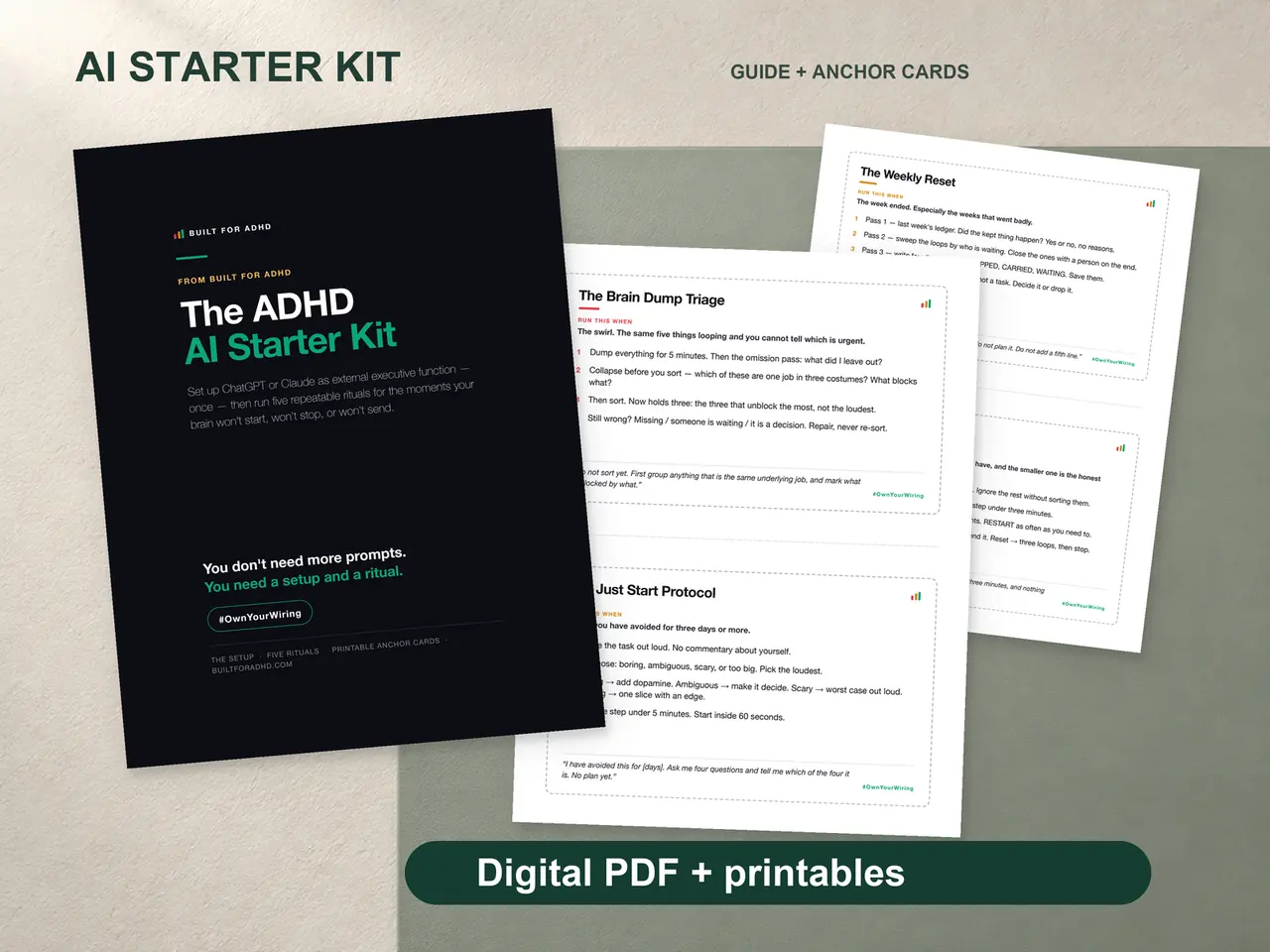
If the dumping starts sticking but the landing keeps slipping — great lists, gone by lunch — that gap is the thing the ADHD AI Starter Kit is built to close: the paste-once setup block so every reply comes back ADHD-shaped without re-explaining yourself, the rituals for morning triage and the night-time dump, and printable anchor cards so today’s three things sit on your desk instead of in a tab you closed. $27 once, no subscription.
Related tools
- The brain dump method — the paper original, still the foundation
- The free Brain Dump Sorter — same sort, no chatbot required
- ChatGPT prompts for ADHD, by stuck state — the full set
- AI task breakdown for ADHD — what to do with the item you picked
- The AI for ADHD hub — every setup guide, technique, and honest review in one place
Sources
- CHADD, “ADHD Can Trip Up Memories” — https://chadd.org/adhd-weekly/adhd-can-trip-up-memories/