In this article
Every ChatGPT-prompts-for-ADHD list is organized by productivity category: “planning prompts,” “focus prompts.” But you don’t experience your day in categories. You experience it in stuck states — frozen in front of a task, drowning in open loops, nine rewrites into an email you can’t send. So this library is organized by the stuck, not the category. Find your state, paste the prompt.
One thing first: prompts work dramatically better after a one-time setup — custom instructions that tell ChatGPT how ADHD answers should look (short, structured, max 3 actions). Do that once; every prompt below gets sharper. Under each prompt here: one line on why it works for this brain, because prompts you understand are prompts you adapt.
Stuck state 1: “I can’t start”
The most ADHD stuck of all. You know what the task is. You even want to do it. The starting mechanism just won’t fire.
The 2-Minute Door:
I’m avoiding this task: [task]. Don’t give me a plan. Give me one physical action I can do in under 2 minutes that counts as starting, then wait for me to report back.
Why it works: initiation, not knowledge, is the broken step (ADDitude) — this deletes everything except the door. (The tiny-first-step method, automated.)
The Just Start ladder:
Break [task] into steps so small each feels almost insulting. First step must take under 2 minutes. Number them. Show only the first 3 — keep the rest hidden until I ask.
Why: a full list re-triggers the overwhelm that froze you; three steps is a hallway, not a wall.
The frozen-morning defrost:
I’m at my desk, frozen, and everything feels equally urgent. Ask me 3 quick questions, one at a time, then tell me the single thing to do first and why the rest can wait.
Why: being interviewed is easier than deciding — answering is a lower-EF act than choosing.
The re-entry (after a distraction crater):
I fell off task 40 minutes ago and I’m ashamed to restart. No commentary on the 40 minutes. Just re-anchor me: what was I doing, what’s the smallest way back in?
Why: shame is the actual barrier to re-entry, so the prompt bans it structurally.
Stuck state 2: “I can’t sort” (too many open loops)
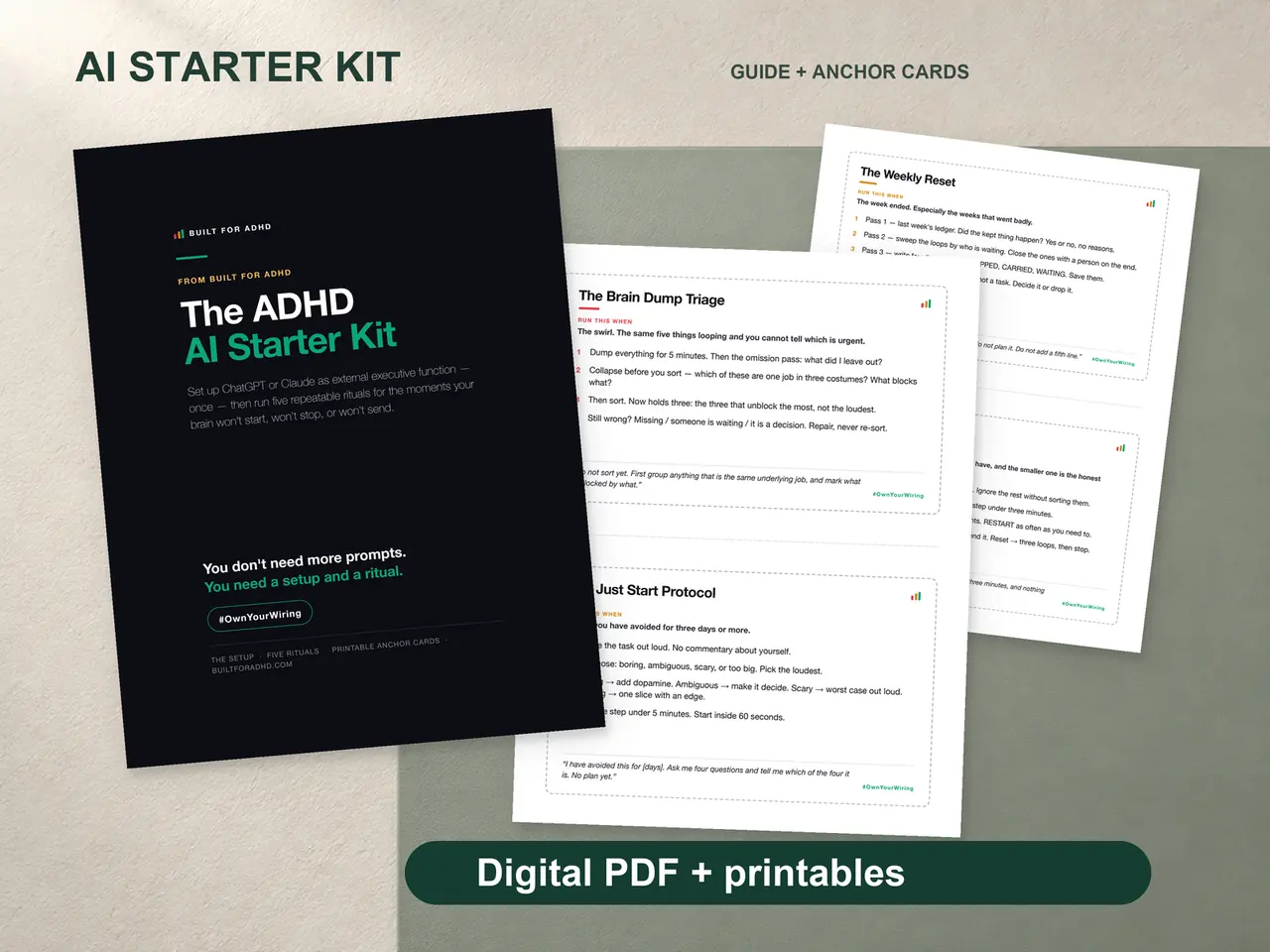
The Brain Dump Triage:
I’m going to dump everything in my head, unfiltered and unordered. Sort it into: TODAY (max 3), THIS WEEK, LATER, and IGNORE (things that are anxiety, not tasks). Then give me the single first action for the top TODAY item. Here’s the dump:
Why: the brain dump empties working memory; the IGNORE pile is the magic — half the load was never a task.
The invisible-load dump (parents, this one’s yours):
Here’s everything our household needs that lives only in my head: [dump]. Turn it into a visible list by person and day, so the remembering stops being my job.
Why: the mental load is a working-memory tax; externalizing it is the whole command-center principle.
The someday-project parking lot:
Here are the 6 projects bouncing in my head: [list]. I can only actually run one. Interview me briefly, pick the one, and park the rest in a numbered lot I can revisit Friday.
Why: ADHD idea-generation outruns capacity; a parking lot honors ideas without obeying them.
Stuck state 3: “I can’t stop” (hyperfocus and rabbitholes)
The rabbithole tether (paste BEFORE you research anything):
I need to look up [thing] for [purpose]. Give me exactly what I need for that purpose and nothing adjacent. If I ask follow-ups that drift from the purpose, point it out and ask if I want to park them.
Why: AI is a rabbithole amplifier by default — infinite patient answers. The tether makes it the exit instead.
The hyperfocus gate:
I’m about to give this project a hyperfocus block: [project]. Before I disappear: does anything else blow up if I’m gone for 3 hours? Check bills, people waiting on me, appointments. Then tell me it’s safe to dive.
Why: hyperfocus’s damage is collateral, not the focus itself — the gate check takes 90 seconds.
The exit ramp:
When I say “landing,” walk me out of this work session: capture where I stopped, what the next step is, and what future-me needs to know to restart without re-reading everything. Keep it to 5 lines.
Why: the post-hyperfocus crash destroys the context you’ll need Monday; the note is a gift across time.
Stuck state 4: “I can’t send” (the RSD drafts folder)
The RSD-safe send:
I’ve rewritten this message too many times: [paste draft]. Tell me: 1) Is anything in it actually likely to land badly, or is that the RSD talking? 2) Give me a version that’s direct and warm. 3) Tell me it’s okay to send it — once.
Why: RSD turns “ok.” into a verdict; an outside reader with no amygdala breaks the loop.
The bad-news opener:
I have to tell [person] something they won’t love: [situation]. Draft the first two sentences only — direct, no over-apologizing, no wall of context. I’ll take it from there.
Why: avoidance lives in the first sentence; everything after it is downhill.
The panic-to-status translator:
Turn this anxious mess into a calm 4-line status update for my [boss/client]: what’s done, what’s in progress, what’s blocked, what I need. Here’s the mess: [dump]
Why: you’re not behind on the work as often as you’re behind on the narrating of the work.
Stuck state 5: “I can’t decide”
The dinner override:
Decide dinner for me. Constraints: [what’s in the fridge / budget / energy level 1-10]. Give me ONE answer, no options. I get one veto, then I’m eating whatever you say next.
Why: at 5 PM the decision budget is gone; options are the problem, not the solution. (The paper version.)
The two-yes filter:
I’m deciding between: [options]. Ask me the two questions that actually matter for this decision, then make the call and tell me why in 2 sentences. If I argue, hold your position unless I give you new information.
Why: “hold your position” is the line that stops the re-litigation spiral.
The estimate doubler:
I think [task] will take [time]. You know I have ADHD time blindness. What do I actually need to block, and what’s my leave-the-house time if I need to be somewhere at [time]?
Why: the brain doesn’t feel time; arithmetic doesn’t care.
Make them fire automatically
A library you have to remember is a library you’ll lose by Thursday — the ADHD tools problem in miniature. Three moves fix it:
- Set custom instructions so every answer comes back ADHD-shaped without prompting.
- Save your top 3 as text shortcuts on your phone (“;dump” → the Brain Dump Triage) so the prompt costs two keystrokes at your worst.
- Put the paper layer on your desk. The ADHD AI Starter Kit ($27) ships the full versions of these as five repeatable rituals plus printed anchor cards — the prompt library that survives the week you don’t open anything, because it’s physically looking at you.
Or start free: the free ADHD AI prompt pack has the most-used of these formatted for copy-paste.
Sources
- ADDitude, “Why Getting Started Is So Difficult for Adults with ADHD” — https://www.additudemag.com/getting-started-adhd-challenges/
Related tools
- ChatGPT custom instructions for ADHD — do this once first
- AI body doubling: the complete protocol — the working-session version
- Claude for ADHD — same library, Claude-flavored setup
- ADHD AI Starter Kit — $27: rituals + anchor cards, no subscription
- The AI for ADHD hub — every setup guide, technique, and honest review in one place