In this article
“Renew your passport.” Four words. It has been on your list for five months.
Not because it’s hard — because it isn’t a task. It’s a fog bank: forms you haven’t identified, a photo requirement you half-remember being weird, some fee, probably an appointment? Your brain looks at the fog, cannot find the first physical action inside it, and files the whole thing under later. That’s task paralysis, and it isn’t laziness — it’s what happens when a brain that needs a next action is handed an outcome.
Breaking outcomes into actions is the fix, and it has always been the fix. The problem is that the breaking-down is itself executive function — the exact resource that’s depleted. Asking an ADHD brain to decompose the task before starting it is asking it to spend the budget on the packaging.
This is the one job AI does close to perfectly, in seconds, for free. And because we promise honesty on this site: you don’t need to buy anything to do it — including from us. Here’s how to do it well, and the part the breakdown alone doesn’t solve.
Doing it right: the difference between steps and starts
Paste the fog into ChatGPT or Claude and ask it to break the task down and you’ll get something decent. Add three constraints and you’ll get something that actually beats paralysis:
1. Demand a 2-minute first step. “Break ‘renew my passport’ into steps. The first step must be doable in under 2 minutes, sitting where I am, with the device in my hand.” The difference between “Step 1: Gather required documents” and “Step 1: Google ‘passport renewal DS-82’ and open the first .gov link” is the difference between a prettier fog and an ignition. Steps describe work; starts describe motion.
2. One step at a time on the hard ones. For the genuinely dreaded tasks, seeing all eleven steps is its own overwhelm — the list becomes the fog. Ask instead: “Give me ONLY the first step. When I say done, give me the next.” Working memory holds one thing beautifully. Let it.
3. Make it interrogate the fog. Sometimes a task is stuck because it secretly contains a decision — “plan mom’s birthday” is really “decide restaurant vs. cooking,” wearing a fog costume. Ask: “Before breaking this down, ask me the one question that’s actually keeping it vague.” Watching the real blocker fall out of a five-month-old task is worth the price of admission, which is zero.
The honest part: the breakdown isn’t the bottleneck for long
Here’s what we’d tell you as a friend rather than a store: free tools already do pure task-shattering well — the beloved Goblin Tools has done it for years, and a plain chatbot with the prompts above does it too. If step-splitting were the whole problem, ADHD would have been solved in 2023.
What actually happens after week one: the steps exist and the starting still doesn’t. Because the breakdown was never the whole mechanism — it’s one move inside a bigger loop. The task has to get into the system on a bad morning (the dump-and-sort). The first step needs a session structure around it so step two follows (the body-double pattern). The steps have to live somewhere your eyes go, not in a closed tab. And the whole thing has to survive the day you skip it, without a shame spiral relaunching the paralysis.
Breakdown is a feature. The workflow is the fix.
The workflow, assembled
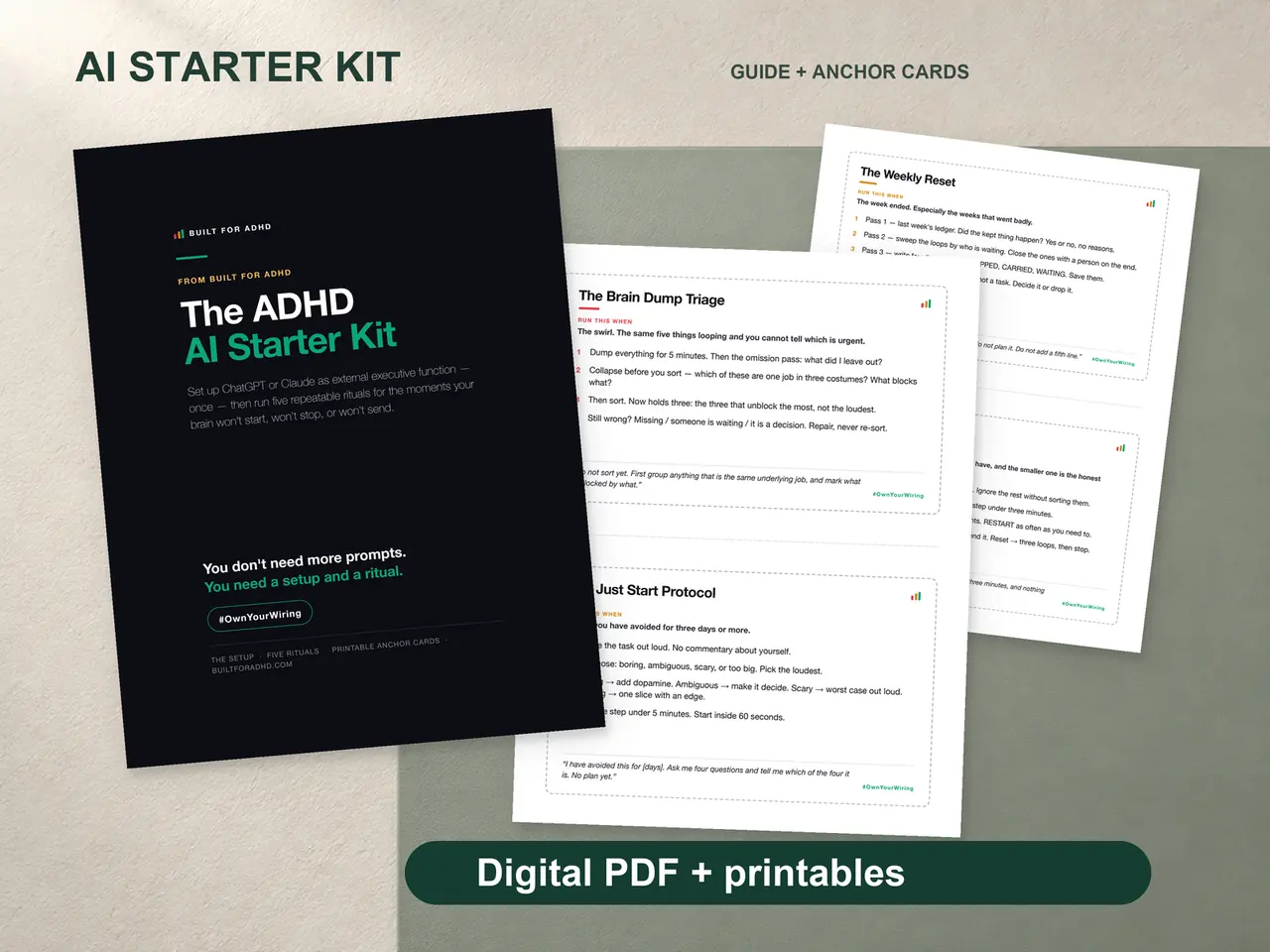
That’s the actual design of the ADHD AI Starter Kit — not a better step-splitter, but the loop around it: the paste-once setup block that makes every breakdown come back ADHD-shaped by default (tiny starts, one at a time, no lectures), the Just Start Protocol that welds breakdown to ignition, the surrounding rituals for triage, sessions, dreaded sends, and the weekly reset, and printable anchor cards so today’s three steps exist on your desk instead of in a tab. $27 once, no subscription — because a tool for people who abandon apps should not bill them monthly for the privilege.
Try the free versions first, genuinely: the prompts above cost nothing, the 25-prompt pack bundles them, and the Brain Dump Sorter handles the upstream sort. If those become a habit that keeps slipping through your fingers — that slipping is the thing the Kit fixes.
Meanwhile, the passport: open a chat, paste “Break ‘renew my passport’ into steps — first one under 2 minutes, doable right now with my phone.” Five months of fog, two minutes of motion. Go.
ChatGPT for task initiation: when the breakdown is not the problem
Sometimes the steps already exist. You did the breakdown, or ChatGPT did it for you in ten seconds, and the list is sitting right there — and you still haven’t touched step one. That’s not a breakdown problem. That’s task initiation, and it’s a different failure mode with a different fix.
Task initiation is the gap between knowing what to do and starting to do it, and for a lot of ADHD brains it isn’t about difficulty at all — it’s a freeze. I feel frozen is the more accurate description than “I don’t want to,” and freezing doesn’t respond to a better list. It responds to getting moving, at almost any cost, on almost anything adjacent to the task.
This is where a chat window earns its keep, used differently than for breakdown. Three ways to use it:
Ask for a first step under two minutes, framed as motion, not planning. “Give me one thing I can do about [task] right now, in under two minutes, that doesn’t require a decision.” Not “what’s step one” — that reopens the planning door you’re trying to close. A prompt like this hands you a physical action: open the folder, find the confirmation email, put the form on the counter. Motion first, thinking later.
Ask it to pretend it’s a video game tutorial. “Walk me through [task] one step at a time, like a video game tutorial — tell me only the current step, wait for me to say done, then give me the next one.” This works because a tutorial never shows you the whole skill tree before you’ve picked up the sword. One visible objective at a time removes the part of the fog that makes eleven steps feel like ten reasons to quit.
Build a check-in loop instead of a one-shot answer. Tell it up front: “Check in with me every few minutes and ask only whether I’ve moved, not why I haven’t.” A single breakdown is a static object; a loop is a companion. That loop is the same mechanism behind AI body doubling — the presence matters more than the content of any single message.
None of this replaces the tiny-first-step method — it’s the AI-assisted version of the same idea, for the days your own working memory can’t hold “just do the tiny thing” long enough to act on it.
As of 2026 the evidence on AI as executive-function support for ADHD is early-stage and small-sample: a 13-person diary study of ADHD adults using ChatGPT found it supporting both executive function and emotional regulation over a week of real use, and CHADD’s own overview of AI tools for ADHD reaches a similar conclusion — genuinely useful, not a substitute for care, and not yet proven at scale.
FAQ
Why does ChatGPT’s breakdown of my task not help me start? Because breakdown and initiation are two different jobs, and a task list only solves the first one. A clear list of steps still requires the separate, expensive act of choosing to begin — if you’re frozen, more clarity about what to do doesn’t touch the freeze itself.
What’s the best ChatGPT prompt for task initiation? Ask for exactly one action, under two minutes, framed as something you do with your hands rather than something you decide. “Give me the smallest possible physical first move on [task], no decisions required” beats “break this down” every time you’re stuck at the starting line rather than lost in the plan.
Is using AI to get unstuck a real strategy or a crutch? A real strategy — the same logic as a calendar or an alarm. Task initiation is one of the executive functions most consistently affected by ADHD, and offloading part of it to an external prompt is no different from offloading time-tracking to a timer. It becomes a problem only if the prompting replaces starting entirely, which is worth noticing if a week goes by with nothing but conversations.
Related tools
- The tiny first step method — the manual version of this entire post
- Goblin Tools review — the one-click chopper, and where it stops
- ChatGPT prompts for ADHD, by stuck state — this prompt plus 24 more
- The free Brain Dump Sorter — sort the swirl before you break it down
- A ChatGPT morning routine — where the breakdown fits in a daily loop
- ADHD AI Starter Kit — $27: the setup block, the Just Start Protocol, the cards
- The AI for ADHD hub — every setup guide, technique, and honest review in one place
Sources
- Pinto, A., Quilter, E., Vasikaran, J., Koerner, S., Chimonas, T., Nielsen, E., Marshall, P., & O’Hara, K. (2025). “‘A little bit of a life raft’ – Exploring the Use and Experiences of ChatGPT as a Support Tool among Adults with ADHD.” OZCHI ‘25. https://doi.org/10.1145/3764687.3764713
- Sophos, S. (2024). “Harnessing Artificial Intelligence to Live Better with ADHD.” CHADD, Attention Magazine. https://chadd.org/attention-article/harnessing-artificial-intelligence-to-live-better-with-adhd/