In this article
The first time I asked for something at work, I said: “I think I’d do better with a bit more flexibility.”
My manager said that sounded reasonable. Nothing changed. Not because he was dismissive — he was genuinely fine with it — but because I had handed him a feeling and expected him to return a policy. He had nothing to approve — no sentence he could forward, no line he could put in a calendar. So the conversation ended warmly, and the week after looked exactly like the week before.
That is the whole failure mode, and it is almost never about whether the workplace is willing. It is that the ask was not a request. It was a mood.
(Worth saying plainly up front: I am not an HR person or a lawyer, and I am not going to tell you what any employer owes you. Policies and processes differ enormously between companies and countries. This is only about the writing problem — how to put the ask in a form somebody can act on.)
Why “more flexibility” never survives contact
When you ask for understanding, you are asking someone to change how they see you. Nobody can grant that, and most managers will try to be kind instead — which reads as a yes and functions as nothing.
When you ask for a working condition, you are asking for a thing that either exists next Tuesday or does not. “Can my 1:1 move to 2pm” is a yes or a no. “Can we do decisions in writing” is a yes or a no. A manager can approve those in eleven seconds without having an opinion about your brain, and that is exactly what makes them land.
So the translation step is the actual work, and it happens before you open the email. Take what you are struggling with, and keep asking “so what specifically would be different” until the answer is a thing on a calendar, in a document, or in a tool.
- I can’t focus in the open office → a recurring two-hour block, headphones-on, no meetings in it
- I forget what I agreed to in meetings → decisions confirmed in a message after the meeting, not just said out loud
- My mornings are wrecked → my deep-work block is 7–9am and my meetings start at 10
- I lose the thread on long projects → a 15-minute weekly check-in instead of a monthly one
Same problems. Completely different asks. The right-hand column is the one that gets granted.
The four that actually get approved
Across every job I have had, almost everything useful I ever got fell into four shapes. They are cheap, they are boring, and boring is what gets a yes.
1. A protected block. One recurring hold on the calendar, named something neutral — focus block, project work. Not a whole protected calendar; one block. You cannot defend a schedule, but you can defend a block, and one defended block is where the hard thinking actually gets done.
2. Decisions in writing. “Can you drop the decision in the channel after the meeting?” This is the single highest-value thing I have ever asked for. It is framed as a team hygiene improvement because it genuinely is one, and it quietly removes the part where you leave a meeting having retained the tone and not the task. If nobody else will do it, do it yourself — see the AI meeting notes setup for how to catch what was said when you cannot listen and write at the same time.
3. One channel per thing. “Please send me anything actionable by email rather than catching me in the hallway.” Hallway tasks and drive-by Slack messages do not survive an ADHD working memory, and when work arrives in five places, the pile is the problem rather than the work. This ask pairs with an inbox you actually process — the email overwhelm system is the other half.
4. Shorter feedback loops. A 15-minute Friday check-in instead of a monthly review. This one costs your manager almost nothing and fixes the thing where a project drifts for three weeks because time blindness made three weeks feel like four days.
Pick one. Possibly two. A list of six specific requests reads as a renegotiation of the job, and the person reading it will take the whole thing away to think about, which means nothing happens. One ask, granted next week, beats six asks under review forever.
The email, with blanks
Short, specific, forwardable. Written so the last line is the easiest thing in the world to answer.
Subject: Small change to how I work — quick ask
Hi [name],
One thing that would make a real difference to the quality of my work on [project or area]: [the specific condition — e.g. “a recurring 9–11am block on my calendar with no meetings in it”].
The reason: I do my best [deep / analytical / writing] work in a single uninterrupted stretch, and right now it gets split across the day, which costs me more than the hours suggest. [Optional: One concrete example — “the Q3 analysis took three sessions instead of one.”]
It wouldn’t change [my availability for X / the Thursday standup / anything client-facing] — I’d still be reachable for anything urgent.
Happy to try it for a month and tell you whether it made a difference. Can I go ahead and put it on the calendar?
Thanks, [you]
Four things are doing the work in there. The ask is a specific object. The reason is about output quality, not about you. The sentence that names what will not change removes the unspoken worry. And the trial frame means they are approving an experiment rather than a permanent policy, which is a much smaller door to walk through.
Notice what is not in it: no diagnosis, no explanation of ADHD, no apology, no “I know this is a lot.” You can mention ADHD if you want to and if you trust the person — that is entirely your call and the request works either way. What matters is that the ask stands on its own without the context.
Who to send it to
Your direct manager, by name, in one message. Not the team channel, not HR first, not a meeting request titled “quick chat” that gives them twelve hours to invent what it is about.
If your workplace has a formal accommodations process, you can run both tracks — but send the small informal ask anyway, because the formal process takes weeks and a calendar block takes a minute. One of those changes your November.
And if the answer is no, ask one follow-up question: “Is there a version of this that would work?” Half the time the no is about one detail, and the second answer is the yes.
The part after the yes
Write down what was agreed, the day it was agreed, in a file you keep. One line:
Oct 22 — agreed with [name]: 9–11am focus block, no meetings, trial through November. Revisit Dec 1.
It is not a defensive move. Trials quietly expire, people forget, teams reorganize, and six months later you will want to know what was actually said. It is also the same file that makes the performance review self-evaluation writable, and the same habit the first 90 days of a new job runs on: write it down in the calm moment so you are never retrieving it in the expensive one.
In the next ten minutes
Write one sentence. Just the ask, as an object: what, when, how often. Not the email yet, not the reasoning — the one specific thing that would be different on your calendar or in your inbox next week.
If you can write that sentence, you already have the request. The rest of the email is scaffolding around it, and the reason the first version of mine failed was never courage or timing. I just never got the sentence down.
If you want somewhere for the protected block and the agreement file to live, the free ADHD starter kit for adults is the ten-minute version of the setup.
Related tools
- The ADHD work-from-home productivity system — the working surface the protected block sits inside
- ADHD and the first 90 days of a new job — when to make the ask at a new job (not week two)
- ADHD performance review self-evaluation — what the agreement file turns into
- AI meeting notes for ADHD — for catching decisions when nobody will write them down
- The ADHD email inbox overwhelm system — the other half of “one channel per thing”
- Body doubling while working from home — for the protected block you keep not starting
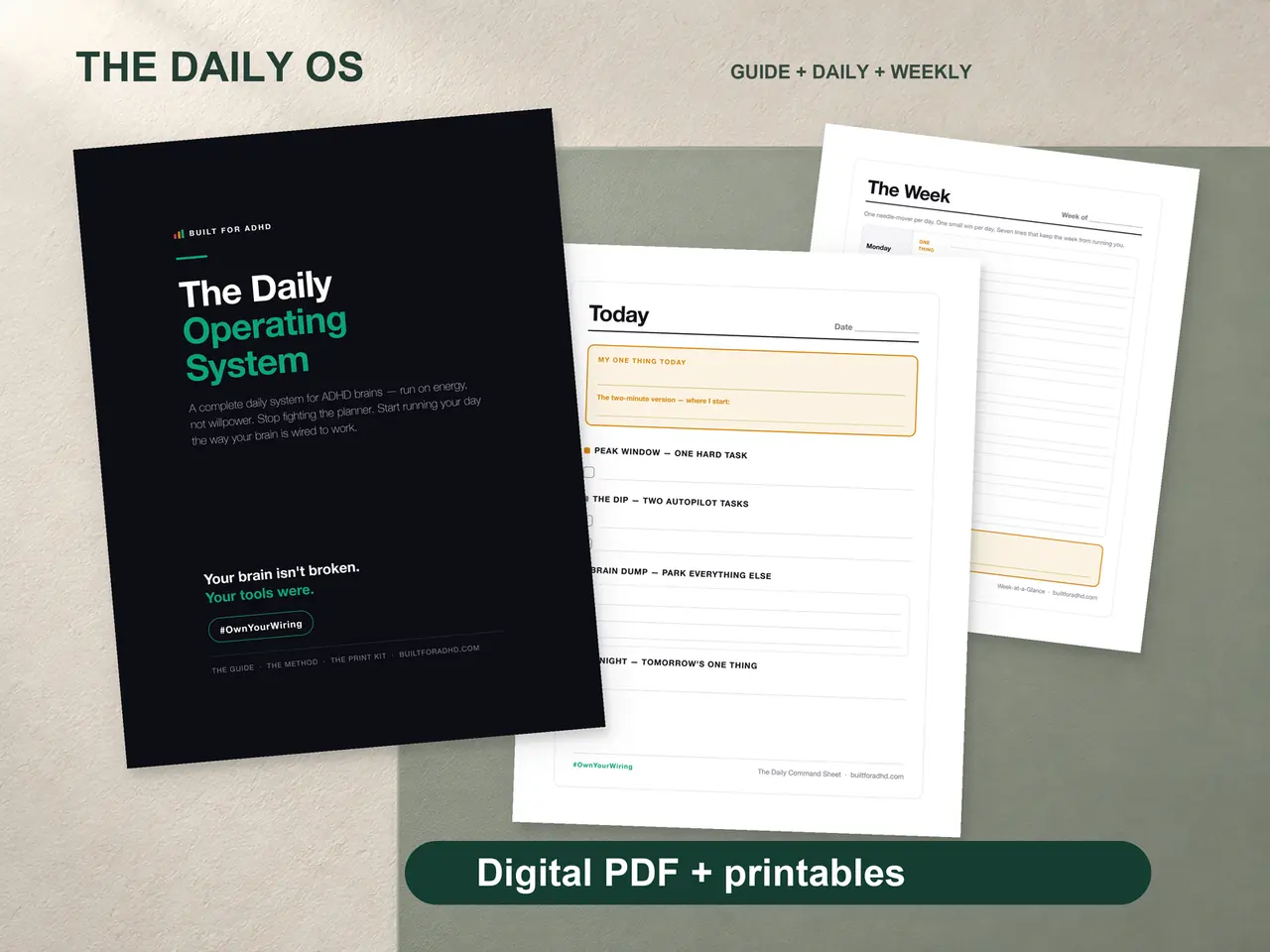
If you want the structure underneath all of this — energy-sorted days, the brain dump, and a one-page Command Sheet the protected block feeds into — that’s the ADHD Daily Operating System, $17. The asks above work fine with a plain notes app; the Daily OS is just the version that already has the pages.