In this article
You don’t need an office to get the effect of body doubling at work — you need the same three things remote work strips away: a witness, a start time, and someone who’d notice if you drifted. Body doubling supplies exactly those, and for remote ADHD workers it’s less a nice-to-have than the missing bridge between thinking and doing, because when nobody’s watching you walk into the office, the walking-in part just doesn’t reliably happen.
The 9am start wall
In an office, momentum is borrowed from other people — you see coworkers arriving, a meeting starts, someone says good morning, and your body follows the room into work mode. At home, none of that exists. You’re alone with a laptop and a task, and “I feel frozen” is the honest description of what happens between opening the laptop and actually starting. The fix isn’t a better morning routine. It’s borrowing the presence you lost when the office disappeared.
Coworking calls with a colleague
The simplest version: ask a coworker to open a video call, mute, and both work in silence for the first hour. This works especially well with someone on your own team, because you already have a reason to be in touch and the ask costs almost nothing — “want to hop on a silent call while we both get through our inboxes?” What it gives you that solo work at home doesn’t: a real person, at your actual job, who’d notice if you vanished. What it costs: you both need to be free at the same time, which doesn’t always line up.
Focusmate or Flow Club for the first block
When no colleague is free, a dedicated coworking platform gives you a stranger instead — which turns out to matter less than you’d expect. Focusmate pairs you with someone for a fixed session; you each state a goal out loud, work with cameras on, and check in at the end. Flow Club runs similar sessions in small groups with a facilitator keeping time. Neither cares what you’re working on, which is the point — you’re renting the presence effect, not a coworker. We compared these in full — body doubling apps for ADHD — for exactly this decision. Either one is worth using for the first block of the day specifically, because that’s when the start wall is highest and a stranger’s presence is enough to get you moving.
The AI check-in loop for meetings-to-emails afternoons
Mornings have structure — meetings, standups, a coworker’s call. Afternoons often don’t: the calendar clears out and it’s just you and a list of emails and follow-ups that never quite feel urgent enough to start. This is where an AI session earns its keep, because nobody at your company is available to sit with you through inbox cleanup. Open a chat and say: “Act as my virtual body double for the next 40 minutes. My task is clearing my inbox and following up on the three things from this morning’s meeting. Keep me company while I do it and ask gentle check-in questions every 15 minutes.” Start the first email before you finish reading its reply. The full version of this — the exact contract, what to do when you report drifting — is in the AI body doubling protocol.
Boundaries with a partner who’s also home
Working from home with a partner who’s also working from home creates a specific version of this problem: they’re right there, but “right there” and “body doubling” aren’t the same thing unless you say so out loud. Undeclared presence turns into interruptions — a question here, a comment there — because neither of you set the container. Say it plainly: “I’ve got a focus block from 2 to 3, can we save conversation for after?” That single sentence turns a housemate into an actual body double instead of a source of drift. And for the work that only happens after they’ve gone to bed — the late finish, the one more email — an AI session is the version that lets you ask the same question at 3am without burdening my people, which matters more than it sounds like it should when the person you’d normally ask is already asleep.
What to tell your manager
If your manager notices you’re using coworking calls or asks why you’re on video with a colleague for silent work, the honest answer is also the practical one: “I focus better with someone else present, even quietly — it’s a known productivity technique, not a distraction.” You don’t need to disclose a diagnosis to explain a work habit, and most managers care about output, not method. If your company already supports flexible focus time or quiet hours, frame it as using that time deliberately rather than asking for something new. This isn’t legal advice — if you have questions about formal accommodations, that’s a conversation with HR, not a blog post.
Bring the structure to every part of the day
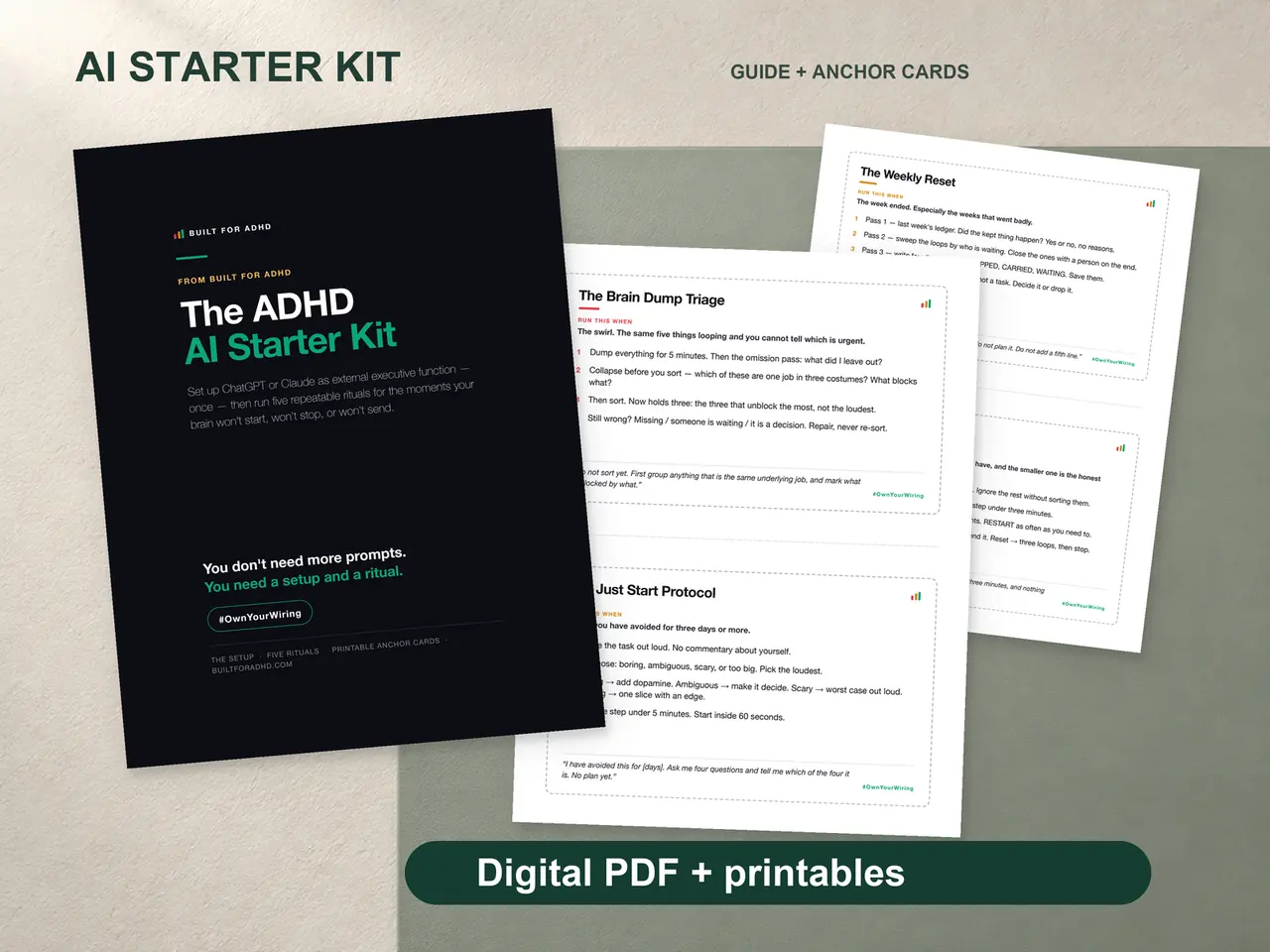
Coworking calls and AI sessions solve the moment of starting. What carries you through the rest of a remote day is knowing which task to bring to which body double — the AI for the quiet afternoon inbox grind, a colleague for the morning block, nobody at all for work that’s already easy to start. The ADHD AI Starter Kit packages the Body Double Session as one of five ready-to-run rituals, plus the paste-once setup block so you’re not re-explaining your brain every time you open a chat. $27, one-time, no subscription. Pair it with the complete guide to remote ADHD productivity for the rest of the day beyond the start.
FAQ
Does body doubling actually work over video, or does it need to be in person? Yes — virtual body doubling, including plain video calls and platforms like Focusmate, produces most of the same effect as in-person sessions, because what matters most is visible, mutual presence rather than physical proximity. As of 2026 the direct evidence on body doubling for ADHD is early-stage and small-sample, but it points the same direction.
What if my coworkers would think a coworking call is strange? Frame it as focus time, not a meeting — most people are used to “heads-down block, camera on, mostly quiet” once you explain it once, and many will admit they’d like to try it too.
How do I body double for work tasks I can’t tell anyone about? Use an AI session and declare the task in general terms — “catching up on a work project” — without naming anything sensitive, since it’s still a text window and the same hygiene rules apply as any other chat log.
What’s the best time of day to use body doubling when working from home? The first hour of the day and the stretch right after lunch tend to have the highest start-wall, since neither has a meeting to borrow momentum from — those are the two blocks worth protecting with a coworking call or an AI session.
Is it unprofessional to ask a manager for quiet focus time instead of explaining ADHD? No — framing it as a productivity technique rather than a diagnosis disclosure is a normal, professional way to ask for what helps you work, and you’re not obligated to share more than that.
Sources
- Zinat Ara et al., “You Are Not Alone: Designing Body Doubling for ADHD in Virtual Reality” (2025), arXiv:2509.12153 — https://arxiv.org/abs/2509.12153
- Tessa Eagle et al., “‘It Was Something I Naturally Found Worked and Heard About Later’: An Investigation of Body Doubling with Neurodivergent Participants,” ACM Transactions on Accessible Computing (2024) — https://doi.org/10.1145/3689648
- Cleveland Clinic, “What Is ‘Body Doubling’ and Can It Help With ADHD?” — https://health.clevelandclinic.org/body-doubling-for-adhd
Related
- What is body doubling for ADHD? — the full explainer
- AI body doubling protocol — the check-in loop in full
- ADHD work-from-home productivity — the rest of the remote-work system
- ADHD AI Starter Kit — $27: five rituals including the Body Double Session