In this article
The project was quoted at three weeks. It ran nine. Nobody did anything wrong, exactly — the client asked for a second version of the homepage, then asked if I could “take a quick look” at their email templates while I was in there, then had one more round of changes that turned into four. Every single request was small. Every single one got a yes. And at the end I had done roughly double the work for the original number, and felt vaguely resentful about a client who had been perfectly pleasant the entire time.
That is scope creep, and for years I thought it happened to me because my contracts were too loose. So I wrote better contracts. It kept happening. The contract was never where the leak was. (The systems side of this sits in my organization tools for ADHD freelancers.)
The leak is that scope creep does not arrive as a scope change. It arrives as a friendly message on a Tuesday, and answering it takes four seconds, and the four-second version of me says yes to everything.
Why the ADHD version of this is worse
Freelancers of all wiring deal with scope creep. A few things stack it against us specifically.
The request arrives at the exact moment we have no capacity to evaluate it. A “quick question, could you also…” lands in the inbox mid-task. Answering it requires estimating hours, comparing against the quote, and deciding — three separate judgments, all of them at the moment you’re being asked to stop what you were doing. That is the point in the day when the deciding part is already gone, and the cheapest available answer is “sure, no problem.”
“Quick” is a time estimate, and time estimates are not a thing we do well. The thirty-minute favor that takes six hours isn’t a lie you told the client, it’s a genuine misread. We agree to the version of the task that exists in our head, which has no context switching in it, no revision round, and no discovering that their email platform needs a login nobody has.
Saying no feels like the relationship ending. If a single piece of critical feedback can land like a catastrophe, then declining a request feels like actively causing one. So you say yes to keep the temperature down, and the yes costs you a weekend, and the resentment shows up later disguised as procrastination on that client’s work.
And the extra work is often more interesting than the contracted work. This one gets talked about least. The homepage revision is boring; the email templates are a fresh problem. Novelty is genuinely energizing for an ADHD brain, so scope creep can feel like relief in the moment — right up until the boring contracted thing is late.
The real fix: move the decision out of the moment
You cannot get better at evaluating requests in the four seconds after they arrive. Nobody can, and asking yourself to is how the last three years went.
What works is deciding once, in advance, when you have capacity, and then having a sentence ready so that the in-the-moment version of you doesn’t have to invent one. That’s the whole method. Everything below is just the wording.
The one rule underneath all four scripts: you never say no. You say “yes, and here’s what that costs.” Scope creep survives because refusing feels adversarial. Pricing doesn’t. A client asking for more work is not a conflict — it’s a client asking to buy more work, and they usually don’t know that’s what they’re doing.
The four scripts
Save these somewhere you can paste from. The point is that you are never composing this under pressure.
1. The in-scope request that isn’t. For “could you also just…”
Happy to do that — it’s outside what we scoped, so it’d be an add-on. I can either fold it in and push the delivery date to [date], or quote it separately and keep the current timeline. Which works better?
Two options, both of them a yes, neither of them free. You’re not refusing, you’re handing back the trade-off you were absorbing silently.
2. The revision round past the limit. For round five of three.
We’re past the revision rounds in the original scope, which I want to flag before I start rather than after. Additional rounds are [rate]. Want me to go ahead on that basis?
“Before I start rather than after” is doing the heavy lifting. It reads as professional care, and it is — you’re preventing an invoice surprise, which is the thing that actually damages relationships.
3. The urgent thing that isn’t your emergency. For Friday at 4pm.
I can get this to you by [realistic date]. If it needs to happen sooner than that, I can move it ahead of the other work in the queue as a rush — that’s [rate]. Let me know.
Never quote the heroic timeline first. You will hit it once, and then it becomes the timeline.
4. The scope conversation you should have had a month ago. For projects already deep in the creep.
I want to reset where we are, because the project has grown a lot from the original scope and I’d rather name that than quietly absorb it. Here’s what we scoped, here’s what’s been added since, and here’s what I’d suggest for the rest. Can we talk Thursday?
This one is uncomfortable to send and it is nearly always received well. Clients are not tracking accumulated scope either. Usually they genuinely have no idea.
The part that actually prevents it: write down what “done” is
Scripts handle the request when it arrives. What stops most requests from arriving is a client knowing, in writing, where the edges are — and the reason we skip this step is that it’s admin, and admin is the thing that doesn’t get done.
So keep it to four lines in the proposal. Not a legal document. Four lines:
- What you get: the deliverables, listed as nouns. “Five page designs” not “a website.”
- What’s not in this: two or three things you can predict will get asked for. This single line prevents more creep than everything else combined.
- Revisions: a number. Any number.
- What happens after: “additional work is quoted separately at [rate].”
That’s it. Ten minutes at proposal time, and it converts every future awkward negotiation into pointing at a document you both already agreed to.
The one you’ll actually skip, so do this one instead
Realistically you are not going to retrofit four-line scopes onto your existing clients this week. So here’s the smaller version that works starting today:
Stop answering requests the moment they arrive. Not for a day — for an hour. The reply becomes “let me check the schedule and come back to you this afternoon,” which is a complete sentence, requires no decision, and buys you the gap in which you can actually think.
That one habit fixed more of this for me than any contract language did. The requests didn’t change. The version of me answering them did — it was the version with the project timeline open instead of the version who got pinged mid-task.
What changes when the boundary holds
The thing I did not expect: the clients got better, not worse.
Nobody left over a scope conversation. Two of them bought the add-on work at full rate — work I had previously been doing for free while feeling taken advantage of. And the resentment went away entirely, which mattered more than the money, because resentment was quietly making me avoid those projects and avoiding the project is how the invoice ends up unsent two months later.
The scope creep was never a boundary-strength problem. It was a decision-timing problem. I was being asked to price work at the worst possible moment, with no prepared answer, by someone I liked — and losing, every time, in four seconds.
Write the sentences down while you’re calm. Paste them when you’re not.
If you want the surrounding structure, the pipeline view that makes an over-scoped project visible before it’s nine weeks long lives in the self-employed organization tools, and the free entrepreneur starter set is about ten minutes if you’re starting from nothing.
Related tools
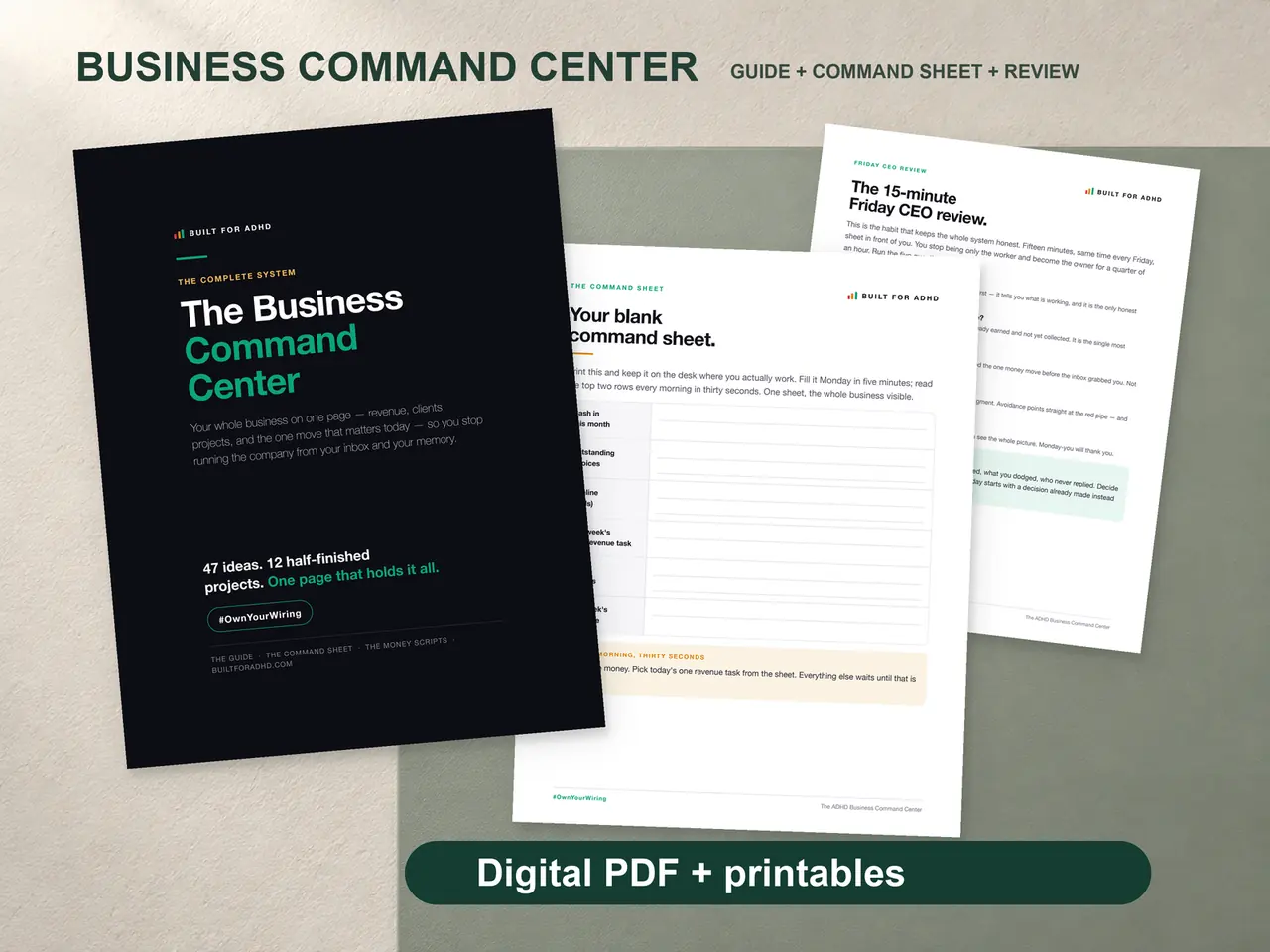
- ADHD Business Command Center — $19: the one-page business cockpit, the five zones, and the copy-ready client scripts
- Managing clients with ADHD and RSD — the emotional half of the same problem
- The ADHD entrepreneur’s productivity system — the layer this sits inside
- ADHD and forgetting to invoice clients — what unbilled scope turns into
- Cold outreach follow-up with ADHD — the same scripts-in-advance approach, pointed at new work
If you want the whole solo-business version — the Command Sheet, the five zones, the Friday review, and the client and money scripts as actual printables — that’s the ADHD Business Command Center. $19, one page, entire business, no willpower required.