In this article
I once sent thirty-one cold emails in a single night. It was one of those good, loud, 11 PM sessions where the research and the writing and the sending all felt like the same motion, and by 2 AM I had a sent folder that looked like a business development strategy.
I followed up on exactly none of them.
Five months later one of those people replied on their own — apologized for the delay, said the timing was finally right, and became a real client. Which was lovely, and also the most expensive thing that happened to me that year, because it meant the other thirty were probably not rejections. They were just emails that arrived on a busy Tuesday and got buried, and the only person who was ever going to dig them back up was me.
That’s the actual shape of the problem. Cold outreach with an ADHD brain doesn’t fail at sending. It fails at the second message.
The send is the dopamine. The follow-up has none.
Sending is a creative act. Following up is an admin act. Writing the first message is interesting — you’re researching a person, figuring out an angle, making something. That’s fuel. The follow-up is copying a sentence you already wrote onto a name you already contacted, with no novelty anywhere in it. Same reason the invoice never goes out after the work is done: the part that pays you is scheduled for after the tank is empty.
Nobody is waiting on it. No one on earth will email you asking why you didn’t follow up on your own pitch. It is the most silent task in your business, and silent tasks are the ones that evaporate.
“I’ll check back in a week” is not a real date. A week out is a vague future to a brain that doesn’t feel time passing, and it stays vague right up until it becomes a vague past. By the time you think about it again, enough days have gone by that following up now feels weird, so you don’t, and the lead closes itself.
And then there’s the part nobody admits. Silence reads as a verdict. If you have rejection-sensitive wiring, a non-reply doesn’t feel like a busy inbox, it feels like a judgment that already happened — and following up feels like asking someone to deliver it again out loud. So you tell yourself you don’t want to be annoying, which sounds like professional restraint and is actually RSD making a business decision on your behalf.
Here is the flat, boring truth that dissolves most of that: on average it takes multiple touches before a cold contact replies at all, and the overwhelming majority of first messages get no response for reasons that have nothing to do with you. Someone was in a meeting. Someone flagged it and forgot. The first email is not a referendum. It’s a notification.
The fix is a fixed ladder, decided once
The reason follow-up dies is that every single one requires a judgment call — is it too soon, is it too pushy, has it been too long now — and each of those is a decision, made at your least resourced moment, about a thing your nervous system has already flagged as socially risky. You will lose that argument every time.
So don’t have it. Decide the whole schedule once, in advance, while you’re calm, and then never decide it again:
Touch 1 — the pitch. The actual email. Touch 2 — day 3. A short bump. One or two lines. Touch 3 — day 10. Re-send with something new attached — a relevant example, a thought about their situation, anything that isn’t just “checking in.” Touch 4 — day 24. The close-the-loop note, which is the one that actually gets replies.
Then you stop. That’s the part that makes the rest of it survivable — the ladder has an end, so following up is no longer an open-ended obligation you carry around forever. Four touches and the lead is closed, by you, on purpose. No lingering. Nothing to feel bad about.
The tracker: five columns, one page
Not a CRM. A CRM is a place you go to feel behind. One page, five columns, in a spreadsheet or a notebook:
Who · What I sent · Date sent · Next touch date · Status
That’s it. The load-bearing column is next touch date, because that’s the one piece of information your brain will not hold and no software will show you unless you go looking. Everything else is context.
The one rule that makes it work: an email isn’t sent until the line is written. Not sent, then logged later. Sent and logged, in the same motion, while the tab is still open — the same discipline that keeps the inbox from becoming a to-do list you can’t see the bottom of. Thirty seconds now, or a permanently lost lead in three weeks.
The three scripts, written on a good day
Write these once, when you have energy, and paste them forever. The entire point is that follow-up day never requires you to compose social tone from scratch.
The day-3 bump: “Bumping this in case it landed at a bad moment — happy to send more detail if it’s useful.” Two lines. No apology, no paragraph explaining yourself.
The day-10 add: “Thought of you when [specific thing] came up — here’s a quick example of how we handled it. Original note below.” This is the one that converts, because it gives them something instead of asking again.
The day-24 close: “I’ll assume the timing isn’t right and stop cluttering your inbox — if that changes, I’m here.” Send this one. It is the single highest-reply message in the sequence, it costs you nothing, and it ends the loop cleanly whether or not they answer.
Notice what’s missing from all three: any version of “just following up again, sorry to bother you.” That sentence is anxiety leaking onto the page, and it invites the reader to feel bothered.
One outreach day, both jobs
Pick a day. Same day every week, attached to something that already happens. Thirty minutes.
Follow-ups first, new sends second. Always that order — because follow-ups are the boring part, and if you do the fun part first you will not come back for the rest. Open the tracker, sort by next touch date, send everything due, update the dates. Then, with whatever time is left, write new pitches.
This also stops the boom-and-bust pattern where a hyperfocus night produces thirty leads and then nothing for six weeks. A small weekly batch that gets followed up beats a huge burst that doesn’t, by an enormous margin — the same principle as aiming hyperfocus at the thing that pays instead of letting it pick. Let the good nights happen, then let outreach day catch what they produced.
What to do in the next ten minutes
Open a blank page. Write down every person you pitched in the last three months who never replied.
Now put a date next to each one, using the ladder — anything older than four weeks gets the day-24 close, today. That’s the whole first session. You are not restarting a pipeline, you are closing loops that have been quietly costing you attention, and a few of them will reply, because they always do.
Then put outreach day on the calendar as a repeating event before you close the tab.
The rest of the solo-business scaffolding — where the week’s priorities live so admin isn’t the thing you default to — is the free entrepreneur starter set, about ten minutes to set up. The printable versions of the trackers live with the self-employed organization tools.
You don’t need to be braver about following up. You need the second email to be a scheduled event with the words already written, so that sending it costs you nothing and asks you to decide nothing.
Related tools
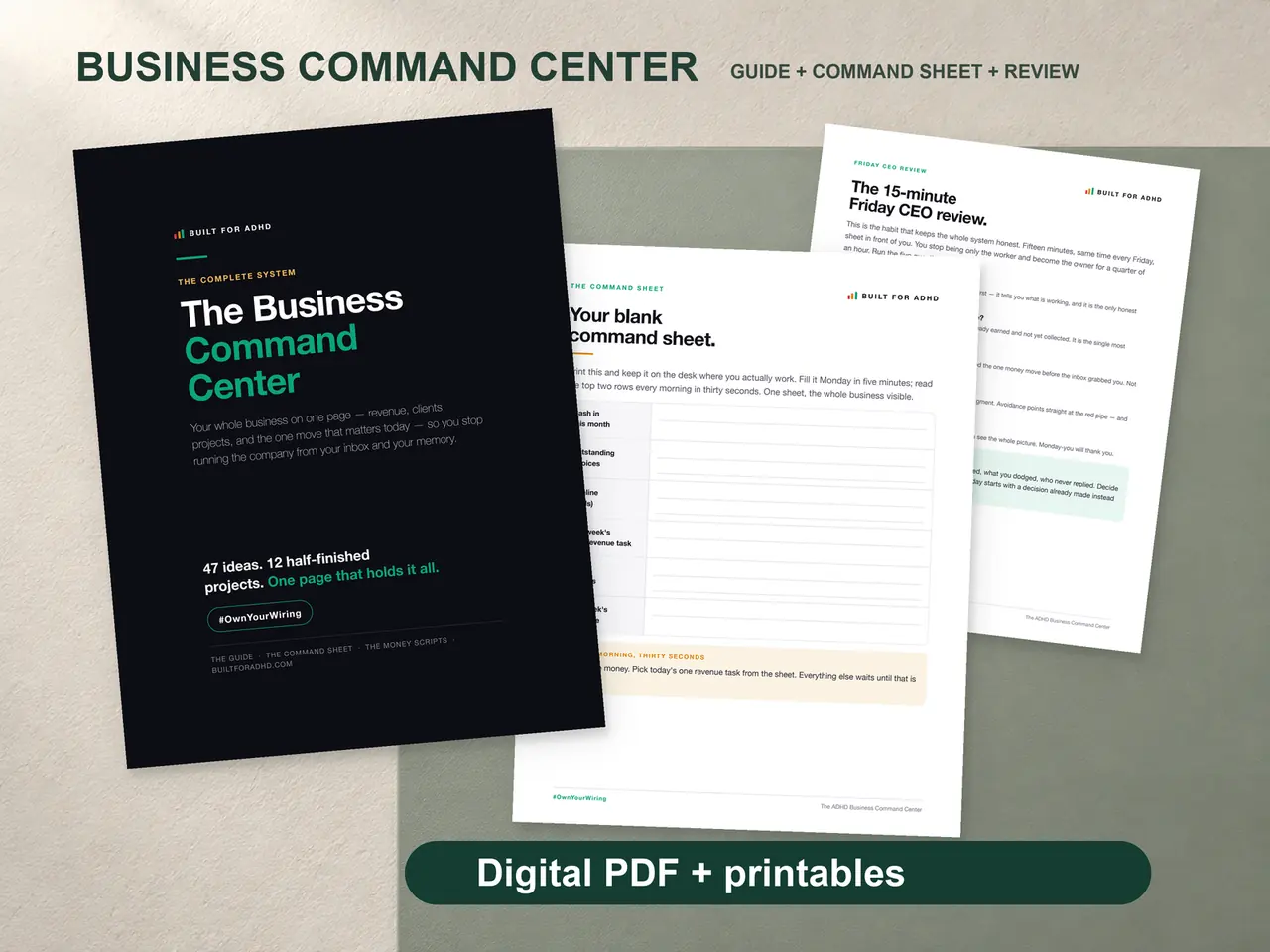
- ADHD Business Command Center — $19: the one-page business cockpit, the five zones, and the copy-ready scripts
- The ADHD entrepreneur’s productivity system — the layer this sits inside
- ADHD and forgetting to invoice clients — the same failure, at the other end of the job
- Managing clients when you have ADHD and RSD — for when silence feels like a verdict
- The email system that doesn’t run on willpower — where all of this actually happens
If you want the whole solo-business version — the Command Sheet, the five zones, the Friday review, and the pipeline and follow-up trackers as actual printable pages — that’s the ADHD Business Command Center. $19, one page, entire business, no willpower required.