In this article
I used to read my own resume like a rap sheet.
Every role on it followed the same shape. Three months of being the best version of myself — learning fast, saying yes, visibly good at the thing. Then a long competent middle where nobody complained. Then a stretch somewhere past the first year where I was still producing but had quietly stopped being present, and the only thought in my head on a Tuesday afternoon was I cannot do another two years of this. And then a new job, and the three good months again.
I had a story about that, and the story was that I lacked staying power. Everyone else’s resume looked like a staircase. Mine looked like a list. (The fix turned out to be systems, not staying power, and the complete guide to ADHD tools for adults is where those live.)
Here is the thing I eventually noticed, and it reframed the whole pattern: I was making the decision to leave at the exact point in the cycle when I had the least information. Month fourteen, at 2 PM, running on empty, three months past the last time the work felt interesting. That is not a career decision. That is a mood, holding a resignation letter.
The cycle is a novelty curve, not a character verdict
A new job hands you an enormous amount of the one thing an ADHD brain reliably runs on: novelty. Everything is unfamiliar, so everything is engaging. There is no accumulated dread yet, no pile of old obligations, no reputation to maintain. Interest does the work that discipline usually has to, and you look — accurately — like someone operating at the top of their range.
That supply has an expiry date. The first 90 days run on it, and then it leaves, and whatever system you built underneath it is what you have left. If nothing got built, the drop feels like the job turning bad. It is the same mechanism as the hobby that owns you for three weeks and then sits in the closet — the intake is euphoric and the maintenance is a different job entirely.
Which means the honest question is not am I a job hopper. It is: is this role genuinely a bad fit, or is this month fourteen of a pattern that has fired five times now? Those two have identical symptoms and opposite answers, and you cannot tell them apart by how you feel at 2 PM. You can tell them apart on paper.
The audit: one page, four columns
Do this before you open a job board, not after. It takes about twenty minutes and it only works written down, because the whole point is to get the pattern out of the part of your brain that is currently exhausted.
One row per job you have held, going back as far as you can stand. Four columns:
1. How long it stayed good. Not how long you stayed. How many months before the flatness showed up. Write the number.
2. What specifically went flat. This is the column that does the work, and it has to be concrete. Not “I got bored.” Try: the work became repetition of something I had already solved. The interesting part got handed to someone else. It turned into meetings. The feedback stopped. I was good at it and nobody noticed either way. Pick the one that is actually true, even if it is unflattering.
3. What was still good when you left. Almost everyone leaves this blank the first time, and almost everyone is wrong to. Pay, the commute, one manager who got it, the two hours a week where you were genuinely in flow. Write them down, because you are about to go shopping for a replacement and you will otherwise forget to check whether the new one has these.
4. What you did about it before you quit. Be precise. For most of my rows the honest entry was nothing — I waited, then I left.
Then read down column two.
Reading the page
You are looking for one thing: does the same word appear three times?
If column two repeats, it is a design problem, not a job problem. When five rows all say became repetition or lost the interesting part, the next job will do it too, roughly on schedule, because the thing you are allergic to is a stage every role eventually reaches. Switching employers resets the clock. It does not change the curve. That is the version worth fixing from inside, because a lateral move buys you about eleven good months at the cost of all your accumulated context.
If column two says something different every time, the fit really has been wrong. Different failure modes across different jobs is evidence, not a pattern. Move with a clear head and use columns two and three as your actual screening criteria at the next interview — which is a much better use of the one-page interview script than another round of describing your strengths.
If column four is empty in every row, you do not have enough information to decide yet. You have never once run the experiment of changing the role while you were in it. That is not a failure of character; it is just a missing data point, and it is the cheapest one on the list to go collect.
If the answer is stay, change one thing
Not everything. One thing, aimed at whatever column two keeps saying.
If the flatness is repetition, the ask is a new surface — a project outside your lane, the onboarding doc nobody has written, the thing that is broken and unowned. If it is the interesting part got handed off, the ask is to keep one piece of it, named out loud, in writing. If it is no feedback, the ask is a standing fifteen minutes, which is also most of what makes the self-evaluation survivable. If what actually went flat is the environment rather than the work — the open floor, the noise, the interruptions — that is a sensory load problem and it has concrete fixes that have nothing to do with your job title.
Make it a specific written request about what would be different next week. Asking for a workplace change is mostly a sentence-construction problem, and it does not have to be a disclosure conversation to be a real one.
Then give it a date. Eight weeks, on the calendar, with a note to yourself about what you asked for. If nothing has changed by then, you now have column four filled in — and leaving becomes a decision with evidence behind it instead of a Tuesday afternoon.
If the answer is go, go on purpose
Leave with the page in your hand. Column three is your must-have list, column two is your disqualifier list, and both of them are more reliable than anything you will think of while a hiring manager is being nice to you.
And budget for the drop. Month three of the new job will be wonderful and month fourteen will arrive on schedule unless something is different this time — which means building the boring underneath-layer while the novelty is still paying for it. Sorting the week by energy instead of by deadline is the version of that I actually keep, because it survives the point where interest stops volunteering.
What to do in the next ten minutes
Open one page. Write the four column headers. Fill in the current job only — one row. How long it stayed good, what went flat, what is still good, what you have tried.
One row is enough to find out whether you are in month fourteen of a pattern or in a genuinely bad fit. You can do the rest of your history later, or never. The point was never a complete archive (it was getting the thing out of your head and onto something you can look at).
If you want the ten-minute starter version of this, the free ADHD adult kit has the one-page sheet the audit borrows its layout from.
Related tools
- Free ADHD adult starter kit — the one-page layout, in its shortest form
- ADHD and the first 90 days of a new job — building the layer underneath the novelty
- The ADHD hyperfixation cycle — the same curve, in hobbies
- ADHD job interview prep script — where columns two and three become screening questions
- How to ask for ADHD workplace accommodations — the one-thing-changed request, in writing
- ADHD work burnout recovery — if month fourteen is actually exhaustion
- Energy-based task management — what holds after interest stops volunteering
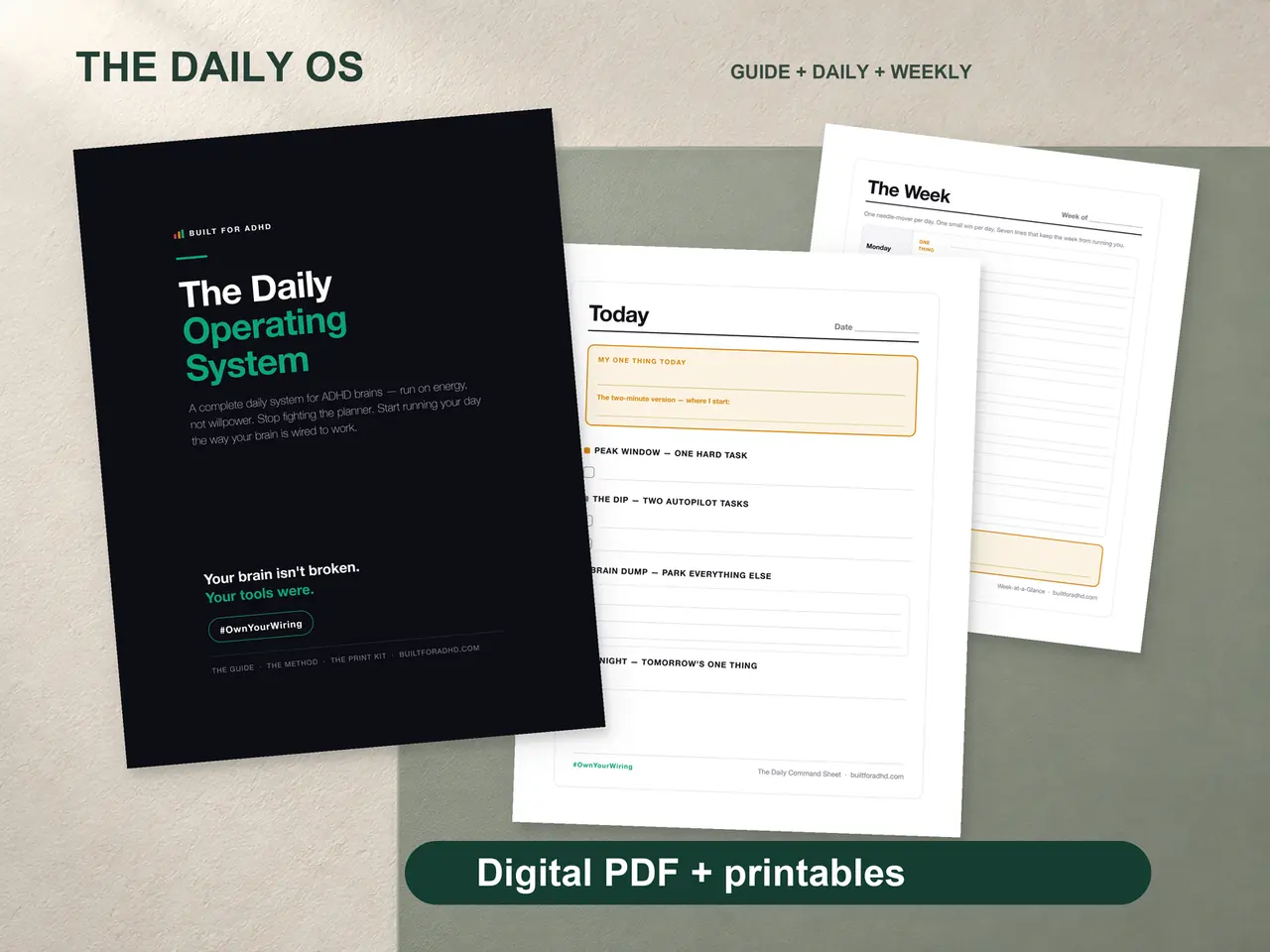
If the eight-week experiment is the part you want already built — the energy sort, the Daily Command Sheet, and the restart pages for the weeks it slips — that’s the ADHD Daily Operating System, $17. A blank page and a calendar reminder do the same job; this is just the version where the pages already exist. It’s a planning tool, not treatment for anything.