In this article
I once walked out of a meeting where a client told me the thing I built had changed how their whole team worked, and spent the drive home certain I was three weeks from being found out.
Not false modesty. I would have failed a lie detector on it. The praise was real, the results were real, and none of it was available to me by the time I hit the highway. What was available was the Tuesday I missed a deadline, the email I had not answered, and a total conviction that the whole thing was held together with tape and would come apart the moment anyone looked closely.
For a long time I filed this under character — a confidence problem, fixable by deciding to feel differently about myself, which worked for roughly the length of the decision.
It is not a confidence problem. It is a retrieval problem. And retrieval problems get solved with records, not with reassurance.
Why your own wins don’t stick
Here is the uncomfortable mechanic underneath it.
What lands and stays in an ADHD brain tends to arrive with something attached — stakes, urgency, a jolt. Failure comes with all three. The deadline you blew has a knot in your stomach attached, so it files itself permanently, in high resolution, with the exact wording of the apology email.
A compliment in a meeting has none of that. It arrives flat, it is over in four seconds, and you were half-occupied noticing the room. It does not file. By Thursday it is genuinely gone — not suppressed, not minimised, gone, the way the thing you walked into the kitchen for is gone.
So when you sit down to assess yourself, you run the assessment on whatever is actually retrievable. And what is retrievable is the misses, because the misses came with stakes. You are not being hard on yourself. You are reading an honest report from a wildly incomplete archive.
Then the second thing. Output that arrives in bursts feels less legitimate than output that arrives steadily, even when the burst produces more. Four days of nothing and then a day that does three weeks of work reads, from the inside, like luck — you cannot point to a process, so you assume you do not have one. Which is the exact gap productivity systems built for other brains widen rather than close: they measure consistency, and you are not producing consistency, you are producing results.
And you have probably been covering for the erratic part for years. The covering works — nobody sees the Sunday nights — which means the praise lands on a version of you that you know is partly performance. Praise for a performance is very hard to cash.
The receipts file
The fix is not an attitude. It is an artifact: a plain, boring, retrievable record of what you actually did, written at the moment it happens rather than reconstructed later from a mood.
One page. Four columns. Here is what goes in them.
Date. Just the date. No week numbers, no system.
What happened. One line, concrete, no adjectives. “Shipped the onboarding rebuild.” “Kate said the deck made the board decision easy.” “Fixed the billing bug open since March.” Specific enough that you cannot argue with it in six weeks.
Who said it, or what measured it. This column is the whole point. It is the difference between I think that went well and the client wrote this sentence down. Quote it if you have it. Paste the actual line from the actual email. Numbers go here too — the revenue, the turnaround, the thing that moved.
What it cost. The honest one. Four calm hours, or a weekend and the Monday you lost? Not to punish yourself with — to show you the pattern later.
That is it. No scoring, no tags, no review cadence. A page you append to.
Where to keep it so it survives
The usual way this dies is that it gets built somewhere thoughtful and never opened again. So it goes wherever you already are at the end of the day — a note on your phone, a pinned text file, a paper sheet taped inside a drawer you open anyway. Your hand has to already go there, which is the same rule that makes a habit tracker actually hold.
Entering a line has to take under thirty seconds, or it will not happen on the days it matters most. No formatting, no deciding whether it counts. If you are wondering whether it counts, it counts.
And one rule that matters more than it looks: write it the day it happens. Not in a weekly review. By the weekly review you are already reconstructing, and reconstruction runs on the same broken archive the whole problem comes from.
What to do with it
Two uses, both practical.
The first is the moment. You are about to send something and the feeling arrives — the one that says they are going to realise. You do not argue with it. You open the page, read four lines, and send the thing anyway with the feeling still running. Not to feel better; the feeling usually does not move much. You read it to put a fact next to it. The goal was never calm, it was the send.
The second is the paperwork. Self-assessments, reviews, raise conversations, a proposal where you describe what you are good at — all of them ask you to retrieve evidence on demand, from a standing start, under time pressure. That is the worst possible condition for this brain, and it is why those documents so reliably undershoot your actual year. With the file, writing a performance review self-evaluation stops being a memory test and becomes a copy-and-paste job. Freelancers: the same lines answer what the retainer bought, which is the part time tracking for billable work leaves out.
Read the fourth column after a month
The cost column is the one that earns its place over time, and it is worth a slow read after four or five weeks.
If almost every line in the second column has a weekend in the fourth, you have learned something real, and it is not that you are a fraud. The results are genuine and the engine is expensive — a different problem with a different fix, and the one that quietly becomes work burnout if nobody names it. Aiming the big-output days on purpose is most of the work there, and so is scheduling by what a task costs rather than how long it takes.
If it instead shows a short list of things that moved everything and a long tail of competent work nobody noticed, that is also information. It usually explains a career that reads like a job-hopping pattern from outside and like boredom from inside.
One honest note. Some of this quiets down when the covering stops being necessary — when the erratic part is a known working condition rather than a secret, which is its own decision with its own script if telling a manager is where this goes next. And if you are early after a diagnosis and every system you own looks suspect, the keep-kill-rebuild audit is the better first job.
Fifteen minutes, starting now
Open a note. Title it Receipts. Write four lines from the last two weeks — the four you can still retrieve. Put the quote in if you have the email.
Four lines is not a system yet. But four lines is four more than you had available on the drive home, and that is the entire mechanism: the next time the feeling shows up, there is something to read instead of only something to feel.
If you want a surface to put it on while you start, the free ADHD starter kit for adults has the ten-minute version. Working for yourself, the free entrepreneur kit is the closer fit.
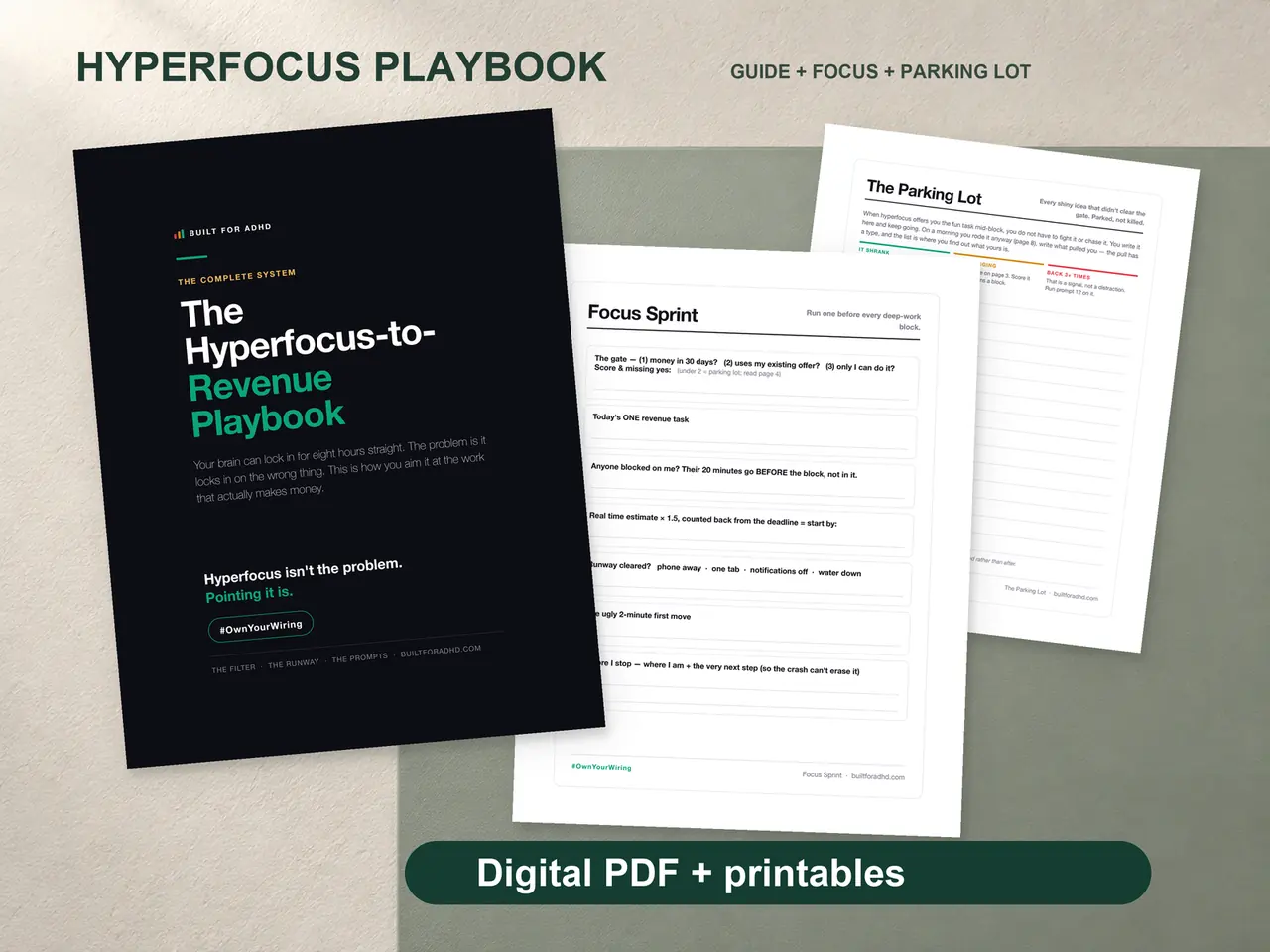
If the fourth column is where your attention went — the results are real but they cost a weekend every time — that is the problem the Hyperfocus-to-Revenue Playbook is for, $9. It is about aiming the big days at the work that pays rather than hoping they land there. The receipts file above is free and it is the part that has to happen first.
Related tools
- Writing an ADHD performance review self-evaluation — where the file gets cashed in
- Rebuilding your systems after an ADHD diagnosis — the audit that comes before this
- ADHD over-apologizing and RSD — the habit attached to the same feeling
- ADHD work burnout recovery — what the cost column warns you about
- The complete guide to ADHD tools for adults — the rest of the working set