In this article
Direct answer: AI is a genuinely useful way to build the external executive-function structure you never got a diagnosis-shaped head start on — especially because it doesn’t come with the shame of asking a person for help with things you feel you “should” already know how to do at your age. It’s not a replacement for whatever else your diagnosis process involves. It’s a practical tool for the daily logistics a late diagnosis leaves you catching up on.
This is written for women getting an ADHD diagnosis as an adult after years — sometimes decades — of managing without one, often after masking symptoms well enough that nobody, including yourself, connected the dots earlier. That masking pattern is one this community talks about constantly and specifically; this guide doesn’t try to explain why it happens, just to help with what comes after it’s finally named.
The specific weight a late diagnosis carries
If this is you, you likely spent years building elaborate personal workarounds for things that had a name the whole time. The particular grief of a late diagnosis isn’t just “I have ADHD” — it’s often “I built twenty years of self-blame around a thing that was never a character flaw.” That reframe alone is heavy before you even get to the practical question of what to actually do differently now.
There’s also a specific exhaustion that comes with having masked well enough, for long enough, that asking for basic help now feels harder than it should — like you’ve spent years proving you don’t need it, and admitting otherwise feels like undoing that work. AI sidesteps a piece of that specific friction: it has no memory of the version of you that had it together in front of other people, no expectations to walk back, and no visible reaction to manage while you ask for something basic.
Where AI actually helps here
No re-explaining yourself to a new person. One of the quieter costs of late diagnosis is explaining your brain, over and over, to coaches, apps, and well-meaning people who assume you need what a typical adult needs. A configured AI assistant only needs the explanation once — paste your context into a chat and it holds it for that conversation, or set it as standing custom instructions so you never re-explain it again at all.
Building structure from zero without judgment. If you’re starting your first real organizational system in your 30s, 40s, or later, an AI assistant doesn’t know or care that this is “late” — it just helps you build what you need today. Ask it plainly: “I’m building basic daily structure for the first time as an adult with ADHD. Help me start with the smallest possible version, not a full system.” That framing — smallest possible version — matters more here than almost anywhere else, because the instinct after a late diagnosis is often to try to fix everything at once, which usually collapses under its own weight within a week.
A place to think through the masking cost. Rejection sensitivity and years of masking often mean the honest version of a thought gets edited before it’s said out loud, even to yourself. Writing or talking through a messy, unedited brain dump into an AI chat — not to get advice, just to get it out of your head — can be a genuinely useful release valve precisely because there’s no social cost to being unfiltered with it. The AI brain dump method built for stuck moments works the same way here.
RSD-safe communication. If you’re now having conversations with family, a partner, or your workplace about what you need, drafting the hard message with AI first — getting the anxiety-charged version out, then asking for a calmer edit — can lower the activation energy of conversations that already carry extra weight after years of being told (or telling yourself) you were just being difficult.
The specific trap of “I’ve made it this far without help”
There’s a particular thought that shows up for a lot of women after a late diagnosis: I’ve functioned for twenty, thirty, forty years without a system — needing one now feels like admitting the whole thing was a performance. It wasn’t a performance. It was an enormous, sustained amount of effort that had no name and no support, and the exhaustion of that effort is exactly why things might be harder to sustain now, not easier. Starting to use external tools at this point isn’t evidence the earlier years don’t count. It’s what happens when the effort finally has somewhere to go besides just holding on.
This matters for how you talk to an AI assistant about what you need, too. If your instinct is to undersell what you’re asking for — “it’s probably nothing, I just need a little help staying on top of things” — try being specific instead: name the actual daily friction point, not a minimized version of it. An assistant configured with plain, direct instructions responds better to plain, direct requests than to a softened version of the real problem.
What AI can’t do here, and shouldn’t be asked to
AI is not a diagnosis, a therapist, or a substitute for whatever clinical support is part of your process — this site’s tools are productivity support, not treatment, and that line matters especially here, where the temptation to use a chat window as a stand-in for professional support is real and understandable. If you’re processing grief, anger, or a mental health concern tied to the diagnosis itself, that belongs with a person qualified to hold it, not a chat window. What’s covered here is strictly the practical, daily-structure side: the tasks, the systems, the logistics of a life that’s about to run a little differently than it did before.
A starting setup, if you want one
Something like this, pasted into a new chat: “I was diagnosed with ADHD as an adult after years of managing without a name for it. I’m building basic daily structure for the first time — help me start as small as possible, one thing at a time, no full system yet. Don’t assume I know things a typical adult ‘should’ already know; explain plainly, without judgment, and don’t add motivational pressure.” That’s the whole ask. Small, plain, no shame framing baked into the response.
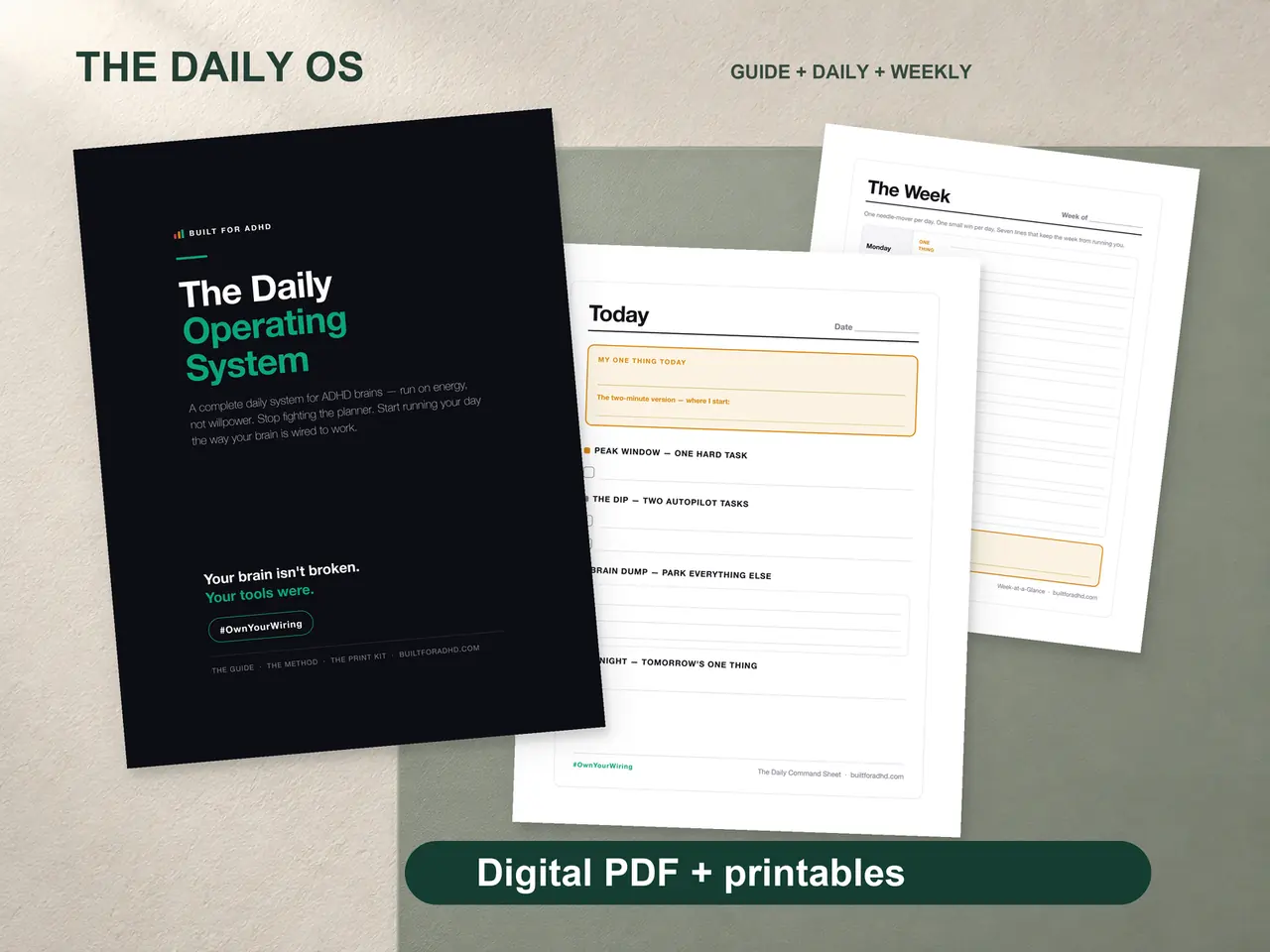
From there, the actual daily structure matters more than the AI wrapper around it — an energy-based system built around how ADHD attention actually moves, rather than a generic planner assuming a brain that runs in a straight line, gives the AI conversations somewhere consistent to land instead of starting from scratch every day.
FAQ
Is it normal to feel behind after a late ADHD diagnosis? That feeling is common and understandable — you’re often catching up on systems other people had years to build gradually. It’s not a fair comparison, since you were managing without the framework the whole time; naming that doesn’t erase the feeling, but it does put it in context.
Can AI help me explain my diagnosis to family or a partner? It can help you draft what you want to say and take the edge off an anxiety-charged first draft, the same way it helps with any hard message you’ve been avoiding. The conversation itself is still yours to have.
Should I use AI instead of seeing a specialist about my diagnosis? No — AI is productivity support for daily logistics, not a substitute for clinical care. If you’re still working through the diagnosis itself, that belongs with a qualified professional.
Where should I start if I feel completely overwhelmed by “getting organized” now? Smaller than feels sufficient. One tiny piece of structure — a single daily check-in, one place brain dumps go — beats a comprehensive system you build once and abandon in a week. Ask an AI assistant for the smallest possible version of whatever you’re trying to build, explicitly, every time.
Related
- ChatGPT Custom Instructions for ADHD — the setup that stops you re-explaining yourself
- What Does RSD Feel Like — for the conversations that come with a new diagnosis
- ADHD Daily Operating System — $17, a starting structure that doesn’t assume you’ve already built one
- The AI for ADHD hub — every setup guide and honest review in one place
If you’d rather start completely free, the adult starter bundle is the lowest-friction first step.
Sources
- ADDitude Magazine, “ADHD Masking: Pretending to Be Neurotypical Is Unhealthy” — https://www.additudemag.com/adhd-masking-signs-consequences-solutions/