In this article
Direct answer: AI works well here as a nightly brain-dump partner and routine scriptwriter — a place to offload the racing thoughts that show up specifically at bedtime, and a way to build a repeatable wind-down sequence instead of reinventing your evening from scratch every night. It’s not a sleep aid or a treatment for insomnia, and this isn’t medical advice — it’s a practical tool for the specific ADHD pattern of a brain that gets loudest exactly when it’s supposed to quiet down.
If you know the feeling of your brain refusing to shut off at night — suddenly remembering everything you forgot to do today, replaying a conversation from three days ago, starting a new hyperfocus project at 11:47pm — this is about giving those thoughts somewhere to go besides staying in your head.
Why bedtime is when ADHD brains get loud
During the day, there’s usually enough external stimulation — tasks, people, screens — to keep an ADHD brain occupied enough that the background noise of unfinished thoughts stays in the background. At night, the external stimulation drops away right as your brain is supposed to power down, and all the thoughts that had nowhere to land during the day suddenly have the floor. This isn’t a willpower failure or bad sleep hygiene — it’s what happens when a brain that relies on external structure loses its structure right at the moment it needs to relax.
Where AI genuinely helps
The nightly brain dump. Before you try to sleep, open a chat and dump everything currently looping — tomorrow’s tasks, something you’re worried about, a random idea, an unfinished conversation. Don’t organize it, don’t fix it, just get it out of your head and into the chat. The point isn’t the AI’s response; it’s that writing something down (even to an AI) tells your brain the thought has been captured and doesn’t need to keep circling to make sure it isn’t forgotten.
Turning the dump into tomorrow’s first move, so it stops needing to be remembered tonight. After the dump, ask: “Pull out anything here that actually needs action tomorrow, and give me just the first tiny step for the most urgent one.” This closes the loop your brain is running — it’s not trying to solve tomorrow’s problems tonight, it’s trying to confirm they won’t be forgotten, and a captured first step does that job better than an unresolved worry does.
A repeatable wind-down script. Ask AI to help you write a short, specific wind-down sequence — five or six steps, in order, the same every night: phone in another room, brain dump, one page of a physical book, lights off. A written sequence removes the nightly decision of “what should my routine even be,” which matters because deciding a routine from scratch every night is itself a task an already-tired brain will skip.
A response for racing-thought loops specifically. If a particular thought keeps circling — an embarrassing moment, a “what if” scenario — try describing it and asking for a short, calming reframe you can read back to yourself when it recurs. This isn’t therapy and won’t resolve deep anxiety, but for a passing 1am spiral, having a pre-written response ready is often enough to break the loop instead of feeding it.
What this isn’t
This is not a treatment for insomnia, anxiety disorders, or any clinical sleep condition, and nothing here should be read as medical advice. If sleep difficulty is severe, persistent, or tied to a broader mental health concern, that belongs with a doctor or sleep specialist, not a nightly AI chat. What’s covered here is the everyday, non-clinical version of “my brain won’t quiet down at bedtime” — a pattern most ADHD adults recognize, not a diagnosis.
It’s also worth naming honestly: a screen at bedtime, AI chat included, works against the wind-down goal for some people more than it helps. If typing into a chat keeps you more alert rather than less, try the brain-dump step earlier in the evening — an hour or two before bed — so the capture happens before the screens-off part of your routine, not during it.
Why a written routine beats “just relaxing”
Generic sleep advice often lands on some version of “wind down by relaxing” — which is close to useless for a brain that doesn’t have a default relaxed state to fall back into. “Relax” isn’t a step; it’s a result, and results aren’t things you can just decide to have. A written, specific sequence works better because it replaces an abstract goal with a concrete list of physical actions that, done in order, tend to produce the calmer state as a side effect rather than as the direct instruction.
This is the same principle behind most of what works for ADHD generally: specific, small, external structure outperforms an internal instruction to just feel or behave differently. “Phone in the kitchen, then brain dump, then one page of a book” is something you can actually do on a bad night, even a genuinely exhausted one. “Wind down and relax” is not — it requires you to already be in the state you’re trying to reach in order to follow the instruction at all.
A setup you can paste tonight
“Help me build a 5-step wind-down routine for an ADHD brain that races at bedtime. Keep each step small and specific. Then, each night, I’ll paste in whatever’s looping in my head — pull out anything that needs action tomorrow and give me one small first step for it, so I can stop holding it in my head overnight.” Save this as a standing instruction if your assistant supports it, so the nightly version is just “here’s tonight’s dump” rather than re-explaining the whole setup each time.
Keeping it consistent, even on the nights motivation is lowest
The nights a wind-down routine matters most — the ones with the loudest racing thoughts — are usually the same nights you have the least energy to follow a multi-step process. That’s not a coincidence; it’s the same pattern as any ADHD system that only works when you’re already doing well. Build in a genuinely minimal fallback version from the start: if the full five-step routine feels like too much, the brain dump alone, even without the rest of the sequence, still does most of the work of getting the loop out of your head. A partial routine done is better than a full routine skipped entirely because it felt like too much to start.
FAQ
Is this a substitute for sleep hygiene advice or treatment for insomnia? No. This is a practical tool for racing thoughts at bedtime, not medical advice or a treatment for a sleep disorder. Persistent or severe sleep difficulty is worth discussing with a doctor.
Won’t using a screen right before bed make things worse? For some people, yes — screen light and stimulation can work against winding down. If that’s you, do the brain-dump step an hour or two earlier in the evening, before the screens-off part of your routine begins, rather than right at bedtime.
What if the same worry keeps coming back every night? A recurring, specific worry that won’t resolve with a brain dump and a captured next step may be something bigger than an ADHD racing-thoughts pattern — that’s worth mentioning to a doctor or therapist rather than managing solo through a nightly routine.
What if I fall asleep before finishing the routine some nights, or don’t have a paid AI subscription? Falling asleep mid-routine is a fine outcome, not a failure — it means the racing-thought pattern calmed down, which was the goal. Just pick the sequence back up the next night from step one. And no paid subscription is needed either — the free tier of ChatGPT or Claude covers everything described here.
Related
- ADHD Brain Won’t Shut Off at Night — the pattern this routine is built to address
- Revenge Bedtime Procrastination and ADHD — for when the issue is delaying sleep, not just racing thoughts
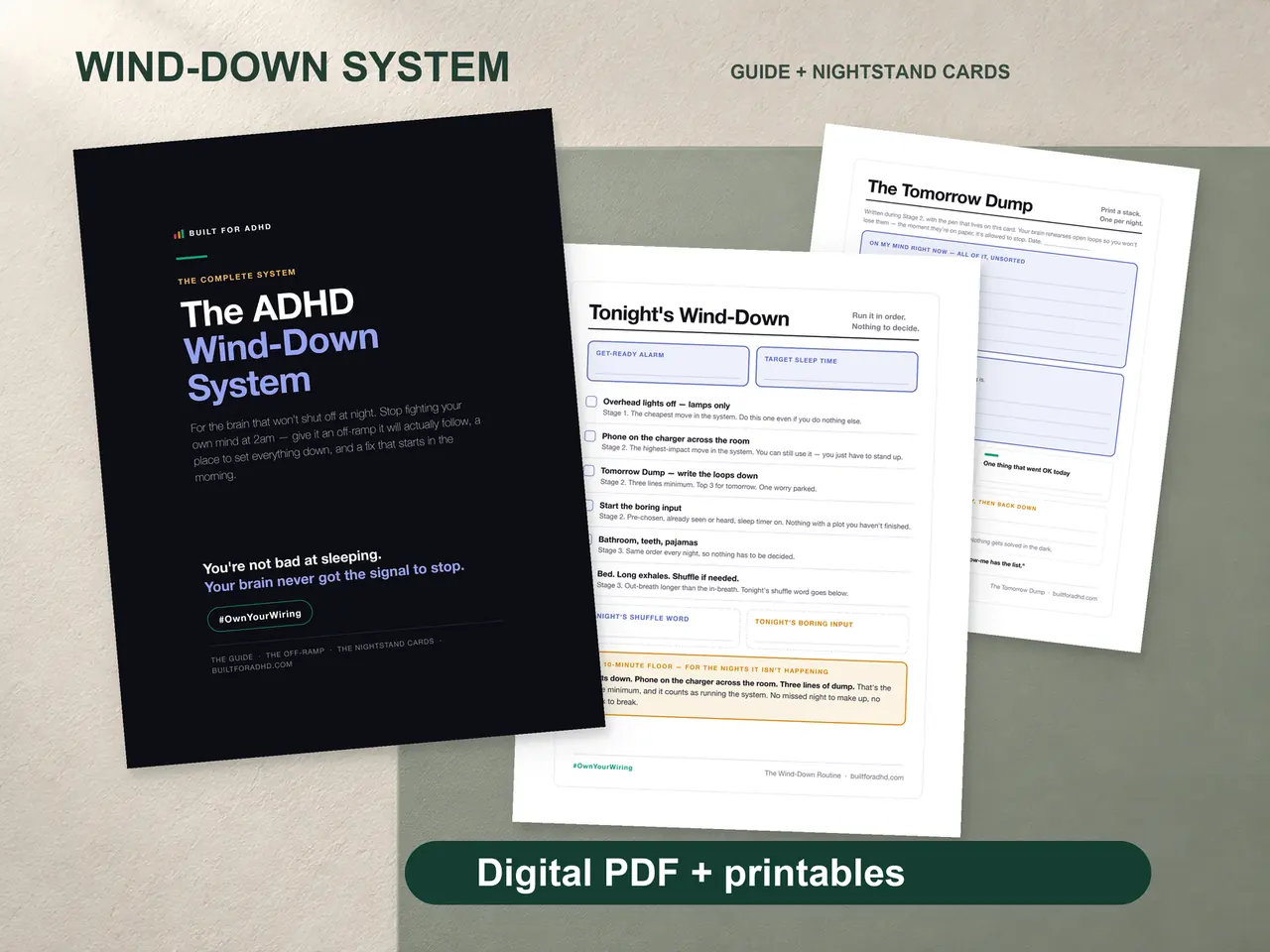
- ADHD Wind-Down System — $12, a full paper-based routine for the same problem, screen-free
- The AI for ADHD hub — every setup guide and honest review in one place
If you’d rather start free, the wind-down guide sampler is the no-cost first step.
Sources
- ADDitude Magazine, “This Simple Sleep Formula Calms My Racing ADHD Brain” — https://www.additudemag.com/adhd-sleep-issues-formula/