In this article
The screen fight has a shape, and every family running one knows it by heart.
It starts as an ordinary afternoon. Somebody has the tablet. Somebody else wants it, and has decided — with total conviction and no evidence — that the first kid has had it way longer. You are in the kitchen holding a colander. You are asked to rule on this. You have no idea who had what, because you were in a meeting for the part of the afternoon that’s now under dispute, so you make up a number: ten more minutes. Then ten minutes later you are the one who has to walk over and take it, and the actual explosion happens — not over the ruling, but over the ending.
By dinner you have refereed the same case twice, invented two arbitrary numbers, and been the villain in both. Nobody in the house thinks screens are going well.
I want to name the thing that took me embarrassingly long to see: almost none of that was a screen problem.
The fight is never about the screen
Two separate things are getting mashed into one argument, and they have completely different fixes.
The first is the transition. Being pulled off a screen mid-thing is genuinely awful for an ADHD brain, and I say that as someone who was that kid and is still that adult. Deep engagement is expensive to enter and expensive to leave. When somebody yanks you out of it with no warning, what you feel isn’t “I wanted more minutes” — it’s the whole absorbed state getting torn, plus the sting of not getting to finish. The meltdown lands at the moment of the ending because the ending is the hard part. The amount was never the issue.
The second is the ledger. Siblings don’t actually fight about fairness in the abstract; they fight because nobody is keeping score and they can feel it. When allocation happens by verbal ruling, every single decision looks arbitrary — because it is. You’re guessing. And a kid who suspects the system is arbitrary will litigate every instance of it, forever, because litigating is the only lever available.
So: one problem is about endings. One is about record-keeping. Neither is solved by a number of hours, which is why every “two hours a day” rule you’ve tried collapsed inside a week.
Why you can’t be the referee
Here’s the part that isn’t your fault. A time-based screen rule requires somebody to hold a running total across a chaotic afternoon, notice when it’s spent, and enforce the ending on schedule. That is working memory, time awareness, and transition enforcement — the exact three things an ADHD brain does not generate reliably, especially at 4:40 PM when it is running on fumes and the afternoon has already emptied the tank.
You’re not failing to enforce the rule. You picked a rule that runs on the fuel you have least of, and then you had to be the timer, the judge, and the bailiff for it. No wonder it feels like the screens are the problem. The architecture is the problem, and it puts every decision on you, live, in the moment, with two kids watching.
The move is the same one that works everywhere else in an ADHD household: convert the daily judgment call into a one-time decision, written down where everyone can see it. Decision fatigue is a tax you can prepay.
The screen agreement: five lines, decided once
Do this on a calm morning — never during a fight, never at 4:40. Get the kids in the room, because a rule they helped write is a rule they’ll argue with less. Write it on the wall where the rest of the week already lives, not in your phone.
1. What unlocks screens. A sequence, not a clock. “Screens open after the after-school reset: shoes away, backpack unpacked, snack eaten.” Sequence rules enforce themselves — the kid can see whether the thing is done — and you stop being the one who has to know what time it is.
2. Who gets it when. Name it in advance and make it boring. Alternating days by name, or a split at a fixed household landmark (“first kid until dinner prep starts, then it switches”). Anything a kid can verify without asking you. A written turn order is not a smaller argument than a verbal ruling — it’s a different kind of thing entirely, because there is nothing to negotiate with. The wall said Tuesday.
3. What the warning is. The single highest-yield line. “You get a five-minute warning, and a one-minute warning, every time.” Then actually give both, every time. A predictable ending is a survivable ending — this is the same principle that makes a bedtime routine finally stick, and it’s doing more work here than any other line on the list.
4. What ends it early. Write down the two or three things that close the screen immediately — usually hitting a sibling, or lying about whose turn it is. Two, not ten. If the list is long you’ll never enforce it and the whole agreement loses its teeth.
5. What happens on a blown day. Say it in advance, in writing: some days everyone is on screens all afternoon and that is not a moral failure; we restart at the next reset, no autopsy. Without this line, one bad Wednesday becomes proof the agreement doesn’t work and you quietly abandon a system that was fine.
That’s the whole thing. Five lines, ten minutes, one Saturday.
The handoff script
The agreement handles the ledger. This handles the ending — and it’s worth having actual words ready, because the moment you’re doing this in is the moment you have the least capacity to improvise.
At five minutes: “Five minutes. Find a save point.” Naming a save point matters more than the countdown. It hands the kid a job — find the end of the level, the end of the video — which converts “something is being taken from me” into “I am landing this.”
At one minute: “One minute. What’s your save point?” Make them say it out loud. Now it’s their plan.
At zero: “Okay — that’s it. Screen goes on the counter.” Then, the part that does the real work: give the next thing immediately. Snack, outside, help me with dinner, anything. The gap right after a screen closes is where the meltdown moves in. Don’t leave it empty.
And when it goes badly anyway — because sometimes it just does — the line is “That was a hard one. You still handed it over.” Name the hard part, credit the handover, skip the lecture. The lecture is for you, not them, and it costs you the next handoff.
What good looks like
Not a screen-free house. Not a chart with gold stars. Good looks like: nobody asked you to adjudicate anything this afternoon, the switch happened because the wall said so, and the ending came with two warnings instead of an ambush.
Start with line 3 alone if five feels like a lot. The two warnings, every time, for a week — that one change does more than the other four combined, and it costs you nothing but remembering to say it. The free parent starter set has the routine cards and the command-wall layout to hang the rest of it on when you’re ready, and if the turn-taking is the piece that keeps collapsing, the ADHD chore chart template is the same who-does-what mechanic in printable form.
If you’re reading this in the back-to-school stretch, do it now rather than in week three — the afternoon shape you set in the first two weeks is the one you’ll be living with in November. That’s the same logic behind rebuilding the four systems before the bell, and it’s why the summer anchors are worth converting rather than dropping.
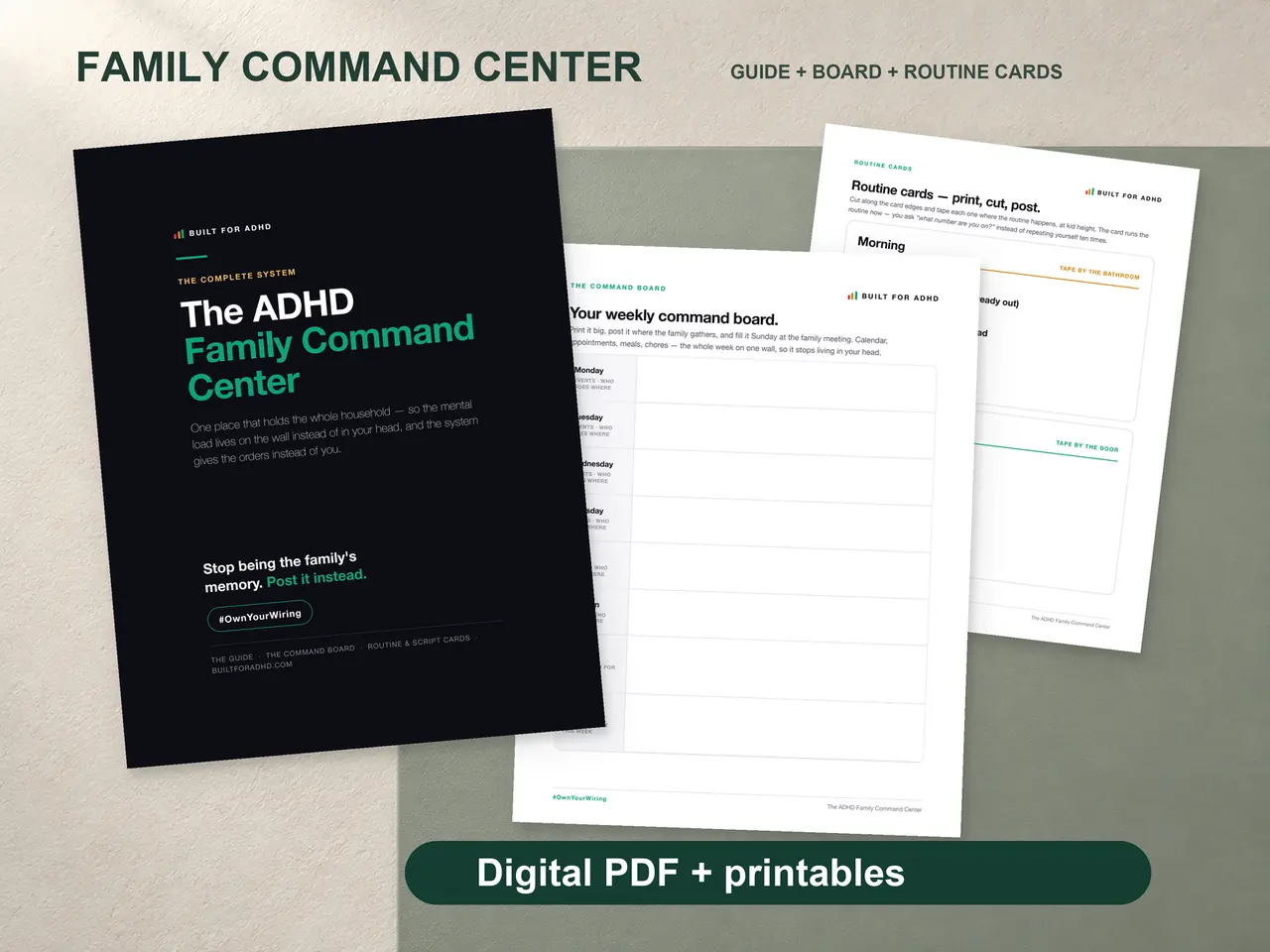
If you’d rather post it than build it — the command board, the routine cards at kid height, the nag-free scripts, and the weekly family meeting agenda where the kids get to renegotiate the screen lines out loud — that’s the ADHD Family Command Center, $19. Print it once and stop being the only ledger your family has.
Related tools
- The free parent starter set — routine cards and the command-wall layout
- The ADHD chore chart template — the printable who-does-what the turn order hangs on
- ADHD bedtime routines that stick — predictable endings, at the other end of the day
- Summer structure for ADHD kids — three anchors, and where screens sit in them
- Setting up an ADHD command center — the wall the agreement goes on
- ADHD parent burnout — why 4:40 PM is the hardest hour in the house