In this article
Week one of summer is great. Everybody sleeps in, nobody packs a lunch, the calendar is blissfully empty.
Week two is when it turns. The kids are up at 6:15 anyway, feral by 9, and asking what we’re doing today — a question that arrives roughly every eleven minutes and has to be answered from scratch each time. By Thursday somebody has been on a screen for five hours, somebody else has cried about a board game, and you are running a summer camp you did not agree to staff, on top of your actual job.
Here’s what changed between week one and week two: nothing about the kids. What changed is that school was doing something invisible all year, and now it isn’t.
School was the scaffolding
A school day is a pre-decided sequence somebody else designed. Wake, go, blocks of time with bells between them, lunch at the same hour, home at the same hour. For an ADHD brain — kid or parent — that external structure is doing enormous unpaid work: it handles the sequencing, the transitions, and the time awareness that the brain struggles to generate internally.
Summer removes all of it at once and hands the job to a nine-year-old with ADHD. Which is why “they have so much free time now” so often produces a kid who seems more dysregulated, not less. Unstructured time isn’t relaxing for a brain that can’t feel time passing. It’s a nine-hour blank page.
And then the fix everyone reaches for makes it worse.
Why the color-coded summer schedule dies by Wednesday
You’ve seen the ones on Pinterest — laminated, half-hour blocks, 8:00 reading, 8:30 outside time, 9:00 crafts. They fail for the same reason every over-built productivity system fails: the plan requires more executive function to run than the chaos did, and it’s you who has to supply it. You become the bell system. Every thirty minutes, you’re the one enforcing a transition, and ADHD kids do not do transitions cheaply.
It also breaks on contact with a rainy Tuesday, a late night, or a friend showing up. And once it’s broken by 10 AM you both quietly agree to stop looking at it, which sets up the next round of feeling like the family that can’t stick to anything.
The alternative isn’t more structure or less structure. It’s coarser structure.
Three anchors, not a schedule
Give the day a shape — three fixed points, in a fixed order, at loose times. Everything between them is genuinely free.
Anchor 1 — the morning start. Not a wake time. A first sequence: eat, get dressed, one chore, and the day is “started.” Whether that finishes at 8:00 or 10:30 doesn’t matter. What matters is that it always happens in the same order, so nobody has to decide anything before breakfast. Same order, not same time — the same principle that makes a bedtime routine actually stick.
Anchor 2 — one out-of-the-house thing. Pool, library, park, the grocery store, a walk to nowhere. One per day, and it can be twenty minutes. This is the load-bearing anchor. A day with no outside edge is the one that dissolves into screens and bickering, and the trip itself does more for regulation than any activity you could plan indoors.
Anchor 3 — the afternoon quiet block. After the out-of-house thing, everybody goes horizontal and separate for an hour. Not a nap, not enforced silence — separate rooms, low demand. This one is as much for you as for them. The 3 PM crash is real for adults too, and an hour where nobody needs a referee is the difference between making dinner and ordering it again.
Three things. That’s the whole plan. The gaps between them stay unplanned on purpose, because unplanned time inside a shape is very different from unplanned time inside a void.
The decisions to make once, in advance
Almost all the friction left over is the same handful of arguments, relitigated daily. Decide them once on a Sunday and post them where everyone can point at them — the same move that turns decision fatigue from a daily tax into a one-time cost.
Screens are tied to the anchors, not the clock. “Screens after the morning start and after the outing” beats “two hours a day,” because a clock rule requires you to track and enforce a running total, and a sequence rule enforces itself. The kid knows what unlocks it. You stop being the timer.
Write the week where they can see it. Ten minutes on Sunday: the outing for each day, who’s where, anything unusual. On the family command wall, not in your phone. “What’s on the wall for today” is a question that answers itself, and it retires the eleven-minute what are we doing loop.
Boredom is allowed; the transition is the hard part. You do not have to solve boredom. Kids need to be bored — it’s where their own ideas come from. What they can’t do is move themselves from bored into an activity without a runway. So keep a short list of restart options on the wall (five things, written when everyone was calm) and point at it instead of generating ideas on demand at 2 PM.
Pre-write the blown day. Some days come apart — a bad night, a heat wave, a canceled camp. The rule, written in advance: screens all afternoon is not a moral failure; we restart at the morning anchor tomorrow, no autopsy. Without a written reset, one bad Tuesday becomes evidence that the whole thing doesn’t work, and you abandon a system that was fine.
What good actually looks like
Not an enriching summer. Not a Pinterest chart with every day themed. Good looks like: the day has a beginning, one thing happened outside the house, everybody had an hour apart, and nobody asked you what we’re doing eleven times before noon.
If you’re reading this in August and thinking it’s too late to matter — the anchors do double duty as the on-ramp back to school. The morning start sequence is the school-morning sequence, minus the deadline, which makes it worth running for the last two weeks of August specifically. That’s the runway the back-to-school checklist is built on, and doing it now while the stakes are zero is the entire trick.
Start with one anchor tomorrow — the out-of-the-house one, since it’s the highest yield and requires nothing but leaving. Add the morning sequence when that holds. If you’d rather post it than build it from scratch on a hot afternoon, the ADHD summer schedule template is the printable version of this exact shape, and the free parent starter set has the routine cards and command-wall layout.
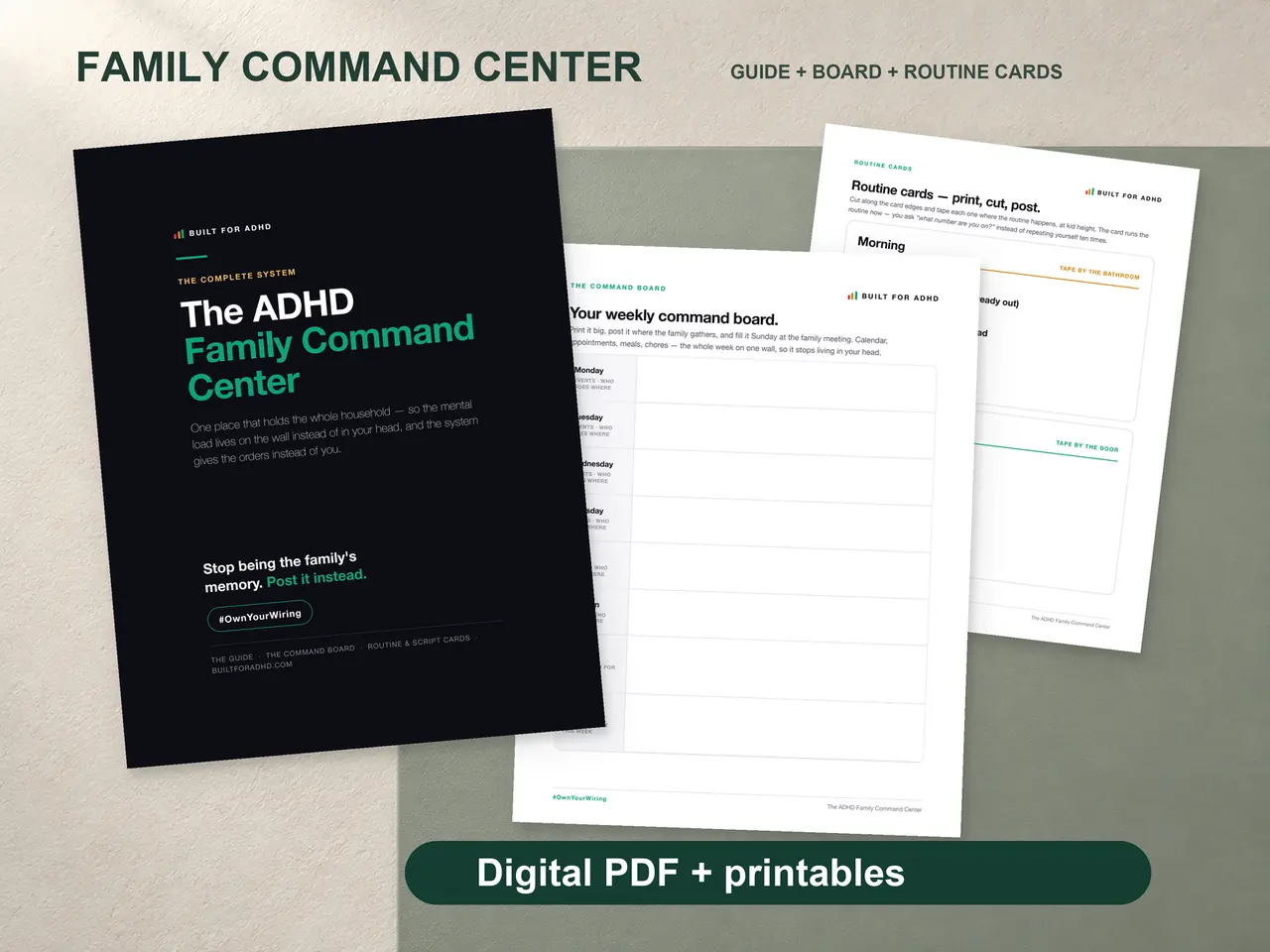
If you want the whole household version — the command board, the routine cards at kid height, the launch pad checklist, and the pre-written reset scripts — that’s the ADHD Family Command Center. Print it once, post it, and stop being the only calendar your family has.
Related tools
- The ADHD summer schedule template — the printable version of the three anchors
- The back-to-school checklist for ADHD families — the four systems to rebuild before the bell
- Setting up an ADHD command center — the wall the week lives on
- ADHD bedtime routines that stick — same-order-not-same-time, at the other end of the day
- ADHD parent burnout — why you’re out of executive function, not patience
- The free parent starter set — routine cards and the command-wall layout