In this article
7:12 AM. Two kids are dressed, which felt like a win eleven minutes ago. One of them will only eat the waffles, and we’re out of the waffles. The other has opened the fridge four times looking for something that was never in there. I am standing over a lunchbox holding a piece of bread, trying to remember whether this is the kid who stopped liking turkey, and we leave in eight minutes.
Nobody is misbehaving. Everyone is dressed. And the morning is still coming apart — because the hard part of a school morning was never the wake-up. It’s the kitchen.
The routines advice all points at the front end: earlier bedtime, visual checklists, get the sequence on the wall — and that advice is good, it’s the foundation, it’s why the kids got dressed at all. But it hands you a regulated child standing in a kitchen where food still has to be decided, twice, from scratch, by an adult brain that is at its lowest executive function of the day. That’s the gap this post is about. (If the wider household is the thing coming apart and not just the kitchen, the ADHD command center guide is the layer above this one.)
Food is a decision problem wearing a task costume
Packing a lunch looks like a five-minute chore. It isn’t. It’s a stack of open-ended decisions — main thing, fruit, snack, drink, does this survive four hours in a bag, did they eat this last time — and every one has to be answered fresh, at 7 AM, while tracking the clock. Decision fatigue doesn’t need a full day to kick in; a dozen small ones before coffee will do it.
Breakfast is the same trap with a shorter fuse. “What do you want?” is an open question handed to a kid whose brain also does not want to make decisions before 8 AM, and the standoff that follows isn’t stubbornness on either side — it’s two under-caffeinated executive-function systems negotiating.
And it lands on the exact minutes you can least afford it, because a school morning has a hard stop. Not a deadline that flexes — a bus. Everything else in ADHD life can slide by ten minutes. This can’t, and the time pressure makes every decision more expensive than it would be at noon.
So the goal isn’t to be faster in the kitchen. It’s to arrive in the kitchen with nothing left to decide.
Delete the decisions
Five breakfasts. That’s the menu. Pick five things your kids reliably eat, write them on the fridge, and that’s what exists on a school day. Not a rotation you have to track — a list they choose from. “What do you want for breakfast” becomes “pick one off the list,” which is a completely different cognitive act: recognition instead of generation. (This is the same reason deciding what to eat wrecks adults too. The fix scales down to seven-year-olds fine.)
Lunch is a formula, not a creative act. One protein thing, one fruit or veg, one crunchy thing, one drink. Same four slots every day; only the contents rotate. You are not building a lunch, you are filling four holes, and filling four holes can be done by a tired person or a child. Write the formula on the inside of the cabinet door where the lunchboxes live.
Build the component bin. One bin in the fridge and one in the pantry, restocked once a week, holding only things that qualify for the four slots — pre-portioned. Sunday’s fifteen minutes of bagging pretzels and washing grapes buys back five mornings. The bin is what makes the next step possible, and the next step is the one that actually changes your life.
Hand it to the kid. Once there’s a formula and a bin, a six-year-old can pack their own lunch. Four slots, one bin, no decisions that require an adult. Yes, it will be a worse lunch than the one you’d make. It will also be a lunch they had a hand in choosing, which correlates suspiciously well with the lunch coming home empty — and it removes you from the loop entirely, which is the whole point. You are trying to stop being the household’s only working memory, and this is a chore that can genuinely leave your plate.
Pack it after dinner, not the night before. “Do it the night before” fails because 9 PM you is not a person with executive function left. Instead, hook it to something already happening: the kitchen is open, the counter is out, dinner is being cleared — lunches get made in that window, as part of that window. Habits stick to existing habits far better than they stick to intentions or clock times. Then the lunchbox goes straight into the bag, and the bag goes to the launch pad by the door, so the morning’s job is carrying, not assembling. (If the launch pad doesn’t exist yet, it’s step one of the back-to-school checklist and it’s the highest-yield thing in this whole post.)
Two rules that keep it alive
A written “we’re out” rule. Running out of the waffles at 7:12 shouldn’t be a crisis, but it is, because it forces improvisation at exactly the wrong hour. So decide the fallback once, in advance, and post it: if the thing isn’t there, it’s toast and a banana, and nobody has to feel bad about it. A pre-written fallback is the difference between a hiccup and a derailed morning.
One reset a week is expected. Somebody will forget, somebody will pack a lunch of three crackers, and one day the whole system will just not happen. That’s a Wednesday, not a verdict. The rule: buy lunch that day, restart tomorrow, no autopsy. Systems for ADHD households have to be built with the bad day already priced in, or the first bad day takes the whole system with it.
What this looks like when it’s working
You walk into the kitchen at 7:12 and there is nothing to decide. Breakfast is one of five things on a list. The lunches were made last night by their owners out of a bin, and they’re already in the bags, and the bags are already by the door. Your job for the next eight minutes is to be a calm adult standing near some children, which — it turns out — is most of what they actually needed from you in the first place.
Start with the formula card and the component bin this Sunday. Just those two. The kid-packs-their-own step follows on its own once the bin exists, because they’ll ask to. The free parent starter set has the printable routine cards if you’d rather post it than write it out.
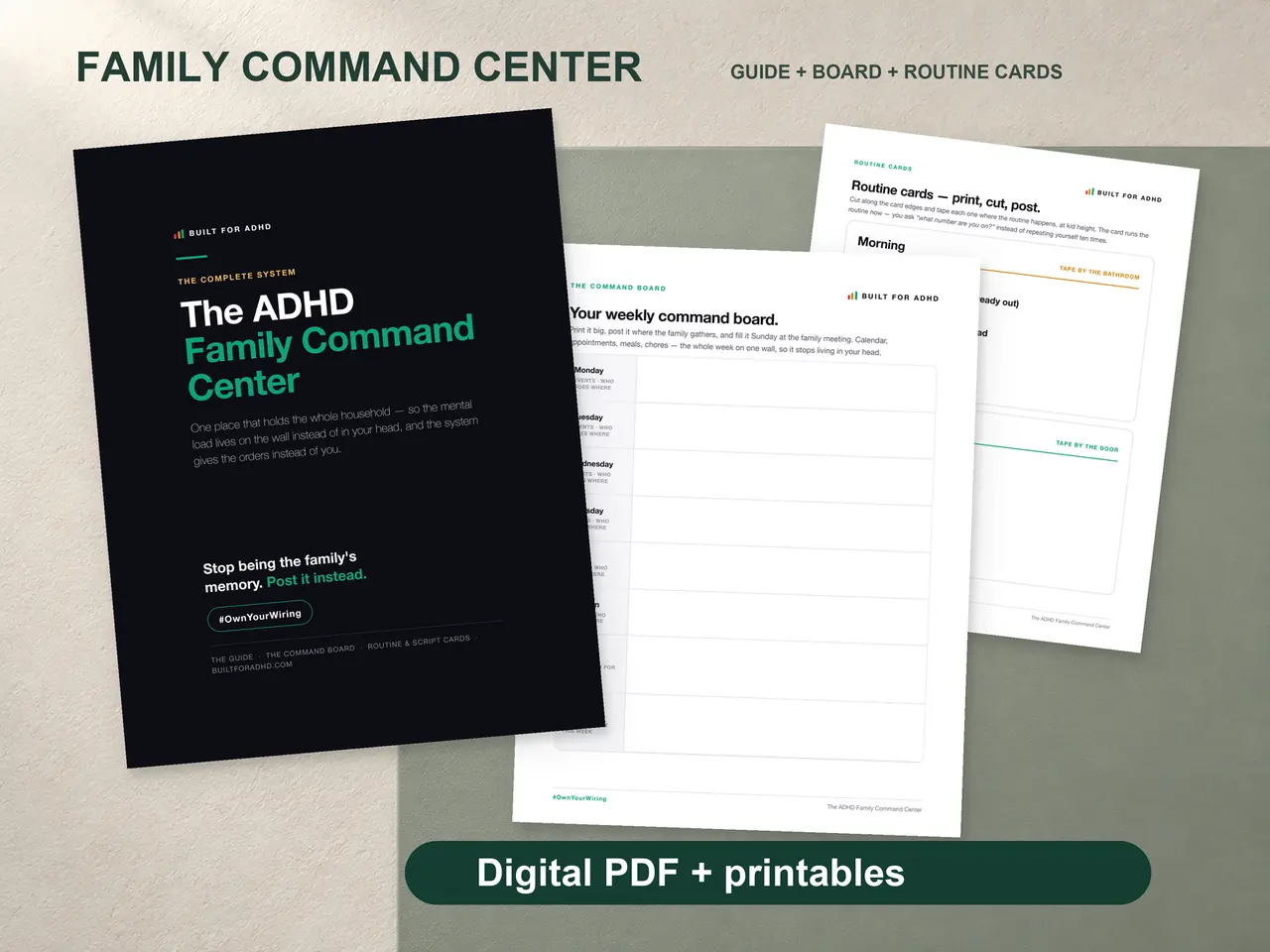
The full household version — the command board, kid-height routine cards, the launch-pad checklist, and the pre-written reset scripts for the mornings that come apart anyway — is the ADHD Family Command Center. Print it, post it, stop running the whole house out of your own working memory.
Related tools
- The ADHD morning routine for kids — the wake-up-to-dressed sequence this post sits on top of
- The back-to-school checklist for ADHD families — launch pad, landing zone, and the other three systems
- ADHD parent burnout — why the load has to leave your head, not get carried better
- Why deciding what to eat is so hard — the adult version of the same problem
- The free parent starter set — printable routine cards and the command-wall layout