In this article
Halloween is the only night of the year that asks an ADHD kid to do every hard thing at once.
Wait all day for one event. Wear a texture nobody consulted them about. Stay regulated in a crowd, in the dark, past bedtime, on a sugar curve, while being told to slow down. Then stop — voluntarily, cheerfully — while the fun is still happening and the street is still full of other kids.
That is not a list of behaviors. It’s a stress test. And when it ends with somebody crying on a stranger’s lawn at 8:40, the thing that broke wasn’t your kid’s character and it wasn’t your parenting. It was a night that had no decisions made in it yet, which is the same reason the rest of the household load goes sideways — the fix lives on a wall, in an ADHD command center, not in anyone’s working memory.
The four decisions, and why they can’t be made at 7pm
Here’s what I actually want you to take from this: every hard moment of Halloween night is a decision, and every one of them gets made badly when it gets made live.
At 7pm you are in a dark street with a tired kid, a sugar spike, an audience of neighbors, and your own executive function running on fumes after the whole day of buildup. That is the worst possible conference room. The decisions are not hard. The timing is what makes them impossible.
So you make all four in advance, write them on one card, and the card runs the night.
One: the costume gets worn before Halloween. Not tried on. Worn — around the house, for twenty minutes, at least three days out. This is the single highest-value thing on the list, because a costume is a sensory contract your kid signed without reading. The seam at the neck, the mask that fogs, the cape that catches on every doorframe. You want to find that on the 28th, in your living room, where the answer is scissors and a t-shirt underneath, instead of at 6:50 on the 31st where the answer is a ruined night.
Ask one question while they’re wearing it: what’s the itchy part? Then fix the itchy part. Do not negotiate with the itchy part.
Two: the route has a number on it, and the number is small. Pick the actual streets, and pick how many houses. Ten is a real Halloween. Eight is a real Halloween. The pull is to let it run as long as the energy holds, and that reliably overshoots, because a kid who is having a great time is the worst available judge of how much they have left — and so is a parent who’s relieved it’s going well.
A short route that ends while everyone is still happy is the version your kid remembers as the good one. The long one that ends in a meltdown gets filed, by both of you, as the year Halloween went wrong.
Three: the candy rule is decided before the first doorbell. Whatever it is in your house — some tonight and the rest tomorrow, pick-three, no rule at all — decide it now and say it out loud at dinner. Candy is the thing that gets argued about on the sidewalk, and an argument about candy at 8:15 is not about candy. It’s a tired kid discovering that the rules of the night are apparently negotiable, which turns every remaining minute into a negotiation.
This one is energy-based too, and worth being honest about: the rule you pick matters much less than the fact that it existed before the sugar did.
Four: the ending has a shape. “We’ll see how it goes” is how you get the lawn at 8:40. Transitions are the hardest thing ADHD brains of any size do, and stopping a fun thing is the hardest transition there is. So the stop gets built in advance, with something on the other side of it — the sorting-the-haul part, the one show, the thing that makes going home its own event rather than the end of the real one.
Name it before you leave: last house, then we walk back and dump it all on the living room floor. You are not asking a kid to stop having fun. You’re asking them to move to the next fun thing, which is a request a dysregulated nervous system can actually process.
Write it on one card
Four lines. Costume worn by the 28th. Ten houses, these streets. Candy rule, in one sentence. Last house, then the floor sort.
Tape it where the family walks past, because a plan stored in your head is a plan that will be unavailable at exactly 7pm — the same reason posted routine cards work for bedtime when verbal instructions evaporate. Read it out at dinner on the 31st. Thirty seconds. That’s the whole intervention.
Then hand it to whoever else is going. The other adult, the grandparent, the older sibling doing the walking. Half of Halloween going sideways is two adults running two different undisclosed plans in the same dark street.
Where this genuinely breaks
The sibling split. One kid wants two hours, one is done at house six. One route cannot serve both, and trying is how you end up with everybody fighting in the car. Two adults, two routes, or stagger them — the younger one early, the older one after. Decide which on the card.
You have no energy left either. Halloween lands on a weeknight this year, after school, after work, at the end of a season that already asked a lot. If you are running on nothing, cut the number before you leave rather than discovering it mid-street. Six houses done well beats twelve abandoned.
The next day. The crash after a big night is real and it is not a discipline problem. Expect a hard morning, put nothing optional in it, and let the routine do the work instead of your voice.
And the honest limit: a card does not make Halloween calm. It’s a loud, overstimulating, late night by design, and the goal was never to sand that off — the loudness is the point of it for your kid. What the card does is stop the preventable parts from stacking on top, so what’s left is just a big night.
Start with the costume
If you do one thing from this, do the twenty minutes in the costume before the 28th. It’s the cheapest fix on the list and it catches the failure that ruins the most Halloweens.
Then write the four lines. Ten minutes at the kitchen table, and the night is decided before it starts — the same move that makes December survivable and that the fall routine reset was built on. The free parents’ starter kit has the wall surface I’d tape it to.
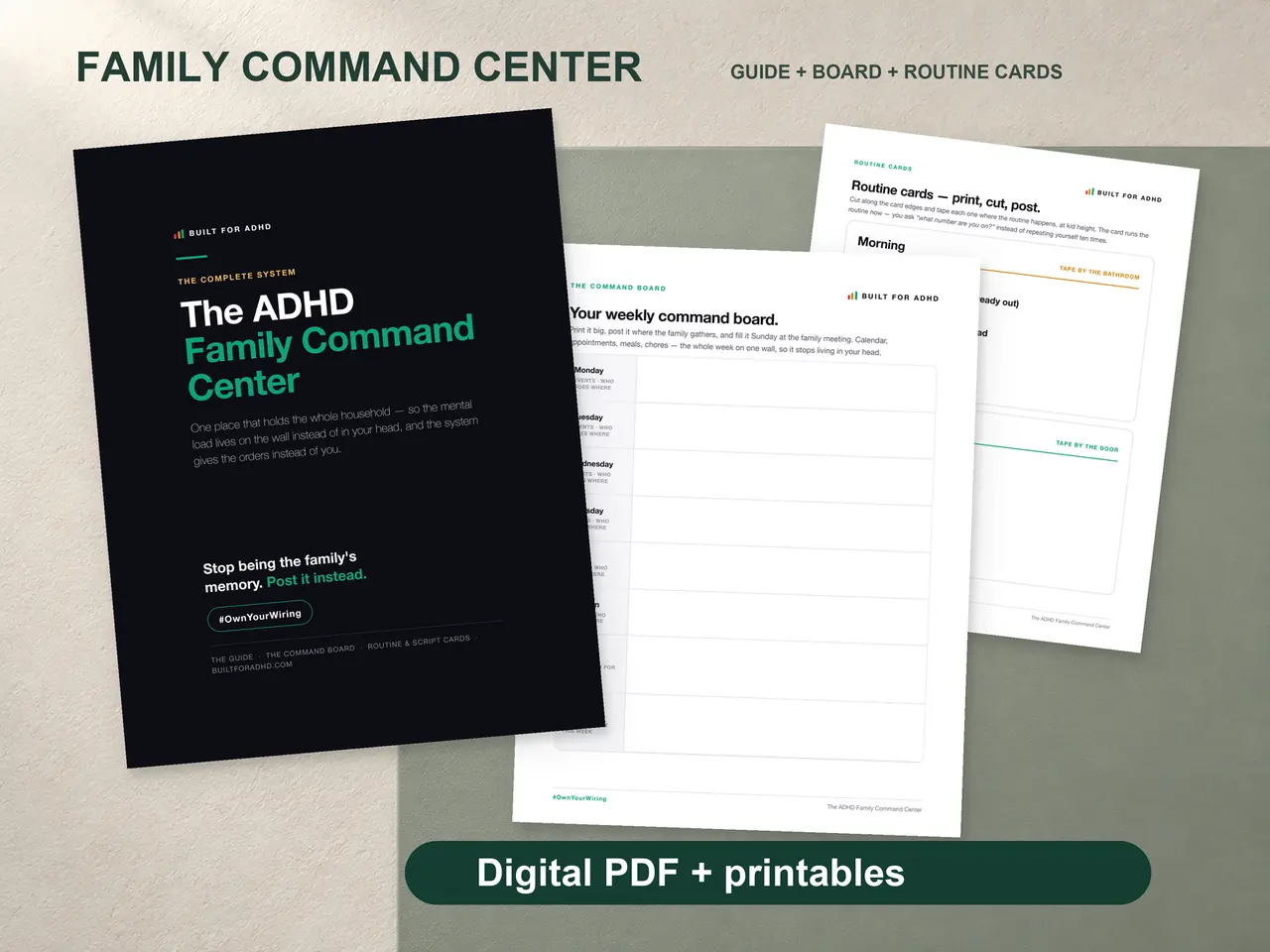
If you want the pre-built version — the Family Command Board the card lives on, the printable routine cards, the launch pad by the door, and the meltdown scripts for the nights that go sideways anyway — that’s the ADHD Family Command Center, $19 once. Honest note: it’s a year-round household system, not a Halloween product. The four lines above are free and they’re the part that actually saves the 31st.
Related tools
- Free ADHD parents’ starter kit — the wall surface this card tapes to
- Setting up an ADHD command center — the visible family system, step by step
- Bedtime routines that stick — posted cards instead of repeating yourself
- Holiday overwhelm in an ADHD family — the December version of the same plan
- The ADHD fall routine reset — the four anchors this season runs on
- ADHD parent burnout — why your own tank matters on nights like this
- The after-school routine — the transition right before Halloween evening starts