In this article
Direct answer: This is about you, the parent, using ChatGPT to run the homework hour itself — breaking assignments into manageable pieces, scripting the conversations that turn into fights, and taking some of the moment-to-moment negotiating off your own already-tired brain. It is not a study-tips post for your child, and it’s not about AI doing the homework. It’s about surviving the hour without both of you ending up upset.
If your search brought you here hoping for study techniques, the study-strategies side of this is covered elsewhere. This post is specifically about the parent’s job during that hour — the logistics, the scripts, the part that has nothing to do with the actual subject material and everything to do with getting a resistant, dysregulated kid through it without a blowup.
Why the homework hour is a parent problem, not just a kid problem
If your child has ADHD, homework time is rarely actually about the homework. It’s about task initiation (the seventeen minutes of avoidance before pencil touches paper), working memory (forgetting the instructions were even given), and emotional regulation (frustration escalating fast when something feels too hard). You’re not managing a subject — you’re managing all three of those, in real time, usually while also making dinner, managing other kids, or trying to answer your own work email. That’s an enormous cognitive load for one parent to carry live, every single night.
This is where AI is actually useful: not as a tutor for your kid, but as a pre-hour prep tool and in-the-moment script generator for you.
Where ChatGPT genuinely helps — the parent’s job specifically
Breaking the assignment into a visible sequence before the fight starts. Before homework time, take a photo or type out what’s assigned and ask ChatGPT to break it into the smallest possible sequence of steps, written the way you’d say them out loud to your specific kid. “Do your math homework” becomes a five-item checklist your child can see and check off, which turns an abstract, overwhelming block into something with a visible start and a visible end — the exact same principle behind AI task breakdown, applied to a ten-year-old’s assignment instead of your own.
Scripting the fight before it happens. If the same battle plays out most nights — “I’ll do it in a minute,” a meltdown over one hard problem, a refusal to start — describe the pattern to ChatGPT and ask for two or three specific phrases to try instead of what you currently say. Something like: “My son shuts down and says ‘I can’t’ the second a problem looks hard. What can I say instead of ‘just try’ that doesn’t escalate him?” Getting language ready before the moment, when you’re calm, produces better scripts than anything you’ll invent mid-meltdown.
The two-minute negotiation. For a child who refuses to start anything, ask ChatGPT to help you frame the smallest possible entry point — “just write your name and the date” instead of “do your homework” — the same tiny-first-step principle that works for adult ADHD task paralysis, scaled down to a homework page.
A calm script for the “I already did it at school” conversation — or whatever the specific evasion is in your house. Naming your child’s actual go-to avoidance line and asking for a response that doesn’t turn into a standoff is a genuinely useful five-minute prep task before the hour even starts.
What this is not
This is not asking ChatGPT to solve the homework, write the essay, or explain the material in your child’s place while you sit back — that undermines what the assignment is actually for and isn’t a homework-hour fix, it’s a different problem. It’s also not a replacement for talking to your child’s teacher if the workload itself is consistently too much, or for an IEP/504 conversation if the accommodations aren’t matching what your kid actually needs — those are structural fixes this tool can’t substitute for.
Building the routine around the tool, not just the tool itself
The scripts and breakdowns help most when they land inside a routine your child can predict, rather than a fresh negotiation every night. A consistent launch pad — same spot, same start time, same first small step every day — does a lot of the emotional-regulation work before ChatGPT even enters the picture, because predictability itself lowers resistance for a lot of ADHD kids. The AI-generated breakdown becomes the content that fills a slot your child already expects, instead of one more unpredictable thing happening to them.
This is also where it’s worth being honest about your own capacity on a given night. Some nights you’ll have the bandwidth to sit down, ask ChatGPT to help you script a specific conversation, and execute it calmly. Other nights you won’t, and that’s not a parenting failure — it’s an accurate read of your own limited executive function on a hard day. On those nights, the goal can shrink to just getting through the hour without a full blowup, using whatever the shortest, calmest script is, rather than the ideal version of the routine. A tool that only works when you’re at your best isn’t actually built for a household running on ADHD time.
A setup that saves you from re-explaining every night
Rather than describing your child’s specific patterns fresh each night, save the context once. In a new chat or a saved Project: “My child has ADHD. Homework time typically goes [describe the actual pattern — shuts down on hard problems, needs movement breaks, gets defensive if corrected]. When I ask for help with homework time, give me short, specific scripts and step breakdowns I can use in the moment, not general parenting advice.” From there, each night’s request — “help me break down tonight’s worksheet” or “give me a script for when he says he can’t” — starts from context that’s already been set.
FAQ
Is it okay to use ChatGPT to help with my ADHD child’s homework? Yes, when it’s helping you — the parent — run the hour: breaking down assignments, scripting hard conversations, and planning entry points. It’s a different use than having AI do the actual academic work, which isn’t the goal here.
Should my child use ChatGPT directly for homework help? That’s a separate, age- and school-policy-dependent question outside the scope of this guide. This post is specifically about tools for the parent managing the homework hour, not about your child’s own AI use.
What if the real problem is the workload, not the routine? If homework consistently takes far longer than it should for your child’s age and grade, that’s worth raising with the teacher or through an IEP/504 process — no amount of scripting fixes a workload that’s genuinely mismatched to what your child can currently do.
What if my child refuses to engage with any of this, even with better scripts? A script changes the words you use; it doesn’t guarantee a dysregulated kid responds well to them every time. This is specifically about the parent’s side of the hour — the scripts, breakdowns, and negotiating — not a general study-techniques guide, and if refusal is a consistent, severe pattern rather than an occasional hard night, that’s worth raising with your child’s teacher, pediatrician, or a behavioral specialist rather than solving through scripting alone.
Related
- ADHD Homework Strategies for Parents — the study-technique and structure side of homework time
- AI Task Breakdown for ADHD — the method this guide scales down for a child’s assignment
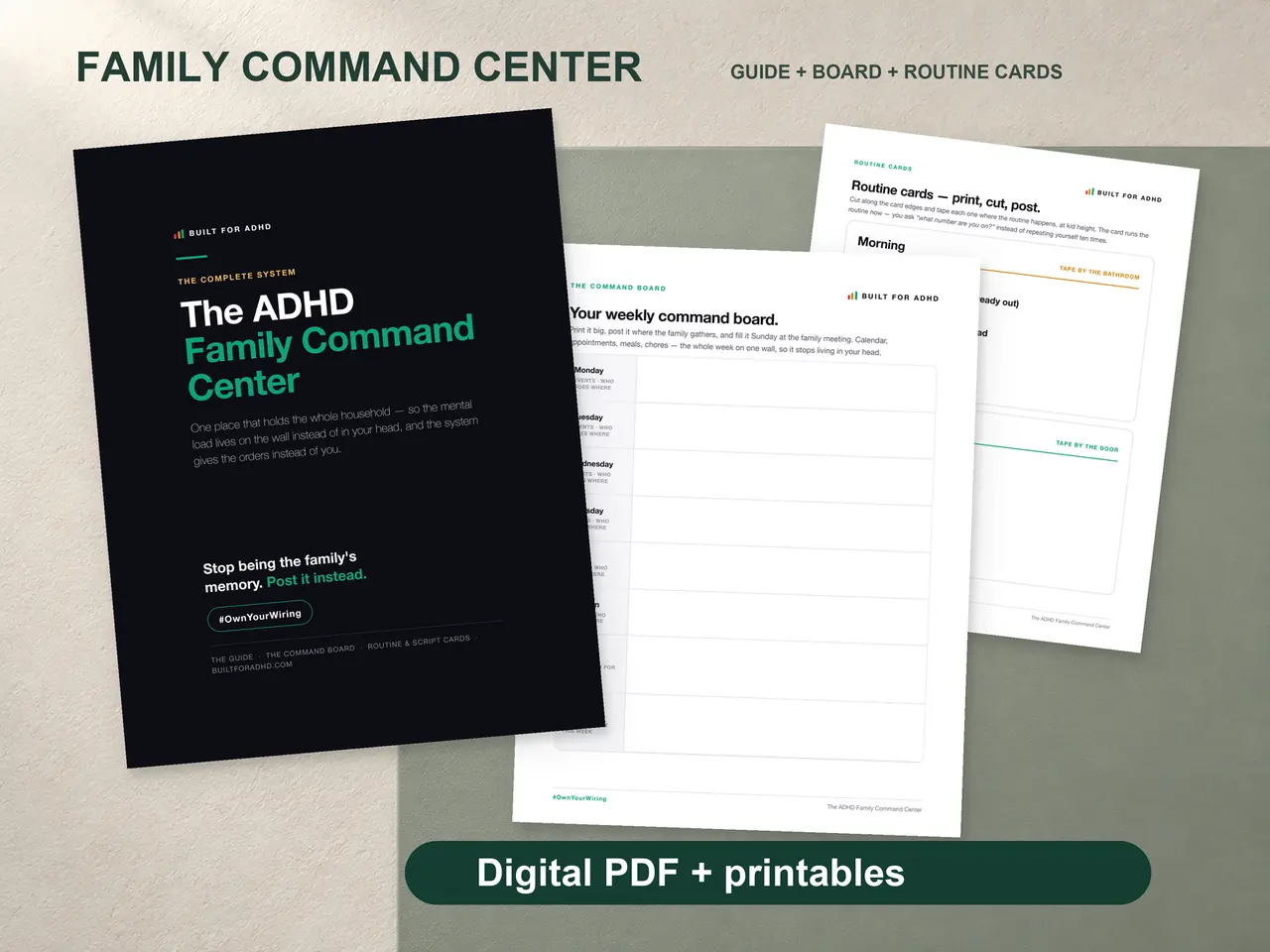
- ADHD Family Command Center — $19, for running the rest of the household beyond just homework
- The AI for ADHD hub — every setup guide and honest review in one place
If you want the free version first, the parents’ starter checklist covers the morning and after-school routines this same approach applies to.