In this article
The pitch writes itself: you have a brain that struggles with planning, prioritizing, starting, and remembering — and now there’s software that plans, prioritizes, breaks things down, and never forgets what you told it. ADHD assistant, solved. Right?
Half right. And the half that’s wrong is the half that ends with you abandoning another tool and adding it to the pile of things that were supposed to fix you.
This is the honest version: what an AI assistant actually does well for an ADHD brain, where it quietly fails, and the one setup decision that separates the people who get real daily value from the people who tried it for a weekend. (The territory map lives at AI tools for ADHD — this post is specifically about the assistant question.)
What it’s genuinely good at
The pattern behind everything on this list: AI is strongest exactly where ADHD executive function is weakest — not because it’s smart, but because it’s external (ADDitude). It’s the same reason paper systems work: the thinking happens outside the overloaded head.
Triage. Paste in the entire swirl — deadlines, guilt tasks, groceries, the thing from March — and get it back sorted into what’s actually today and what isn’t. Decision fatigue is a morning tax; this refunds most of it. (You can feel this one in 30 seconds with our free Brain Dump Sorter — no account, purpose-built for exactly this job.)
Task breakdown. “Renew my passport” becomes seven concrete steps, the first one small enough to do right now. This is the classic anti-paralysis move, and AI does it instantly and without judgment.
First drafts of dreaded communication. The email you’ve avoided for a week gets a draft in ten seconds. You edit instead of create — a completely different, much lighter cognitive act. For anyone whose avoidance is RSD-flavored, having a calm third party phrase the first pass is quietly life-changing.
Body doubling and session structure. Declared work sessions with check-ins, on demand, at 11 PM. Full walkthrough here.
Judgment-free restarts. Tell it you did nothing yesterday and it does not sigh. For a brain trained to expect the sigh, this is not a small feature.
Where it fails — and why people quit
It remembers nothing unless you build memory. Out of the box, every chat starts from zero: your brain, your projects, your “please don’t give me a 12-step wellness plan” — gone. Re-explaining yourself daily is executive-function overhead, which is the exact resource you were trying to save. This is the #1 quit reason, and it’s fixable (below).
It can’t see your life. It knows your calendar, inbox, and energy level only if you tell it, every time. An assistant that must be briefed before it can assist has a real cost-of-use — worth paying for the wins above, but only if the briefing is a paste, not an essay.
Default output is ADHD-hostile. Ask a stock chatbot for help and you get eleven bullet points of generic advice with a cheerleading paragraph. That’s more to read, more to hold, more to feel behind on. Without instructions to be brief and concrete, the “help” is clutter.
It’s confidently wrong sometimes. Fine for drafting and sorting; not fine for facts, deadlines, math you don’t check, or anything medical. An ADHD assistant helps you do things — it is not a doctor, and on days when the problem is bigger than logistics, the right assistant is a human professional.
And the app-graveyard risk is real. An AI assistant is still an app you must remember to open. Out of sight, out of mind doesn’t grant exemptions to chatbots. Anything that matters has to end up somewhere ambient — paper, wall, the command-center logic — or it evaporates when the tab closes.
The setup decision that changes the outcome
Everything above points one direction: the value isn’t in the model, it’s in the configuration. The people getting daily value all did the same thing — they wrote down, once, how their brain works and how they want to be helped, and made it the standing instruction for every conversation. Small steps only. One question at a time. No pep talks. Assume working memory is unreliable. Never shame a restart.
Do that, and the briefing tax drops to near zero; every session starts with an assistant that already knows the operating manual. Skip it, and you’re re-onboarding a new intern every morning — nobody sustains that.
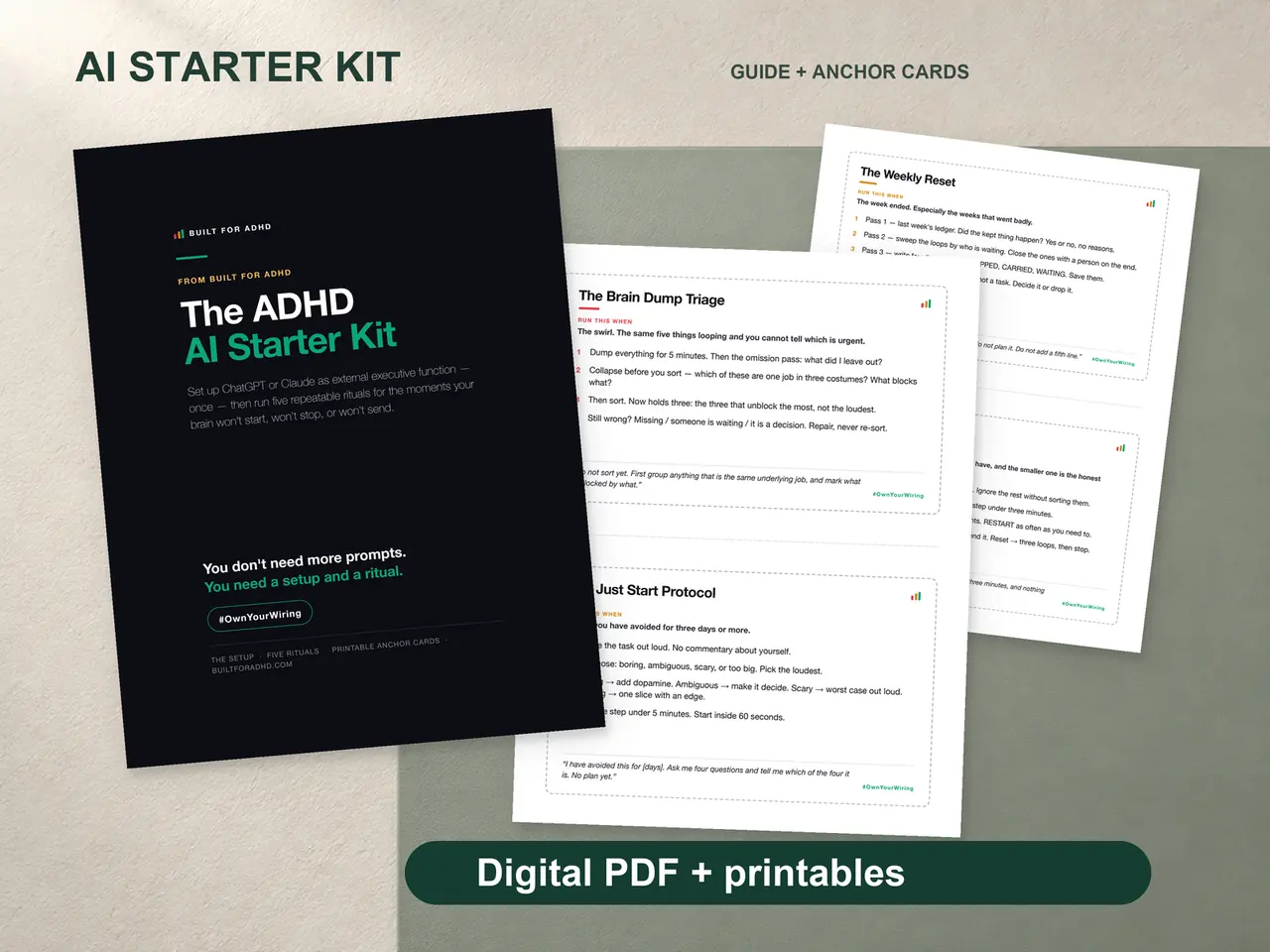
You can absolutely write your own setup block, and if you enjoy tinkering, you should. If you’d rather skip to the working version: the ADHD AI Starter Kit is the $27 done-for-you configuration — the paste-once setup block, five ready-to-run rituals for the recurring jobs (triage, just-start, body double, the dreaded send, weekly reset), and printable anchor cards so the plan survives off-screen. One-time purchase, no subscription — the assistant’s brain on paper, yours forever. The free prompt pack is the no-cost way to test-drive the approach first.
The honest verdict
Can AI be your ADHD assistant? As a mind-reading life manager — no, and anyone selling that version is selling the crash that follows. As external executive function you configure once and borrow daily — triage, breakdown, drafts, structure, restarts — yes, genuinely, and it’s the most useful thing to happen to ADHD tooling in years. The difference between those two outcomes is one setup block and honest expectations. You now have both.
Sources
- ADDitude, “Why Getting Started Is So Difficult for Adults with ADHD” — https://www.additudemag.com/getting-started-adhd-challenges/
Related tools
- Can ChatGPT help with ADHD? — the ChatGPT-specific answer, in depth
- ChatGPT custom instructions for ADHD — the setup block, free version
- Best AI tools for ADHD 2026 — the honest landscape comparison
- AI body doubling — the session structure that keeps you on task
- ADHD AI Starter Kit — $27: setup block, five rituals, anchor cards
- The AI for ADHD hub — every setup guide, technique, and honest review in one place