In this article
Yes. ChatGPT genuinely helps with ADHD — specifically with task initiation, breaking down overwhelming tasks, offloading working memory, and drafting the messages you keep avoiding. It does not help with time blindness, it cannot make you open the app, and unconfigured, it can make rabbitholing worse. That’s the honest shape of it, from someone who runs their business and household on this daily — not from a vendor’s blog and not from a clinical site being carefully vague.
The nuance that most answers miss: the question isn’t really whether ChatGPT can help. It’s that a configured ChatGPT and a raw one are almost different products. Raw, it’s a clever search box that writes long paragraphs — pleasant, occasionally useful, quietly exhausting. Configured for an ADHD brain, it’s the closest thing to borrowable executive function that has ever been free.
What it genuinely fixes
Task initiation — the big one. The wall between you and a task you fully understand is the most ADHD experience there is. A configured assistant turns starting into a dialogue: one 2-minute action, report back, next. Starting-as-conversation clears walls that starting-as-willpower never did.
Task breakdown. “Renew my passport” is actually eleven tasks wearing a coat. Decomposition on demand, sized to how bad today is, beats every static checklist because it can re-chop when a step turns out to be a boss fight.
Working memory. The 3 AM “don’t forget the thing” loop, the seventeen open browser tabs of the mind — dump them, get back four lists and one starting action. The relief is physical.
The unsendable message. Nine rewrites deep on a two-line email because RSD is reading your boss’s mind. An outside reader with no amygdala, available at midnight, breaks the loop.
Body doubling, surprisingly. A 2025 study (VR body doubling, arXiv) found people finished tasks faster and stayed on task better with an artificial companion, much as with a human double, than working alone (N=12 pilot, arXiv:2509.12153). The check-in-loop protocol is the practical version, and it costs nothing.
Where it honestly fails
It cannot make you open it. The plan it made at 8 AM does not exist at 2 PM if you don’t look at it. Screens vanish when you’re dysregulated. This is the single biggest limit, and the reason any real system needs a paper layer — the printed page is the only interface that keeps working when you won’t open anything. (This is why our whole product line is paper-first, with AI as the layer behind it.)
Time stays invisible. ChatGPT can double your estimates for you, but it can’t make 3 PM feel real. Time blindness needs external, visible time — timers, wall clocks, alarms with action labels. Different tool class.
Unconfigured, it amplifies rabbitholes. An infinitely patient answer machine is a hyperfocus hazard by default. The fix is structural, not willpower: custom instructions that cap output at 3 actions and tell it to call out drift — plus the tether prompt before any research session.
Sycophancy is real. Untuned, it validates everything, including your plan to reorganize the garage at 11 PM the night before a deadline. Tell it to push back; it will.
It’s not treatment. Nothing here replaces medication, therapy, or coaching where those are working for you. This is scaffolding for the executive-function gap — glasses, not a cure. Anyone selling more than that is selling.
The 10-minute difference
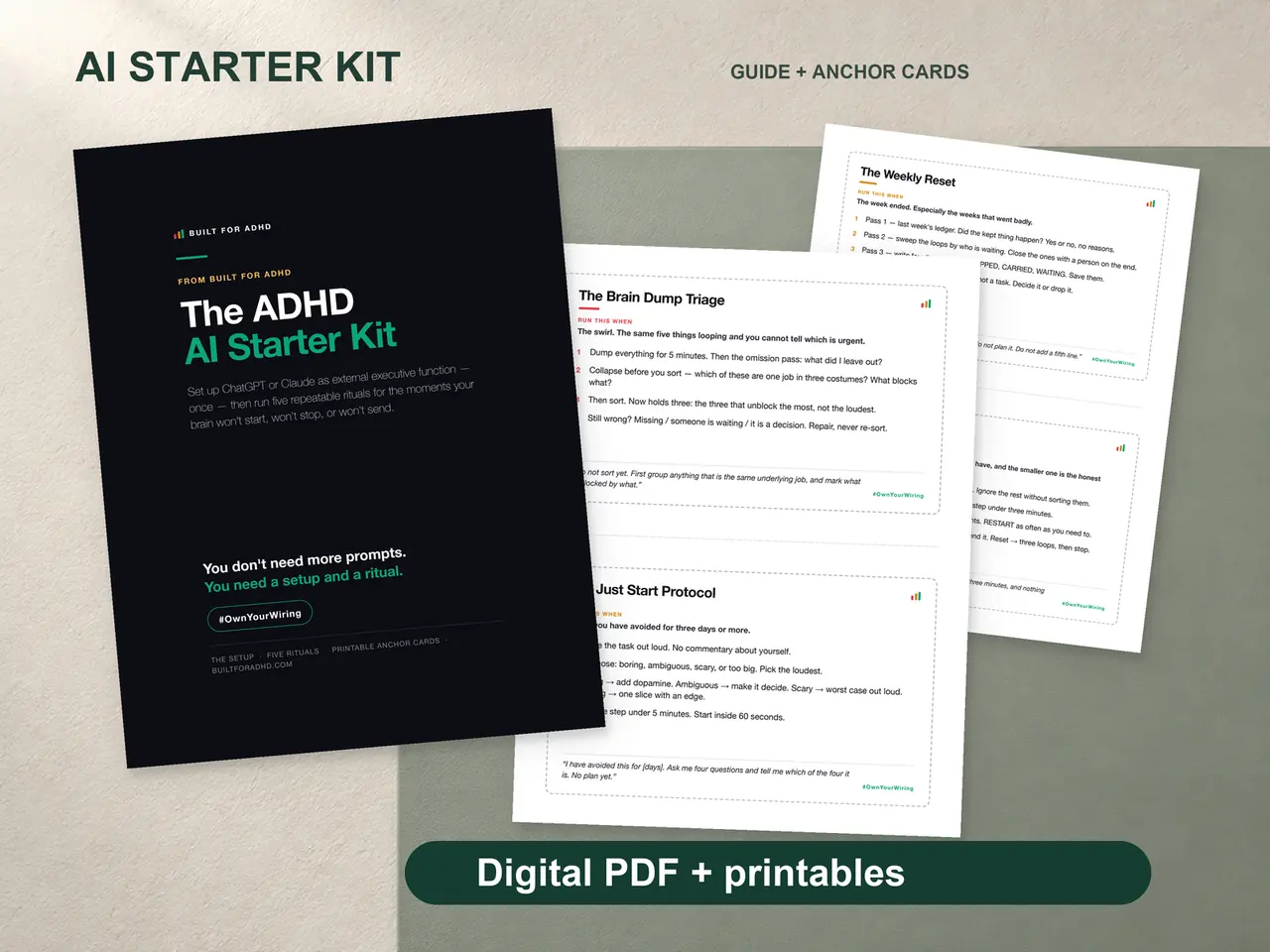
Everything in the “fixes” column assumes one thing: the one-time setup — a paste-in block that makes every answer short, structured, action-first, and honest with you, on the free plan, forever. Do that today and you have the 80% version. The 100% version — both setup blocks (ChatGPT and Claude), the five daily rituals, and the printed anchor cards that carry the system through screen-free days — is the ADHD AI Starter Kit: $27 once, no subscription, works on free accounts.
Start free either way: the ADHD AI prompt pack.
Sources
- Ara, Z. et al. “You Are Not Alone: Designing Body Doubling for ADHD in Virtual Reality.” arXiv:2509.12153 (2025). https://arxiv.org/abs/2509.12153
Related reading
- Can AI be your ADHD assistant? — the wider question beyond ChatGPT
- Best AI tools for ADHD 2026 — the honest landscape comparison
- ChatGPT custom instructions for ADHD — the setup itself
- AI body doubling — the research-backed focus protocol
- The AI for ADHD hub — every setup guide, technique, and honest review in one place